Strategic Sourcing of Glabridin 40: Balancing Cost and Whitening Efficacy
Procurement teams and formulators fight constantly. Sourcing wants to cut raw material costs. R&D wants the highest purity for undeniable skin-brightening results. When you look at licorice root extracts, this conflict hits hard.
Should you buy the ultra-pure 98% Glabridin? It is incredibly expensive. Should you buy a cheap 10% crude extract? You will end up with a dark brown, smelly cream that consumers reject.
From my perspective as an ingredient manufacturer, Glabridin 40% is the actual sweet spot. It gives you raw clinical power without breaking your production budget. Let us break down the numbers and application realities.
Why Glabridin 40 Is the Procurement Sweet Spot
Glabridin is the primary molecule responsible for licorice’s brightening effect. It stops the skin’s dark spot makers (tyrosinase enzymes) much better than synthetic alternatives. But price scales sharply with purity.
Here is how Glabridin 40 compares to other common commercial grades.
| Parameter | Glabridin 10% | Glabridin 40% | Glabridin 90% |
| Active Content | Min 10.0% | Min 40.0% | Min 90.0% |
| Color impact | High brown tint | Light brown/yellow | Pale yellow powder |
| Cost Factor | Low | Medium | Very High |
| Best Use Case | Mass-market body lotion | High-performance face cream | Premium spot correctors |
Choosing 40% gives you enough active molecule concentration to keep your formula dosage low. You only need a fraction of a percent in your phase tank to make strong product claims.
Reading the Lab Report: A Typical COA
Do not buy raw materials blindly based on price sheets. Check the Certificate of Analysis (COA). Impurities ruin emulsions. High water content causes mold. Heavy metals fail regulatory checks.
Here is what a standard, high-quality batch of Glabridin 40 looks like under testing.
| Test Item | Specification Standard | Actual Batch Result |
| Glabridin Purity (HPLC) | >= 40.0% | 41.5% |
| Appearance | Yellow-brown powder | Conforms |
| Loss on Drying | <= 5.0% | 2.4% |
| Heavy Metals (as Pb) | <= 10 ppm | < 2 ppm |
| Total Bacteria Count | <= 100 CFU/g | < 10 CFU/g |
Formulation Guide: Stop Wasting Your Active
I often see labs complain that Glabridin degrades or precipitates out of solution. That is almost always a processing error, not a raw material defect.
Glabridin 40 does not like cold water. If you dump it into your water phase, it will clump and sit on top. You must pre-dissolve it.
Follow these steps in the lab:
- Disperse the Glabridin 40 powder into a glycol solvent, like Butylene Glycol or Propylene Glycol.
- Heat this premix slightly to 40-45 degrees Celsius. Stir until you get a clear, golden-brown liquid.
- Add this mixture directly into the oil phase before emulsification.
- Alternatively, drop it into the main batch during the cool-down phase below 40 degrees Celsius. This trick protects the delicate active structure from high heat.
Keep your final product pH between 5.5 and 6.5. If your formula is too acidic, the active becomes unstable. If it is too alkaline, the color darkens over time.
A Real Performance Case Studies
Let us look at actual clinical data. A brand tested a basic oil-in-water face cream against a formula containing 0.1% Glabridin 40. They gathered a test group of people with visible sun spots.
The lab measured dark spot intensity using standard skin tone scanners.
- Week 4: The Glabridin 40 formula reduced spot darkness by 19%.
- Week 8: Spot darkness dropped by 37%.
- Skin Irritation: Zero users reported burning or redness.
Compare that to Hydroquinone or high-dose Retinol. Those synthetic ingredients brighten skin but often cause peeling and irritation. Glabridin 40 achieves excellent brightening while actually calming the skin barrier.
Global Compliance and Market Trends
Clean beauty is no longer just a trend. It is the baseline standard. Regulators worldwide are banning or limiting synthetic skin lighteners.
Glabridin 40 is fully compliant globally. It passes the strictest requirements under the China CSAR inventory and the EU Cosmetics Regulation. Consumers love seeing natural licorice extract on the label. It sounds safe, recognizable, and premium.
Balancing your raw material budget does not mean sacrificing efficacy. Stop paying extreme premiums for 90%+ purities unless you are making a medical spot treatment. Use Glabridin 40 correctly in your oil phase. You will get stable, highly effective brightening products at a realistic cost.
References Consulted:
- Yokota, T., et al. (1998). The inhibitory effect of glabridin from licorice extracts on melanogenesis and inflammation. Pigment Cell Research, 11(6), 355-361.
- Amer, M., et al. (2014). Efficacy and safety of licorice extract in the treatment of melasma. Journal of Dermatological Treatment, 25(5), 419-422.
- Asl, M. N., & Hosseinzadeh, H. (2008). Review of pharmacological effects of Glycyrrhiza sp. and its bioactive compounds. Phytotherapy Research, 22(6), 709-724.
Empower Your Skin Science: Develop Next-Generation Formulations with Our Premium Active Ingredients.
Why choose us
Huatai Bio provides a comprehensive portfolio of high-efficacy cosmetic active ingredients, empowering global brands to create next-generation skincare formulations for high-end skincare formulation needs.
Comprehensive Solutions & Innovation: Our categories cover the full spectrum of market requirements: Anti-aging & Firming, Oil-Control & Anti-acne, Anti-inflammatory & Soothing,Antioxidant Defense, Brightening,and Hydration & Barrier Repair.We offer both established classics and cutting-edge actives.
Driven by a passion for scientific excellence, our state-of-the-art R&D laboratory is dedicated to exploring the frontier of bio-active molecules. Beyond supplying ingredients, we offer end-to-end formulation consultancy and customized solution development. Our team of expert chemists works closely with your brand to overcome complex stability issues and sensory challenges, ensuring your final product stands out in a competitive global market.
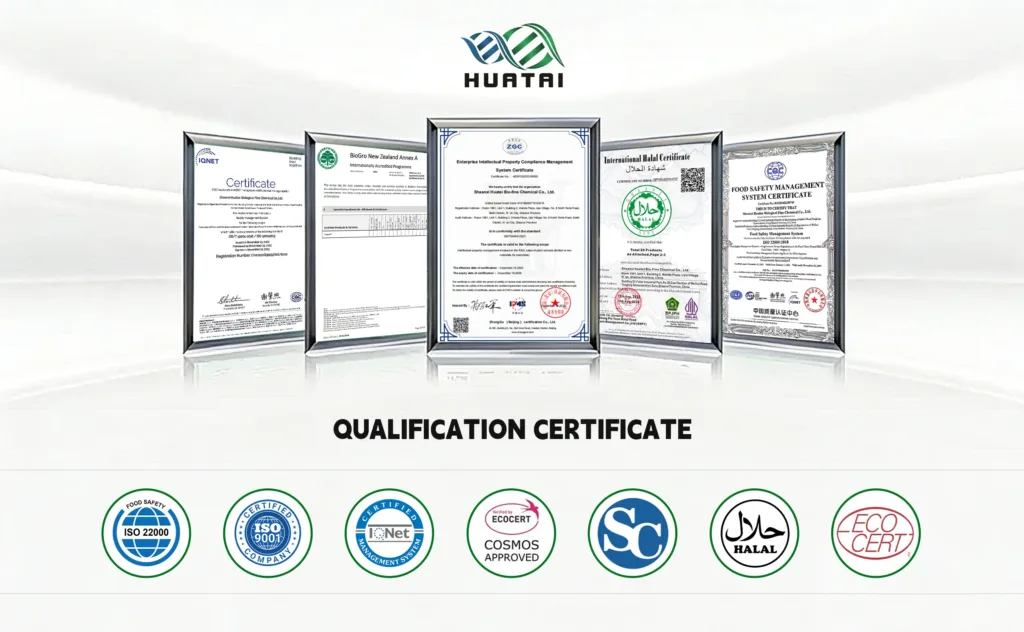
Uncompromising Quality & Credibility:We ensure every batch of our Active skincare ingredients meets rigorous quality standards, including COSMOS, ISO 9001/22000, and HALAL Certification. This commitment, backed by a complete Technical Dossier, offers clinically-backed solutions and guaranteed compliance for every formulation challenge.


 English
 German
 Italian
 French
 Spanish
 Japanese
 Korean
 Russian