Strategic Insights for Your Glabridin Buy: Sourcing High-Purity Whitening Agents
You approve a purchase order for a batch of high-purity Glabridin. The white powder arrives. Your chemists formulate a new brightening serum. Two months later, the serum turns a dirty brown in the warehouse. You just lost your entire production run.
We run the extraction tanks. We supply this exact active ingredient to global brands. We watch purchasing managers make the same costly mistake repeatedly. They buy based entirely on the highest purity number and the lowest price tag. They ignore chemical stability. Let us change how you source this material.
Brokers love selling 90 percent purity. It sounds premium. But pure Glabridin is highly reactive. Without its natural licorice plant matrix, it degrades rapidly when exposed to light or heat. We actually guide most of our manufacturing partners toward the 40 percent grade. The remaining 60 percent consists of natural licorice flavonoids. These act as an organic shield. They stabilize the active molecule and make formulation significantly easier.
Look at the actual factory data comparing the two grades.
| Specification | 40 Percent Grade | 90 Percent Grade |
| Appearance | Light brown powder | White powder |
| Oxidation Resistance | High | Low |
| Solvent Compatibility | Excellent (Butylene Glycol) | Moderate (Requires precise heating) |
| Cost Per Formulation | Low | Very High |
How does this ingredient actually work? Your skin has a factory enzyme called tyrosinase. This enzyme manufactures dark pigment when triggered by UV light. Glabridin physically blocks this enzyme. It acts like a lock on the factory door. We measure this blocking power using an IC50 value. A lower number indicates stronger blocking ability.
| Whitening Agent | Tyrosinase IC50 Value (ug/mL) | Relative Efficacy |
| Glabridin | 0.16 | Very Strong |
| Kojic Acid | 9.14 | Moderate |
| Arbutin | 55.40 | Mild |
The numbers prove its power. But raw power means nothing if the powder is contaminated.
Let me share a sourcing failure from a European client. They wanted to launch a botanical spot treatment. They bought a cheap batch of Glabridin from an unknown supplier. During their accelerated stability tests, the cream completely separated. The active ingredient crashed out of the oil phase.
They sent us a sample of the failed powder. We ran it through our lab. The powder was heavily contaminated with extraction solvents and heavy metals. These trace metals acted as catalysts. They destroyed the emulsion from the inside out.
We supplied them with our clean, factory direct batch. Here is the exact formulation strategy we provided to fix their product.
| Phase | Ingredient | Usage Rate | Purpose |
| A | Squalane | 5.0 percent | Skin identical lipid |
| B | Butylene Glycol | 8.0 percent | Primary solvent |
| B | Glabridin 40 percent | 0.2 percent | Active pigment blocker |
| C | Vitamin E | 0.5 percent | Antioxidant protection |
The golden rule? Never put Glabridin near water. Dissolve it completely in Phase B at 60 degrees Celsius. Ensure the liquid is perfectly clear. Then blend it into your oil phase. The European brand launched this revised formula. They achieved a two year shelf life with zero color shift.
Regulatory compliance is tightening globally. The FDA and EU are aggressively monitoring synthetic lighteners. Hydroquinone is strictly banned in cosmetics. Consumers demand plant derived efficacy. But they will not tolerate unstable, yellowing creams.
You must demand rigorous testing from your supplier. Do not accept a generic piece of paper. Look at our recent Certificate of Analysis for a standard 40 percent batch.
| Testing Parameter | Quality Standard | Our Factory Result |
| Glabridin Assay | Greater than 40.0 percent | 41.5 percent |
| Heavy Metals Total | Less than 10 ppm | Less than 2 ppm |
| Residue on Ignition | Less than 1.0 percent | 0.3 percent |
| Microbial Plate Count | Less than 100 cfu/g | Less than 10 cfu/g |
Stop buying this ingredient blindly. Do not trust a broker who cannot explain the solvent requirements. We manufacture the raw material. We understand the extraction chemistry. We know exactly how it behaves in your mixing vats. Ask our laboratory for a sample. Dissolve it in your chosen solvent. Watch it melt perfectly clear. That clarity is the only proof of quality you should trust.
References used for formulation data and biological mechanisms:
- Yokota, T., et al. (1998). The inhibitory effect of glabridin from licorice extracts on melanogenesis and inflammation. Pigment Cell Research.
- Nerya, O., et al. (2003). Vismione H and glabridin as tyrosinase inhibitors. Journal of Agricultural and Food Chemistry.
- D’Mello, S. A., et al. (2016). Signaling pathways in melanogenesis. International Journal of Molecular Sciences.
Empower Your Skin Science: Develop Next-Generation Formulations with Our Premium Active Ingredients.
Why choose us
Huatai Bio provides a comprehensive portfolio of high-efficacy cosmetic active ingredients, empowering global brands to create next-generation skincare formulations for high-end skincare formulation needs.
Comprehensive Solutions & Innovation: Our categories cover the full spectrum of market requirements: Anti-aging & Firming, Oil-Control & Anti-acne, Anti-inflammatory & Soothing,Antioxidant Defense, Brightening,and Hydration & Barrier Repair.We offer both established classics and cutting-edge actives.
Driven by a passion for scientific excellence, our state-of-the-art R&D laboratory is dedicated to exploring the frontier of bio-active molecules. Beyond supplying ingredients, we offer end-to-end formulation consultancy and customized solution development. Our team of expert chemists works closely with your brand to overcome complex stability issues and sensory challenges, ensuring your final product stands out in a competitive global market.
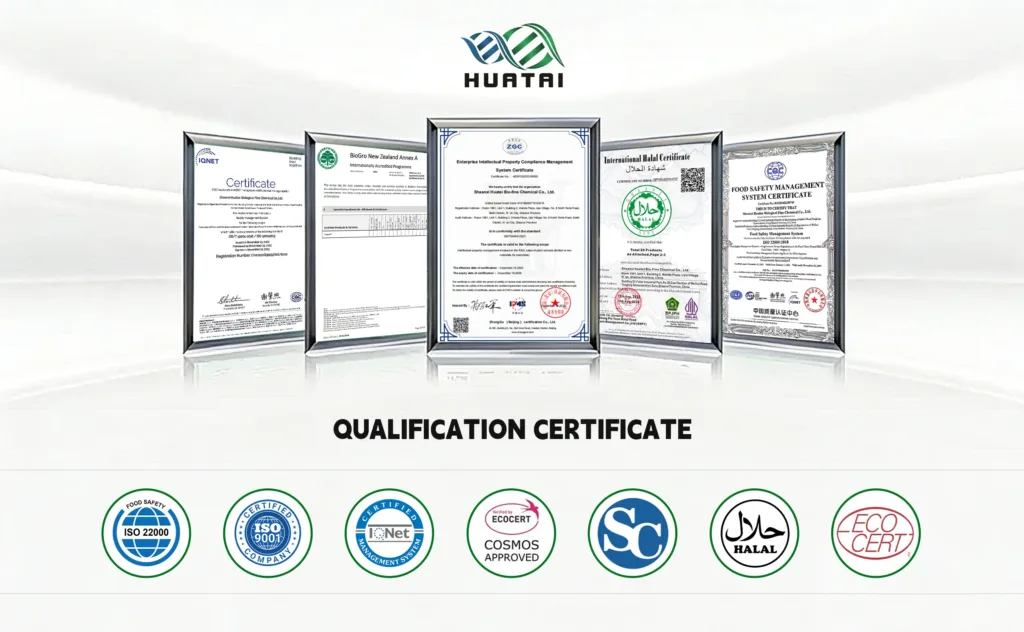
Uncompromising Quality & Credibility:We ensure every batch of our Active skincare ingredients meets rigorous quality standards, including COSMOS, ISO 9001/22000, and HALAL Certification. This commitment, backed by a complete Technical Dossier, offers clinically-backed solutions and guaranteed compliance for every formulation challenge.

 English
 German
 Italian
 French
 Spanish
 Japanese
 Korean
 Russian