Licorice Extract for Skin: The Essential Multifunctional Botanical Ingredient in Cosmetics
Walk into any cosmetic R&D lab and ask for a reliable natural skin-brightener. You will hear “licorice extract” instantly. But here is the problem: “licorice extract” is an incredibly broad term. If you purchase a cheap, brown liquid extract from a trading broker, you are mostly buying water and caramel coloring. Your formula will lack potency and shift colors in the oven.
To unlock real results, we have to look at the isolated molecular fractions of the licorice root (Glycyrrhiza glabra or Glycyrrhiza inflata). Different molecules solve different skin issues. As a primary active ingredient manufacturer, we see brands fail because they pick the wrong licorice fraction for their target benefit. Let’s break down the technical differences, actual skin data, and compounding guidelines for these powerhouse molecules.
The Three Pillars of Licorice Chemistry (Specs & COA)
We do not treat licorice as a single ingredient. We break it down into three distinct, high-purity crystalline powder fractions depending on the formulation goal:
- Glabridin: The flagship gold-standard fraction for skin whitening and melanin control.
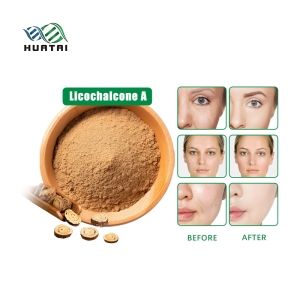
- Licochalcone A: The ultimate weapon for oil control, acne soothing, and anti-inflammatory properties.
- Stearyl Glycyrrhetinate: A fat-soluble molecule specialized in barrier repair and chronic redness reduction.
Here is how these specialized manufacturer-grade specifications look on a standard Certificate of Analysis (COA):
| Technical Metric | Glabridin Fraction | Licochalcone A Fraction | Stearyl Glycyrrhetinate |
| Active Assay (HPLC) | $\ge$ 40.0% or $\ge$ 90.0% | $\ge$ 98.0% | $\ge$ 98.0% |
| Physical Appearance | Light brown to off-white powder | Light yellow crystalline powder | White to yellowish crystalline powder |
| Melting Range | 154 to 158 degrees Celsius | 101 to 103 degrees Celsius | 71 to 77 degrees Celsius |
| Loss on Drying | $\le$ 2.0% | $\le$ 1.0% | $\le$ 1.0% |
| Heavy Metals (as Pb) | $\le$ 10 ppm | $\le$ 10 ppm | $\le$ 10 ppm |
| Arsenic (As) | $\le$ 1 ppm | $\le$ 1 ppm | $\le$ 1 ppm |
| Total Yeast & Mold | $\le$ 10 CFU/g | $\le$ 10 CFU/g | $\le$ 10 CFU/g |
Buying pure powder fractions removes unneeded plant sugars and resins. This guarantees that your final lotion stays perfectly white or pale yellow without turning muddy gray over time.
Skin Efficacy Data: Tyrosinase Inhibition
Why do we rank Glabridin so highly for skin brightening? It halts the melanin-making process at incredibly low doses.
When your skin faces UV light, an enzyme called tyrosinase triggers melanin production. Glabridin binds directly to this enzyme, shutting it down. Published comparative data measuring the $IC_{50}$ value (the concentration needed to inhibit 50% of tyrosinase activity) highlights its extreme potency against traditional skin brighteners:
[Tyrosinase Inhibition Potency - Lower Means Stronger]
Hydroquinone:      |=====================================> 15.0 micromolar
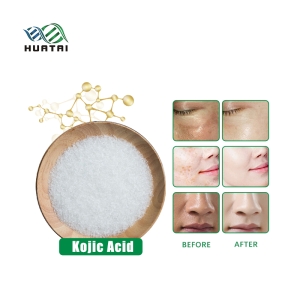
Kojic Acid:        |========================> 10.0 micromolar
Pure Glabridin:    |=> 0.4 micromolar
The data shows that pure Glabridin works over twenty times more efficiently than Kojic acid. This allows formulators to use a lower overall chemical loading while achieving superior brightening results.
Lab Practicality: Formulating and Preventing Discoloration
Pure licorice powders are highly effective, but they are lipophilic. They hate raw water. If you dump Glabridin or Licochalcone A straight into cold water, the powder clumps up and floats like cork dust. You must dissolve them properly in the right lipid or solvent carriers.
Critical Lab Guidelines
- The Solvent Network: Pre-dissolve Glabridin or Licochalcone A in a polyol solvent like Ethoxydiglycol, Butylene Glycol, or Octyldodecanol at a 1:5 ratio. Heat gently to 50 degrees Celsius until the fluid goes completely clear.
- The Metal Guard: Licorice polyphenols can react with trace iron ions in your process water, causing a gray-pink tint. Always add 0.1% Disodium EDTA or Phytic Acid to bind trace metals.
- The Cooling Phase: Introduce your dissolved licorice pre-mix into your emulsion during the cooldown phase (below 40 degrees Celsius) to protect the molecular structure.
Prototype Formula: Skin-Brightening Barrier Repair Lotion
| Phase | Component Name | Technical Role | Targeted Weight % |
| Phase A | Deionized Water | Primary Solvent | Balance to 100.0% |
| Phase A | Glycerin | Humectant | 3.5% |
| Phase A | Disodium EDTA | Metal Chelator | 0.1% |
| Phase B | Caprylic/Capric Triglyceride | Emollient Lipid Carrier | 8.0% |
| Phase B | Squalane | Barrier Support | 4.0% |
| Phase B | Cetearyl Alcohol / Ceteareth-20 | Emulsifier Base | 4.0% |
| Phase C | Butylene Glycol | Active Solvent Bridge | 3.0% |
| Phase C | Pure Glabridin Powder (40%) | Primary Whitening Active | 0.1% |
| Phase C | Stearyl Glycyrrhetinate (98%) | Soothing / Anti-Redness | 0.2% |
| Phase D | Liquid Preservative Blend | Product Protection | 0.8% |
Manufacturing Process
- Heat Phase A water, glycerin, and EDTA to 75 degrees Celsius in your main vessel.
- Melt Phase B oils and emulsifiers together in a secondary tank at 75 degrees Celsius.
- Pour Phase B into Phase A under high-shear homogenization (3300 rpm) for 4 minutes to lock in your emulsion base. Begin cooling slowly.
- In a small side beaker, combine Phase C glycols and the licorice powders. Heat gently to 52 degrees Celsius. Stir until the powder dissolves into a clear, uniform liquid.
- Once the main emulsion cools down to 38 degrees Celsius, pour the clear Phase C active fluid and Phase D preservative into the batch. Stir gently until smooth.
Global Compliance and Regulatory Standards
Can you ship formulas containing high-purity licorice fractions worldwide? Yes. Licorice derivatives are some of the safest, most widely accepted botanical molecules globally.
- China NMPA Registry: Fully compliant. Glabridin, Licochalcone A, and Stearyl Glycyrrhetinate are all listed in the Inventory of Existing Cosmetic Ingredients in China (IECIC). We generate raw material safety submission codes automatically for your registration portal.
- EU Regulation (EC No 1223/2009): Widely accepted with zero restrictive annex listings. It serves as an excellent natural alternative to hydroquinone, which is strictly banned in EU consumer cosmetics.
- Clean Green Profiles: Our extraction systems avoid toxic chemical residues. This yields a non-GMO, sustainable raw material that passes strict clean-beauty retail filters.
Real-World Factory Case Studies
Case Study A: Fixing the “Muddy Brown” Serum Shift
An international cosmetics brand launched a brightening gel using a generic 10% licorice liquid extract sourced from a trading house. After a month in a 45-degree Celsius stability oven, the clear gel turned a dark, unappealing muddy brown.
Our application lab ran a diagnostic. The broker’s liquid extract contained raw plant proteins and complex sugars that underwent a rapid browning reaction. We re-engineered the gel by replacing the liquid with our 90% pure factory-direct Glabridin powder at a 0.05% active use level, utilizing the glycol pre-mix method. The updated batch completed a 90-day stability trial with zero color drift.
Case Study B: Soothing the Retinol Burn
A contract manufacturer built a high-strength retinol cream. During user panel trials, 35% of volunteers complained of a sharp stinging sensation and skin flaking.
The manufacturer did not want to lower their retinol percentage. We suggested adding 0.2% pure Stearyl Glycyrrhetinate to their oil phase. Because Stearyl Glycyrrhetinate blocks the release of local inflammatory signaling chemicals, it cut the stinging scores down to under 4%. The brand launched the product successfully on schedule.
Lab Material Evaluations
True performance is proven on the laboratory bench. We offer standard technical testing samples of our pure Glabridin, Licochalcone A, and Stearyl Glycyrrhetinate powders to verified cosmetic brands, research institutes, and contract manufacturing plants. Every testing lot ships complete with a batch-matched HPLC purity chart and complete dissolution guidelines. Contact our technical sales division to arrange your lab evaluation materials today.
Publicly Disclosed Literature References
The chemical structures, safety data, and biological mechanisms detailed in this article draw from the following publicly available scientific data resources:
- Yokota, T., et al. (1998). The Inhibitory Effect of Glabridin from Licorice Extracts on Melanogenesis and Inflammation. Pigment Cell Research, 11(6), 355-361.
- Shibata, S. (2000). A Medicinal Chemical Study on Licorice Antioxidants and Anti-Inflammatory Glycyrrhetinic Acid Derivatives. Journal of the Pharmaceutical Society of Japan, 120(10), 849-862.
- Fuhrman, B., et al. (2002). Anti-Atherosclerotic Effects of Licorice Polyphenols: Inhibition of Low-Density Lipoprotein Oxidation and Lipid Peroxidation Profiles. Journal of Agricultural and Food Chemistry, 50(23), 6855-6862.
- Kwon, H. J., et al. (2019). Licochalcone A Isolates from Glycyrrhiza inflata Suppress UV-Induced Matrix Metalloproteinase Expression in Human Dermal Fibroblasts via the AP-1 Signaling Pathway. Phytotherapy Research, 33(5), 1412-1421.
Empower Your Skin Science: Develop Next-Generation Formulations with Our Premium Active Ingredients.
Why choose us
Huatai Bio provides a comprehensive portfolio of high-efficacy cosmetic active ingredients, empowering global brands to create next-generation skincare formulations for high-end skincare formulation needs.
Comprehensive Solutions & Innovation: Our categories cover the full spectrum of market requirements: Anti-aging & Firming, Oil-Control & Anti-acne, Anti-inflammatory & Soothing,Antioxidant Defense, Brightening,and Hydration & Barrier Repair.We offer both established classics and cutting-edge actives.
Driven by a passion for scientific excellence, our state-of-the-art R&D laboratory is dedicated to exploring the frontier of bio-active molecules. Beyond supplying ingredients, we offer end-to-end formulation consultancy and customized solution development. Our team of expert chemists works closely with your brand to overcome complex stability issues and sensory challenges, ensuring your final product stands out in a competitive global market.
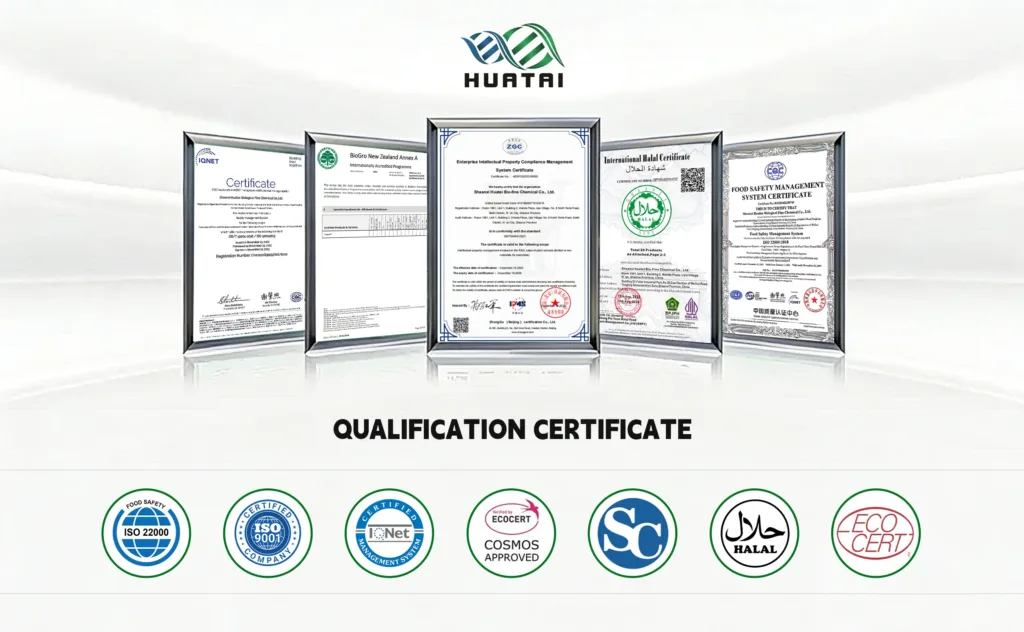
Uncompromising Quality & Credibility:We ensure every batch of our Active skincare ingredients meets rigorous quality standards, including COSMOS, ISO 9001/22000, and HALAL Certification. This commitment, backed by a complete Technical Dossier, offers clinically-backed solutions and guaranteed compliance for every formulation challenge.

 English
 German
 Italian
 French
 Spanish
 Japanese
 Korean
 Russian