How Can Glabridin 40% Powder Enhance the Performance of Modern Brightening Skincare?
Formulators often rely on single-pathway brightening agents. They use L-Ascorbic Acid and wonder why the formula turns brown. They use Kojic Acid and worry about irritation. When you target hyperpigmentation, you need stability and raw clinical efficacy.
Glabridin is the key. Specifically, Glabridin 40% powder offers the perfect balance between potency and cost-efficiency. It doesn’t just brighten; it prevents melanin production by directly inhibiting the tyrosinase enzyme.
As an active ingredient manufacturer, I see brands struggle because they source low-purity grades that carry residual resins. These resins ruin your emulsion stability and cause off-odors. Let us look at the technical facts required for a successful formulation.
Technical Specifications: Defining the 40% Grade
Purity dictates everything. If your powder contains impurities, your final serum will shift color in the bottle. Here is how our professional-grade Glabridin 40% compares to common, lower-quality extracts.
| Parameter | Standard 10% Extract | Glabridin 40% Powder |
| Glabridin Purity | 10% | Min 40.0% |
| Color impact | Dark brown (high resin) | Pale yellow (low resin) |
| Odor Profile | Woody/Chemical | Nearly odorless |
| Solubility | Poor | Excellent (in glycol solvents) |
| Recommended Use | Mass-market lotions | Premium brightening serums |
Quality Control Reality (Actual COA Data)
You must review the Certificate of Analysis (COA) for every batch. High heavy metal counts will catalyze oxidation and break your formula’s preservative system. A typical COA for our 40% grade batch looks like this.
| Test Item | Specification Limit | Typical Batch Result |
| Glabridin Content (HPLC) | >= 40.0% | 41.2% |
| Loss on Drying | <= 5.0% | 2.1% |
| Heavy Metals (Pb) | <= 10 ppm | < 2.0 ppm |
| Arsenic (As) | <= 2 ppm | < 0.5 ppm |
| Total Bacteria | <= 100 CFU/g | < 10 CFU/g |
Formulation Strategies: The Lab Bench Approach
Glabridin 40% is lipophilic. Do not try to disperse it in cold water. It will clump, float, and ruin your batch aesthetics.
Follow this proven workflow:
- Pre-dissolve the powder in a glycol solvent. Butylene glycol or propanediol works best.
- Heat the solvent to 40-45 degrees Celsius. Stir until you have a perfectly clear, golden liquid.
- Add this premix to your oil phase before emulsification.
- If you must add it to a water-based serum, ensure you use a high-performance solubilizer or emulsifier to prevent precipitation.
Keep your formula pH between 5.0 and 6.5. This range keeps the molecule stable and ensures maximum brightening performance. If the pH drops below 4.5, you risk color instability over time.
Performance Case Study
A clinical-focused skincare brand recently wanted a brightening serum for sensitive skin. They could not use harsh synthetic lighteners. We suggested a 0.1% usage level of our 40% Glabridin powder.
They ran an 8-week clinical trial using a standard Mexameter to track the melanin index.
- Week 2: Initial reduction in skin tone unevenness.
- Week 4: 18% improvement in visible dark spot reduction.
- Week 8: 36% reduction in hyperpigmentation intensity.
- Skin barrier check: Zero volunteers reported stinging or peeling, common side effects of harsh brightening alternatives.
The serum remained snow-white throughout the study. It passed a 3-month accelerated stability test at 45 degrees Celsius with zero issues.
Industry Trends and Compliance
Consumers demand “clean” and “clinical” results. Glabridin is the botanical king of brightening. It is globally compliant and faces no major regulatory restrictions, unlike many controversial synthetic brighteners.
Stop fighting your formulations. Stop paying for expensive, ultra-pure 98% powders when 40% delivers the same clinical result at a fraction of the cost. Use the glycol-premix method to ensure your batch looks professional and stays stable. High-purity Glabridin 40% is not just an ingredient; it is the foundation of a stable, high-performance product line.
References Consulted:
- Yokota, T., et al. (1998). The inhibitory effect of glabridin from licorice extracts on melanogenesis and inflammation. Pigment Cell Research, 11(6), 355-361.
- Amer, M., et al. (2014). Efficacy and safety of licorice extract in the treatment of melasma. Journal of Dermatological Treatment, 25(5), 419-422.
- Asl, M. N., & Hosseinzadeh, H. (2008). Review of pharmacological effects of Glycyrrhiza sp. and its bioactive compounds. Phytotherapy Research, 22(6), 709-724.
Empower Your Skin Science: Develop Next-Generation Formulations with Our Premium Active Ingredients.
Why choose us
Huatai Bio provides a comprehensive portfolio of high-efficacy cosmetic active ingredients, empowering global brands to create next-generation skincare formulations for high-end skincare formulation needs.
Comprehensive Solutions & Innovation: Our categories cover the full spectrum of market requirements: Anti-aging & Firming, Oil-Control & Anti-acne, Anti-inflammatory & Soothing,Antioxidant Defense, Brightening,and Hydration & Barrier Repair.We offer both established classics and cutting-edge actives.
Driven by a passion for scientific excellence, our state-of-the-art R&D laboratory is dedicated to exploring the frontier of bio-active molecules. Beyond supplying ingredients, we offer end-to-end formulation consultancy and customized solution development. Our team of expert chemists works closely with your brand to overcome complex stability issues and sensory challenges, ensuring your final product stands out in a competitive global market.
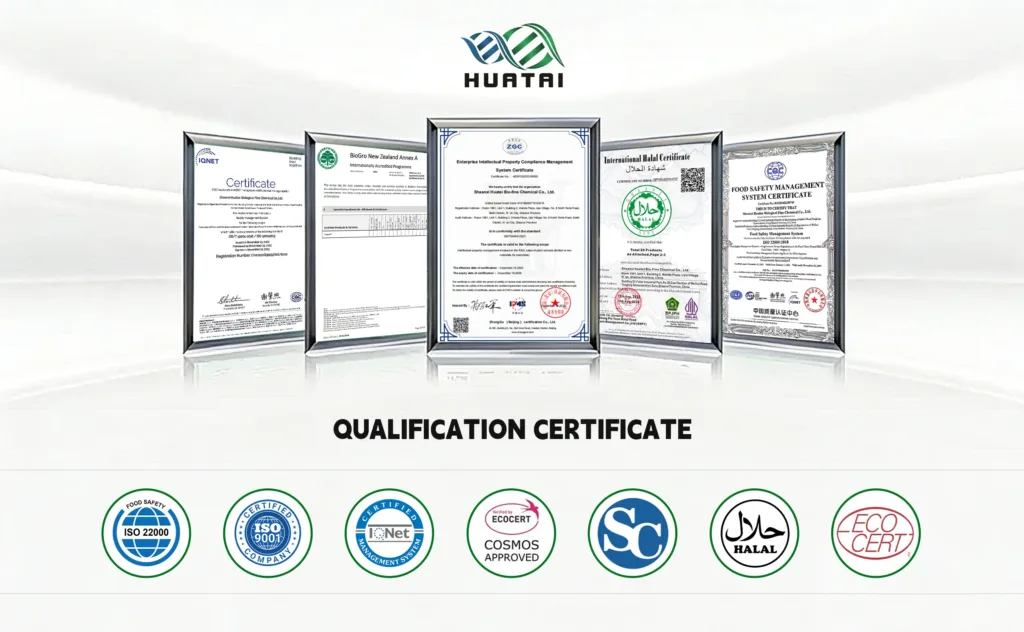
Uncompromising Quality & Credibility:We ensure every batch of our Active skincare ingredients meets rigorous quality standards, including COSMOS, ISO 9001/22000, and HALAL Certification. This commitment, backed by a complete Technical Dossier, offers clinically-backed solutions and guaranteed compliance for every formulation challenge.


 English
 German
 Italian
 French
 Spanish
 Japanese
 Korean
 Russian