Global Standards for Natural Skincare Ingredients Manufacturers and Their Role in Product Innovation
Clean beauty used to mean simply omitting paraben preservatives or mineral oils. Today, the target has shifted entirely. Brands now demand hard data, verified green chemistry, and precise naturality scores. As a manufacturer of high-purity cosmetic active ingredients, we see this transformation firsthand at the laboratory bench. Product innovation no longer starts with creative marketing concepts; it begins with rigorous global standardization and strict molecular control.
How do global compliance frameworks drive modern cosmetic formula innovation? Let us look past the industry buzzwords and examine the raw numbers, testing metrics, and manufacturing standards that dictate performance.
Defining “Natural” through Numbers: ISO 16128 and COSMOS
You cannot formulate scientifically using vague marketing definitions. The global industry relies heavily on ISO 16128 (guidelines on technical definitions and criteria for natural and organic cosmetic ingredients) to establish mathematical clarity. This standard removes ambiguity by forcing raw material suppliers to calculate a precise Natural Origin Index (NOI).
An active ingredient does not automatically get a perfect score just because it originates from a plant. The molecular structure must be mathematically evaluated based on how much of the final compound remains untouched by chemical synthesis.
       M_natural + (0.5 * M_natural_modified)
NOI = ----------------------------------------
                     M_total
Where $M$ represents the molecular weight of the starting materials or structural fragments.
Core Parameter Comparison: Natural Active vs. Semi-Synthetic
To understand how global standards dictate ingredient selection, consider the strict analytical specifications required for active component batches:
| Parameter | High-Purity Botanical Extract (e.g., Natural Glabridin) | Modified Plant Derivative (Semi-Synthetic) |
|—|—|
| Appearance | Light brown to off-white powder | White to cream crystalline powder |
| Assay (HPLC) | 40.0% to 90.0% (Target Active Compound) | 98.0% Minimum |
| Natural Origin Index (ISO 16128) | 1.00 | 0.50 to 0.75 |
| Heavy Metals (Pb, As, Hg) | Less than 10 ppm total | Less than 5 ppm total |
| Residual Solvents (GC) | Ethanol/Water only (Zero Ethanol Rest) | Traces of Acetone/Ethyl Acetate (Filtered) |
| COSMOS Certification | Approved for Organic Formulas | Restricted based on chemical processing |
When we manufacture an active ingredient like high-purity plant extracts, maintaining an NOI close to 1.00 while guaranteeing structural stability is our primary engineering challenge. If an extraction process uses harsh, non-banned petrochemical solvents to increase yield, the naturality index collapses.
Global Compliance as an Innovation Catalyst
Regulatory frameworks like the EU Cosmetics Regulation (EC) No 1223/2009, China’s Cosmetic Supervision and Administration Regulation (CSAR), and MoCRA in the United States do not limit innovation—they actually force it.
Take China’s Inventory of Existing Cosmetic Ingredients (IECIC). Under CSAR, any raw material not listed requires a three-year safety monitoring period before full approval. What does this mean for a global formulator? It means you must maximize the efficacy of known, highly effective green actives through advanced structural purification rather than rushing unverified synthetic molecules to market.
Real Laboratory Data: Efficacy Boost via High-Purity Actives
Why focus on ultra-high purity levels during manufacturing? Because impurities actively suppress performance. For instance, in enzymatic assays measuring tyrosinase inhibition (the pathway responsible for skin pigmentation spots), raw material purity radically changes the concentration required to achieve a 50% reduction in enzyme activity ($IC_{50}$).
- Standard Botanical Extract (20% Active Concentration): Requires an $IC_{50}$ concentration of approximately $0.15\text{ mg/mL}$ to halt pigment production pathways.
- Purified Phytochemical Active (90% HPLC Grade): Achieves an $IC_{50}$ threshold at just $0.0023\text{ mg/mL}$.
By stripping away inert plant sugars and pigments during production, we create a highly concentrated powder. This allows clean beauty brands to use lower input percentages in their final creams while achieving superior, irritation-free clinical results.
Turning Constraints into Solutions: The Formulation Guide
Global natural standards strictly prohibit common synthetic performance enhancers like ethoxylated surfactants, silicone oils, and synthetic polymers. How do you build an elegant, fast-absorbing anti-aging serum using purely compliant natural raw materials?
You must rely on bio-fermented polyols, natural lipid matrices, and structural synergy. Below is a stable frame formulation engineered for a high-performance, natural-compliant brightening serum.
Frame Formulation: High-Performance Natural Brightening Serum
| Phase | Ingredient (INCI Name) | Weight % | Function / Compliance Status |
| Phase A | Water (Aqua) | 73.80 | Natural Solvent (NOI = 1.0) |
| Phase A | Propanediol | 10.00 | Bio-fermented Humectant & Solvent |
| Phase A | Glycerin | 5.00 | Plant-derived Skin Identical Humectant |
| Phase A | Xanthan Gum | 0.40 | Natural Rheology Modifier (COSMOS Approved) |
| Phase B | Cetearyl Olivate (and) Sorbitan Olivate | 3.00 | Natural Liquid Crystal Emulsifier |
| Phase B | Caprylic/Capric Triglyceride | 5.00 | Coconut-derived Emollient |
| Phase B | High-Purity Botanical Active (90% Grade) | 0.50 | Primary Functional Active (Efficacy Focus) |
| Phase C | Sodium Hyaluronate | 1.00 | Bio-fermented Deep Hydrator |
| Phase C | Benzyl Alcohol (and) Dehydroacetic Acid | 1.00 | Nature-Identical Preservative System |
| Phase D | Citric Acid | Q.S. | Natural pH Adjuster (Target pH: 5.2–5.5) |
Manufacturing Execution Blueprint
- Hydrate Phase A: Disperse the Xanthan Gum directly into the Propanediol and Glycerin slurry before adding water. This completely avoids clumping without requiring synthetic dispersing agents. Heat the mixture to 75°C.
- Prepare Phase B: Combine the natural emulsifier flakes, emollient oils, and the high-purity active powder in a separate vessel. Heat to 75°C until completely molten and uniform.
- Emulsification: Introduce Phase B slowly into Phase A under high-shear homogenization (3500 rpm) for exactly 5 minutes. This creates a highly stable, microscopic liquid crystal structure that mimics the skin’s lipid barrier.
- Cool Down: Cool the batch gradually under gentle paddle agitation. Once the temperature drops below 40°C, add the heat-sensitive Phase C components.
- pH Calibration: Measure the batch. Adjust using a 10% citric acid solution until the pH settles between 5.2 and 5.5. This narrow window preserves both active molecule stability and preservative network performance.
Real-World Case Study: The Crystallization Failure
A contract manufacturer approached us regarding a high-end natural face oil formula that kept failing physical stability tests. Every time the product sat in cold storage ($4^\circ\text{C}$ validation chambers) for more than 48 hours, needle-like crystals formed at the bottom of the glass dropper bottles. Consumers would feel a gritty, sand-like texture during application.
The brand’s original formula used a crude plant extract oil containing roughly 30% of the target active molecule, with the remaining 70% consisting of naturally occurring plant waxes and long-chain fatty acids.
Our Analytical Diagnosis
Our technical team analyzed the precipitate using high-performance liquid chromatography (HPLC) and melting point determination. The problem did not stem from the active component itself. Instead, the crude extraction method left behind high-molecular-weight plant sterols and saturated waxes. In a pure lipid base (caprylic/capric triglycerides), these waxes rapidly lost solubility at low temperatures and crystallized out of solution.
Crude Extract (30% Active + 70% Natural Waxes) ---> Cold Temperature ---> Phase Separation (Crystallization)
High-Purity Active (90% Active, Waxes Stripped) ---> Cold Temperature ---> Stable Single-Phase Liquid Solution
The Industrial Solution
We replaced the crude extract oil with our 90% high-purity crystalline active powder and adjusted the manufacturing process:
- Solvent Re-engineering: We dissolved the pure active powder directly into a natural polar emollient solvent (Octyldodecanol) at 60°C before blending it with the core carrier oils.
- Wax Elimination: Because our manufacturing process uses multi-stage molecular distillation to strip away high-melting-point plant waxes, the new formula retained absolute clarity.
The redesigned batch passed all accelerated thermal cycling tests (alternating between $-10^\circ\text{C}$ and $+50^\circ\text{C}$ every 24 hours for 30 consecutive days) without a single trace of crystal precipitation. The brand successfully launched the clean beauty oil across European and North American markets without a single stability-related retail return.
Future Trajectory and Global Compliance
Where is the industry heading next? The upcoming regulatory horizon focuses intensely on microplastic elimination and green extraction engineering. The European Chemicals Agency (ECHA) continues to restrict synthetic polymer thickeners (often called liquid microplastics), which forces manufacturers to innovate using natural polysaccharide networks and clean fermentation processes.
Furthermore, eco-conscious sourcing is no longer optional. Global auditing bodies demand complete traceability from the farm harvest to the final Certificate of Analysis (COA) document.
Sample Evaluation Protocols
We produce our active raw materials under strict ISO 22716 Good Manufacturing Practices (GMP). For research and development laboratories preparing validation batches, compatibility profiles, or clinical trials, raw material evaluation samples are available upon technical request. Our analytical team provides full HPLC fingerprint data and heavy metal clearance records alongside every evaluation batch to ensure seamless integration into your regulatory documentation files.
Referenced Literature and Authoritative Sources
- International Organization for Standardization. (2016). ISO 16128-1:2016 Guidelines on technical definitions and criteria for natural and organic cosmetic ingredients — Part 1: Definitions for ingredients.
- European Parliament and Council. (2009). Regulation (EC) No 1223/2009 of the European Parliament and of the Council on cosmetic products.
- State Council of the People’s Republic of China. (2020). Cosmetic Supervision and Administration Regulation (CSAR).
- European Chemicals Agency (ECHA). (2023). Annex XV Restriction Report: Microplastics.
- Component parameter guidelines and physical chemistry validation data profiles for natural active compounds, Global Cosmetic Functional Materials Directory.
Empower Your Skin Science: Develop Next-Generation Formulations with Our Premium Active Ingredients.
Why choose us
Huatai Bio provides a comprehensive portfolio of high-efficacy cosmetic active ingredients, empowering global brands to create next-generation skincare formulations for high-end skincare formulation needs.
Comprehensive Solutions & Innovation: Our categories cover the full spectrum of market requirements: Anti-aging & Firming, Oil-Control & Anti-acne, Anti-inflammatory & Soothing,Antioxidant Defense, Brightening,and Hydration & Barrier Repair.We offer both established classics and cutting-edge actives.
Driven by a passion for scientific excellence, our state-of-the-art R&D laboratory is dedicated to exploring the frontier of bio-active molecules. Beyond supplying ingredients, we offer end-to-end formulation consultancy and customized solution development. Our team of expert chemists works closely with your brand to overcome complex stability issues and sensory challenges, ensuring your final product stands out in a competitive global market.
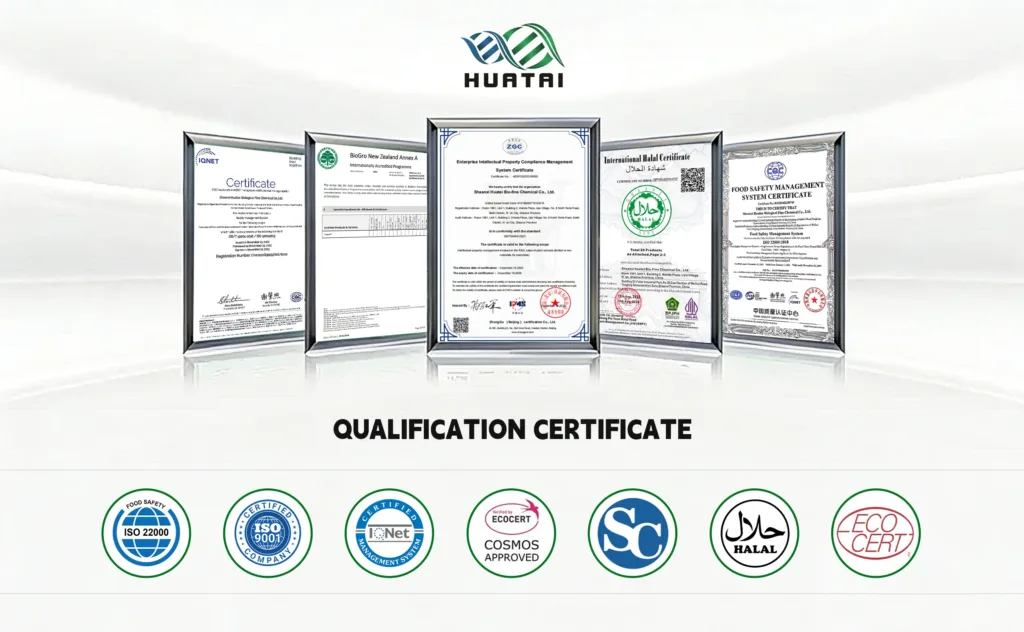
Uncompromising Quality & Credibility:We ensure every batch of our Active skincare ingredients meets rigorous quality standards, including COSMOS, ISO 9001/22000, and HALAL Certification. This commitment, backed by a complete Technical Dossier, offers clinically-backed solutions and guaranteed compliance for every formulation challenge.



 English
 German
 Italian
 French
 Spanish
 Japanese
 Korean
 Russian