
Based on formulation experience and stability studies on polyphenolic compounds, a pH range of approximately 4.0–5.5 is generally considered favorable for maintaining glabridin stability in cosmetic systems. This is a stability-based requirement: glabridin's polyphenolic structure contains multiple phenolic hydroxyl groups that remain in a protonated state under mildly acidic conditions, keeping the molecule most stable. As the environment approaches neutral or alkaline pH above 6.5, the phenolic hydroxyl groups begin to deprotonate, increasing susceptibility to oxidative discoloration and degradation.
The Chemistry Behind the pH Requirement
Glabridin is a polyphenolic isoflavane compound containing two phenolic hydroxyl groups at the 2′- and 4′-positions of the ring structure. These groups are critical to its tyrosinase-inhibiting activity — and they are the primary site of pH-driven oxidative degradation.
Above pH 7.0, glabridin's phenolic hydroxyl groups deprotonate more readily to form phenoxide anions, significantly increasing oxidative sensitivity and accelerating radical-mediated oxidative degradation. This process generates conjugated oxidation products, manifesting as progressive color deepening accompanied by active content loss.
The degradation shows significant pH-dependent acceleration: above pH 7.0, system stability decreases markedly and the formulation may show higher sensitivity to further pH changes. Under accelerated stability conditions (ICH Q1A(R2), 40°C / 75% RH), formulations at pH 7.5 generally show lower stability than those at pH 5.5.
The pH stability behavior documented in published stability data (Ao et al., Natural Product Communications, 2010, DOI: 10.1177/1934578X1000501214) shows glabridin is stable under acidic and neutral conditions, with significant decomposition in alkaline conditions — consistent with this mechanistic understanding.
pH Stability Windows
| pH Range | Stability | Practical Implication |
|---|---|---|
| 4.0–5.5 | Favorable | Target range for most leave-on applications |
| 5.5–6.5 | Good | Acceptable; reinforce antioxidant and chelation system |
| 6.5–7.0 | Marginal | Elevated risk; run accelerated stability before commercializing |
| >7.0 | Poor | Accelerated oxidative degradation under alkaline conditions, progressive color change — avoid |
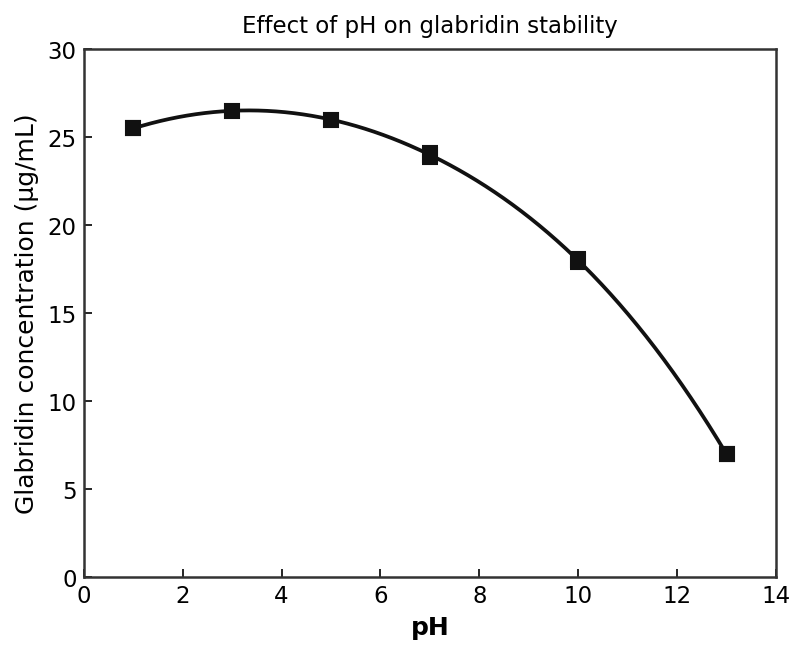
For most leave-on brightening formats (serums, emulsions, toners, essences), pH 4.5–5.5 is both technically favorable for glabridin and cosmetically appropriate — sitting within the physiological range of healthy skin surface pH (4.5–5.5), supporting barrier function and microbiome balance alongside active stability.
Buffer System Selection
Formulation pH may drift during storage, particularly in emulsions, where chemical reactions within the aqueous phase and at the oil–water interface can alter the system over time. In addition, acidic or alkaline degradation of co-ingredients may further shift the overall equilibrium. A properly buffered aqueous phase is required.
Recommended buffer systems
| Buffer System | Effective pH Range | Notes |
|---|---|---|
| Citric acid / Sodium citrate | 3.0–6.2 | Versatile; cosmetically well-tolerated; mild chelating effect on metal ions |
| Lactic acid / Sodium lactate | 3.6–5.8 | Skin-identical; supports barrier function; NMF component |
| Gluconolactone / Sodium gluconate | 3.5–6.0 | PHA; mild exfoliant; adds multifunctional benefit |
Systems to avoid with glabridin
| Buffer / System | Concern |
|---|---|
| Phosphate buffers | Weak metal chelation; lower oxidation protection compared to organic buffer systems |
| Sodium bicarbonate / carbonate | Alkaline range; incompatible with glabridin stability |
| Triethanolamine (TEA) adjustment | Not a buffer; weak pH stability control |
Citric acid/sodium citrate is the most commonly used and most practical choice. Its mild chelating effect on metal ions provides a secondary benefit alongside pH buffering — reducing the chelation burden on EDTA or sodium phytate in the formulation.
The pH Verification Rule
Final pH must be confirmed after full cool-down addition and equilibration.
This is the single most commonly skipped pH management step in production. The reason it matters:
Glabridin and many of its standard co-actives — including niacinamide, tranexamic acid, and certain peptides — can influence the final equilibrium pH of a buffered system upon addition during the cool-down phase. A base formula buffered to pH 5.5 before active addition may change after all actives are incorporated. Always reserve a citric acid solution for final pH correction after all actives are incorporated.
Common production error: If the pH check occurs only before cool-down additions, any shift goes undetected — and the product may ship outside the intended stability range without the formulator knowing.
Practical SOP protocol
- Buffer aqueous phase to target pH (typically 4.5–5.2) before emulsification
- Complete emulsification at standard temperatures
- Begin cool-down; add all actives in order below 50°C
- Measure pH at 30–35°C under fully equilibrated conditions
- Adjust pH if necessary to the target specification range using appropriate acid or base solutions, based on formulation design
- Record final pH in batch record before release to stability
pH and Co-Active Compatibility
pH selection affects not only glabridin stability but the compatibility of the full active system. Several high-value brightening co-actives have pH requirements that must be reconciled with glabridin's window.
| Co-Active | Optimal pH Range | Compatible with Glabridin? |
|---|---|---|
| Niacinamide | 5.0–7.0 | ✅ Yes — overlap at 5.0–6.0 |
| Tranexamic Acid (TXA) | 4.5–6.5 | ✅ Yes — full overlap |
| Ascorbyl glucoside (AA-2G) | 5.0–7.0 | ✅ Yes — overlap at 5.0–6.0 |
| Magnesium ascorbyl phosphate (MAP) | 5.5–7.0 | ✅ Yes — overlap at 5.5–6.5 (note: MAP stability and solubility may decrease below pH 5.5) |
| Dipotassium glycyrrhizate (DPG) | 4.5–7.5 | ✅ Yes — full overlap |
| Ectoin | 4.0–8.0 | ✅ Yes — full overlap |
| Raw L-ascorbic acid | 2.5–3.5 | ❌ No — pH conflict; at pH 2.5–3.5, oxidative risk for glabridin increases |
| Retinol esters | 6.5–7.5 | ❌ No — requires pH above glabridin's stable range |
| AHA (glycolic, lactic at high %) | 3.0–4.0 | ⚠️ Marginal — too acidic for most glabridin formats; use PHA instead |
The most practical brightening co-active stack compatible with glabridin's pH window is: glabridin + niacinamide + TXA + AA-2G, all functional between pH 5.0–6.0. This combination provides upstream tyrosinase inhibition (glabridin), modulation of inflammatory and plasmin-related signaling associated with melanogenesis (tranexamic acid), melanosome transfer blockade (niacinamide), and antioxidant-mediated inhibition of melanin formation and oxidation processes (AA-2G) — four complementary intercept points in the pigmentation pathway, broadly compatible within the same mildly acidic to near-neutral pH window.
Practical Formulation Decision Tree
Every batch ships with COA, TDS, and SDS/MSDS. Additional testing available upon request.
References
- Ao M, Shi Y, Cui Y, Guo W, Wang J, Yu L. Factors influencing glabridin stability. Natural Product Communications, Vol. 5(12), 1907–1912, 2010. DOI: 10.1177/1934578X1000501214. PMID: 21299118.
- Yokota T, Nishio H, Kubota Y, Mizoguchi M. The inhibitory effect of glabridin from licorice extracts on melanogenesis and inflammation. Pigment Cell Research, 11(6), 355–361, 1998. DOI: 10.1111/j.1600-0749.1998.tb00494.x.
- ICH Q1A(R2): Stability Testing of New Drug Substances and Products. International Council for Harmonisation, 2003.

 English
 German
 Italian
 French
 Spanish
 Japanese
 Korean
 Russian