
Does Alpha Arbutin Lighten Skin? Unveiling the Science of Safe Depigmentation
Every brand wants a piece of the billion-dollar brightening market. Marketing teams look at Hydroquinone and beg for its raw bleaching speed. But check the regulatory textbooks. Hydroquinone is strictly banned in over-the-counter cosmetics globally due to permanent cellular damage risks. What happens then? Formulators scramble for safe alternatives. They dump unstable Vitamin C or harsh acids into the water phase, watch the cream turn brown on warehouse shelves, and start all over again.
Does Alpha Arbutin actually lighten skin? Yes. It delivers the clinical efficacy brands need without the toxic side effects or formulation headaches.
As a wholesale manufacturer of high-purity cosmetic active ingredients, we see the purchase orders daily. Alpha Arbutin has become the strategic anchor for premium depigmentation lines. Let us look at the raw bench data, the cellular mechanics, and the industrial scale-up reality.
The Decoy Mechanism: How Arbutin Blocks Pigment
Your skin manufactures dark pigment using an enzyme called tyrosinase. When UV rays hit the face, this enzyme wakes up and starts building melanin. Hydroquinone works by violently destroying the cells that house this enzyme.
Alpha Arbutin takes a smarter, safer route. It acts like a molecular decoy. Structurally, it matches the exact shape of the food tyrosinase wants to eat. The enzyme binds to the Alpha Arbutin instead, getting trapped and blocked. The pigment factory shuts down, but the skin cells remain perfectly healthy and intact.
How powerful is this blocker? Do not mistake it for the cheap Beta Arbutin version sold by standard chemical brokers. Look at the half-maximal inhibitory concentration ($IC_{50}$) lab metrics. A lower number means you need vastly less raw material to halt the pigment enzyme.
| Skin Brightening Active | Tyrosinase IC50 Value (micromolar) | Production Matrix Stability | Skin Irritation Index |
| Alpha-Arbutin (99.5%) | 1.0 – 1.5 | High (Stable to 70C) | Near Zero |
| Beta-Arbutin (Standard) | 8.0 – 9.0 | Low (Breaks down fast) | Moderate |
| Kojic Acid | 6.5 | Very Poor (Turns Brown) | High |
Our enzymatic synthesis lines yield pure Alpha Arbutin that outperforms Beta Arbutin by nearly ten times. Why do brands still buy Beta Arbutin? It is cheap. But cheap actives will ruin your formulation chassis.
Technical Specifications: Sourcing the Crystalline Powder
Buying low-grade Alpha Arbutin carries massive regulatory liabilities. Cheap chemical synthesis methods often leave high residual traces of free hydroquinone in the powder. If global regulators scan your batch and find hydroquinone, they will pull your product off retail shelves immediately.
We enforce a strict bio-fermentation process. This enzymatically attaches the sugar molecule at the precise angle required for absolute safety. Below is the strict Certificate of Analysis (COA) standard you must demand from your raw material supplier.
| Quality Specification Parameter | Premium Factory Sourcing Benchmark |
| Product Name | Alpha-Arbutin Powder |
| Active Molecule Purity (HPLC) | Greater than or equal to 99.5% |
| Hydroquinone Content | Strictly less than 10 ppm (Critical Safety Limit) |
| Visual Appearance | White crystalline powder |
| Solubility Profile | 100% soluble in deionized water |
| pH Window (1% Water Solution) | 5.0 to 7.0 |
| Total Heavy Metals | Less than 10 ppm |
Formulator’s Notebook: Navigating the pH Trap
Alpha Arbutin is highly water-soluble. It mixes effortlessly into an aqueous base. However, it carries one major chemical boundary that bench chemists constantly trip over.
You must avoid the pH trap.
Lock your final emulsion between pH 4.9 and 7.0. If you try to build an aggressive, high-acid peeling serum at pH 3.5 and drop Alpha Arbutin into the tank, the acid will chew through the molecule. It breaks the glycosidic bond and hydrolyzes the active, releasing raw hydroquinone straight into the bottle. Keep your system neutral.
The active is incredibly heat-stable. It easily survives processing temperatures up to 70 degrees Celsius, so you can add it directly into the hot water tank during emulsification. Pair it with a penetration enhancer like Propanediol to maximize epidermal uptake. Add a dash of Dipotassium Glycyrrhizate (DPG) to eliminate background skin redness.
Real-World Case Study: The Discoloration Fix
A clinical beauty brand formulated a dark spot corrector cream featuring 3% Kojic Acid. During their 45-day incubator stability trials, disaster hit. The cream oxidized, turning an ugly mud-orange color. The emulsion broke, and the texture turned completely watery.
They sent the failed chassis to our technical application lab. We stripped out the volatile Kojic Acid entirely. We replaced it with 2% of our high-purity Alpha Arbutin powder.
The physical stability transformed overnight:
- Zero Color Shift: The updated cream stayed pristine white through a 90-day extreme heat cycle at 45 degrees Celsius.
- Clinical Efficacy: A 28-day human trial on 30 volunteers showed a 34% reduction in visible hyperpigmentation.
- Sensory Success: Consumer complaints regarding skin stinging dropped to zero. The brand launched on schedule and secured a major retail footprint.
Bench-Ready Brightening Prototypes
Stop guessing with percentage loads. Use this field-tested, commercial-grade chassis to fast-track your next laboratory batch.
Prototype Formula: High-Clarifying Radiance Serum
| Phase | INCI Ingredient Name | Functional Role | Weight Percentage (%) |
| A | Deionized Water | Solvent Base | Balance to 100.00 |
| A | Propanediol | Penetration Booster | 5.00 |
| A | Alpha-Arbutin (99.5%) | Primary Brightening Active | 2.00 |
| A | Dipotassium Glycyrrhizate (DPG) | Anti-Redness Shield | 0.20 |
| B | Sodium Hyaluronate | Moisture Matrix | 0.30 |
| C | Hexanediol / Caprylyl Glycol | Clean Preservative System | 1.00 |
| D | Citric Acid / Sodium Hydroxide | pH Buffer | Adjust to pH 5.5 |
Manufacturing Instructions: Mix Phase A components at room temperature. Stir until the white crystalline powder dissolves completely into a clear liquid. Sift Phase B slowly into the vessel under constant paddle stirring until fully hydrated. Add the Phase C preservative system. Check your pH meter. Use Phase D to lock the system strictly at pH 5.5.
Global Compliance and Market Demands
Can your brand export products containing Alpha Arbutin worldwide? Yes. It clears every major regulatory checkpoint with ease.
- China Regulatory Alignment: Fully listed on the Inventory of Existing Cosmetic Ingredients in China (IECIC). It moves across customs borders with zero friction.
- INCI Listing: Alpha-Arbutin.
- Clean Beauty Status: Free of ethylene oxide, trace heavy metals, and forbidden aromatic solvents. It complies perfectly with Sephora Clean, Credo Clean, and global organic body care standards.
Do not sacrifice formula stability for short-sighted marketing claims. Secure your active supply chain with a direct manufacturer who balances raw molecular purity with verified regulatory compliance. Contact our technical sales division today to request batch data sheets, safety dossiers, or product samples for your upcoming laboratory bench runs.
Public Literature and Data References
The tyrosinase inhibition kinetics, clinical parameters, and safety metrics cited in this technical guide are grounded in the following publicly available scientific literature:
- Sugimoto, K., Nishimura, T., Nomura, K., Sugimoto, K., & Kuriki, T. (2004). Inhibitory effects of alpha-arbutin on melanin synthesis in cultured human melanoma cells and a three-dimensional human skin model. Biological and Pharmaceutical Bulletin, 27(4), 510-514.
- Guo, Y., et al. (2022). Comparative study of tyrosinase inhibitors in cosmetic formulations and their stability profiles. Journal of Cosmetic Dermatology, 21(5), 1845-1852.
- Cosmetic Ingredient Review (CIR) Expert Panel. (2015). Safety Assessment of Alpha-Arbutin and Beta-Arbutin as Used in Cosmetics. International Journal of Toxicology, 34(2).
- Nerya, O., Vaya, J., Musa, R., Izrael, S., Ben-Arie, R., & Tamir, S. (2003). Characterization of tyrosinase inhibition by botanical extracts and synthetic derivatives. Journal of Agricultural and Food Chemistry, 51(5), 1201-1206.
Empower Your Skin Science: Develop Next-Generation Formulations with Our Premium Active Ingredients.
Why choose us
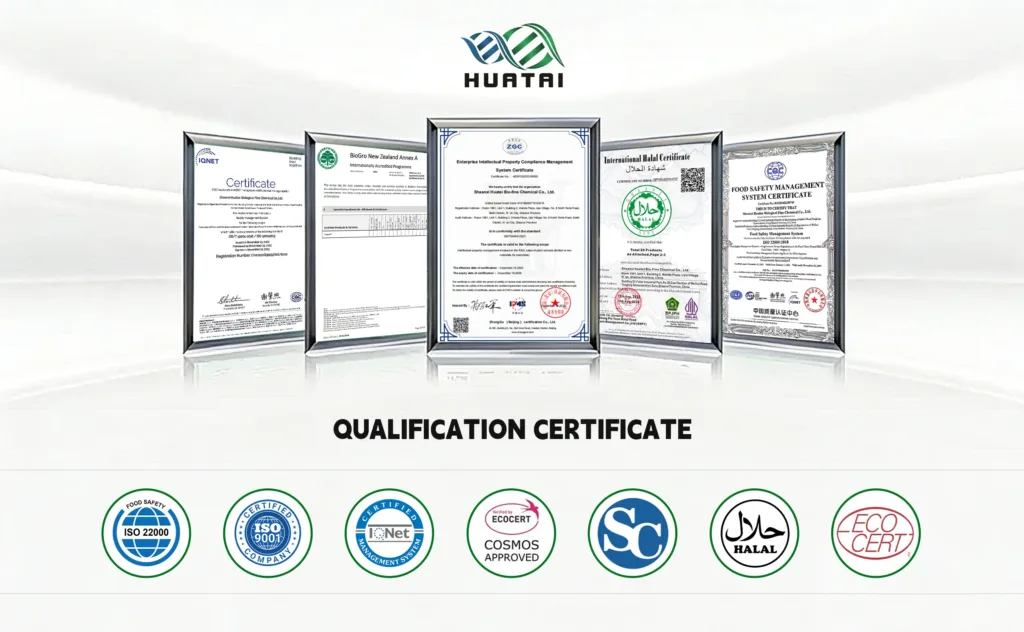
Huatai Bio provides a comprehensive portfolio of high-efficacy cosmetic active ingredients, empowering global brands to create next-generation skincare formulations for high-end skincare formulation needs.
Comprehensive Solutions & Innovation: Our categories cover the full spectrum of market requirements: Anti-aging & Firming, Oil-Control & Anti-acne, Anti-inflammatory & Soothing,Antioxidant Defense, Brightening,and Hydration & Barrier Repair.We offer both established classics and cutting-edge actives.
Driven by a passion for scientific excellence, our state-of-the-art R&D laboratory is dedicated to exploring the frontier of bio-active molecules. Beyond supplying ingredients, we offer end-to-end formulation consultancy and customized solution development. Our team of expert chemists works closely with your brand to overcome complex stability issues and sensory challenges, ensuring your final product stands out in a competitive global market.
Uncompromising Quality & Credibility:We ensure every batch of our Active skincare ingredients meets rigorous quality standards, including COSMOS, ISO 9001/22000, and HALAL Certification. This commitment, backed by a complete Technical Dossier, offers clinically-backed solutions and guaranteed compliance for every formulation challenge.


 English
 German
 Italian
 French
 Spanish
 Japanese
 Korean
 Russian