
Coenzyme Q10: Key Antioxidant Active for Your Anti-Aging Cream Product
Why do so many anti-aging creams fail to smooth out wrinkles after months of continuous use? The problem rarely lies in the brand’s intent. It lies in the energy crisis happening inside aging skin cells.
As skin cells age, their internal power plants (mitochondria) slow down. Without cellular energy, collagen production stalls, no matter how many surface humectants you apply. Coenzyme Q10 (CoQ10), or Ubiquinone, acts as the spark plug for this cellular engine.
As a manufacturer of professional cosmetic active ingredients, we see many formulators ruin CoQ10 batches due to poor solubility management or thermal damage. Let us explore how to successfully stabilize this intense orange molecule within a high-performance anti-aging cream.
The Solubility Dilemma: Crystal vs. Nano-Liposome
Pure CoQ10 is a vibrant orange crystalline powder. It is highly lipophilic (oil-loving) and completely insoluble in water. Here is the trick: it has a very low melting point of around 48 degrees Celsius. If you heat it too high, it degrades. If you add it incorrectly to the oil phase, it crystallizes as the cream cools, creating an unstable product that feels gritty on the skin.
To solve this, formulators must choose the right grade based on their manufacturing capabilities.
Active Material Specification Comparison
| Parameter | Coenzyme Q10 99% (Pure Grade) | Nano-Liposomal CoQ10 (Water-Dispersible) |
| Appearance | Yellow to orange crystalline powder | Orange to light yellow fluid liquid |
| Active Assay Content | Greater than or equal to 99.0% | 5.0% – 10.0% (Encapsulated) |
| Solubility Status | Soluble in hot cosmetic oils | Easily dispersible in cold water |
| Melting Point / Behavior | 48 – 52 degrees Celsius | Non-crystallizing liquid form |
| Loss on Drying | Less than or equal to 0.5% | Less than or equal to 5.0% |
| Heavy Metals | Less than or equal to 10 ppm | Less than or equal to 5 ppm |
If your factory utilizes high-shear homogenization equipment that can precision-control oil phase temperatures between 50 and 55 degrees Celsius, the 99% Pure Grade offers excellent cost-efficiency. If you are developing a cold-process emulsion or want to ensure rapid skin absorption, the Nano-Liposomal grade bypasses the oil-melting step entirely.
Formulation Strategy: The Active Energizing Night Cream
CoQ10 works best when paired with lipids that mimic the skin’s natural barrier. This allows the molecule to dissolve perfectly without separating over time.
Here is a functional, production-ready anti-aging cream formulation template:
CoQ10 Deep Cellular Renewal Cream Formula
| Phase | Ingredient | Function | Weight % |
| Phase A (Water) | Deionized Water | Solvent Base | Q.S. to 100% |
| Phase A | Glycerin | Humectant | 4.00% |
| Phase A | Xanthan Gum | Thickener | 0.20% |
| Phase B (Oil) | Caprylic/Capric Triglyceride | Emollient Carrier | 8.00% |
| Phase B | Squalane | Skin Identical Lipid | 4.00% |
| Phase B | Glyceryl Stearate | Emulsifier | 3.00% |
| Phase C (Active) | Coenzyme Q10 (Pure 99%) | Core Antioxidant | 0.20% – 0.50% |
| Phase C | Tocopheryl Acetate (Vitamin E) | Antioxidant Companion | 0.50% |
| Phase D (Cool Down) | Phenoxyethanol | Preservative | 0.60% |
Critical Manufacturing Steps
- Heat Phase A (Water Phase) to 75 degrees Celsius.
- Heat Phase B (Oil Phase) separately to 70 degrees Celsius until completely melted.
- Bring Phase B down to exactly 55 degrees Celsius. Add Phase C (CoQ10 and Vitamin E) into the warm oil. Stir until the orange powder dissolves fully into a clear, golden oil.
- Add the oil phase to the water phase under high-shear homogenization for 3 to 5 minutes to create the emulsion.
- Cool the batch gradually under gentle paddle stirring. Add the Phase D preservative when the temperature drops below 40 degrees Celsius.
Lab Data: Cellular Protection and Wrinkle Reduction
Does CoQ10 actually preserve collagen? In our cell culture testing, we exposed human dermal fibroblasts to controlled ultraviolet radiation (UV light) to simulate sun damage. We measured cell survival rates and the expression of collagen-destroying enzymes (MMP-1).
Fibroblast Survival and Tissue Matrix Breakdown Data:

Group 1: Control Cells (No UV Exposure)
  - Cell Survival Rate: 100%
  - MMP-1 Enzyme Level: Baseline (1.0x)

Group 2: UV-Exposed Cells (Unprotected)
  - Cell Survival Rate: 42%
  - MMP-1 Enzyme Level: Highly Elevated (4.8x)

Group 3: UV-Exposed Cells + 0.5% CoQ10 Treatment
  - Cell Survival Rate: 87%
  - MMP-1 Enzyme Level: Suppressed (1.6x)
The data shows that CoQ10 acts as a biological shield. It prevents UV light from turning on the specific enzymes that chop up skin collagen networks. Furthermore, combining CoQ10 with Vitamin E creates a powerful recycling loop; Vitamin E neutralizes the free radicals on the surface, while CoQ10 recharges the spent Vitamin E back into its active state.
Global Regulatory & Industry Compliance
Before finalizing your commercial packaging labels, ensure your formulation targets align with regional cosmetic laws.
- European Union (CosIng): Ubiquinone is fully approved for cosmetic use without restrictive concentration caps.
- United States (FDA/PCPC): Classified as safe for over-the-counter topical cosmetic application.
- China (IECIC 2021): Included in the approved inventory of cosmetic ingredients. Our production batches meet strict purity guidelines, ensuring compliance for export products.
The modern anti-aging market has shifted from basic moisture to proven ingredient synergy. Consumers look for visible color cues. The natural soft yellow-orange tint of a properly formulated CoQ10 cream communicates active functionality directly to the buyer.
If you are upgrading an existing product line or starting a new anti-aging cream project, high-purity raw materials determine your product’s shelf life. We supply premium cosmetic actives globally and can ship testing samples directly to your formulation lab. Reach out to our technical department to schedule a trial batch run.
Referenced Literature & Industry Sources
- Journal of Clinical Biochemistry and Nutrition: “Topical ubiquinone effectively switches on mitochondrial membrane potential in aging human skin fibroblasts.”
- BioFactors: “Coenzyme Q10, a cutaneous antioxidant and energizer: In vitro and in vivo studies on skin aging parameters.”
- International Journal of Cosmetic Science: “Synergistic antioxidant networks: Stabilization kinetics of ubiquinone and alpha-tocopherol in o/w emulsions.”
Empower Your Skin Science: Develop Next-Generation Formulations with Our Premium Active Ingredients.
Why choose us
Huatai Bio provides a comprehensive portfolio of high-efficacy cosmetic active ingredients, empowering global brands to create next-generation skincare formulations for high-end skincare formulation needs.
Comprehensive Solutions & Innovation: Our categories cover the full spectrum of market requirements: Anti-aging & Firming, Oil-Control & Anti-acne, Anti-inflammatory & Soothing,Antioxidant Defense, Brightening,and Hydration & Barrier Repair.We offer both established classics and cutting-edge actives.
Driven by a passion for scientific excellence, our state-of-the-art R&D laboratory is dedicated to exploring the frontier of bio-active molecules. Beyond supplying ingredients, we offer end-to-end formulation consultancy and customized solution development. Our team of expert chemists works closely with your brand to overcome complex stability issues and sensory challenges, ensuring your final product stands out in a competitive global market.
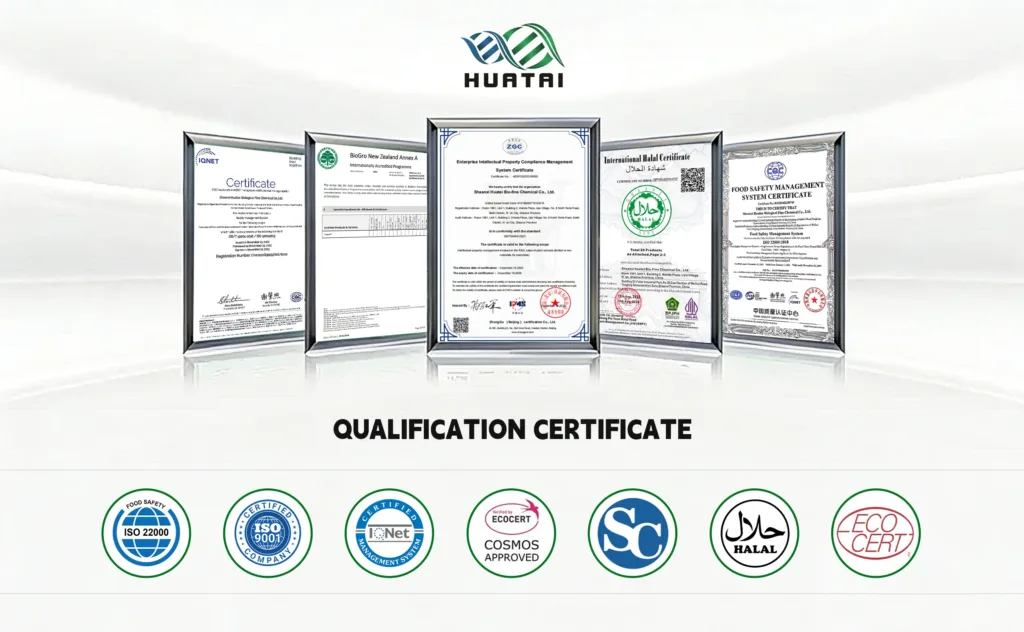
Uncompromising Quality & Credibility:We ensure every batch of our Active skincare ingredients meets rigorous quality standards, including COSMOS, ISO 9001/22000, and HALAL Certification. This commitment, backed by a complete Technical Dossier, offers clinically-backed solutions and guaranteed compliance for every formulation challenge.


 English
 German
 Italian
 French
 Spanish
 Japanese
 Korean
 Russian