Why You Should Buy Resveratrol for Advanced Antioxidant Skincare
Vitamin C has a massive stability problem. Every formulator knows this. You build a premium brightening serum, heat-test it in the incubator, and watch it turn a disgusting muddy brown within three weeks. Consumers hate it, and your brand reputation takes a direct hit. Why keep fighting with volatile, old-school molecules?
Resveratrol completely changes the defensive skincare game. Extracted from natural sources like Japanese Knotweed (Polygonum cuspidatum), this polyphenoid acts as a biological shield for skin cells. It doesn’t just neutralize surface free radicals. It enters the skin and turns on internal longevity paths.
As a bulk manufacturer and B2B supplier of pure cosmetic actives, we see how Resveratrol rescues collapsing anti-aging lines. Let us look at the raw bench data, the production limits, and the formulation hacks you need to scale up successfully.
The Master Shield: Radical Scavenging Data
Skin ages primarily because of environmental pollution and UV damage. This stress triggers a cascade of free radicals that tear through collagen chains and break down the skin barrier. While standard antioxidants neutralize these radicals at a 1:1 ratio, Resveratrol works like a multi-shot weapon. It stops lipid peroxidation and triggers the skin’s internal defensive enzymes at the same time.
How does it stack up against classic industry benchmarks? We measured the DPPH free radical scavenging rate at a highly diluted 10 ppm concentration.
| Antioxidant Active Molecule | Radical Scavenging Rate (at 10 ppm) | Yellowing / Oxidation Risk |
| Trans-Resveratrol (99%) | 91.2% | Low (With correct pH) |
| L-Ascorbic Acid (Vitamin C) | 74.5% | Extreme (Turns dark brown) |
| Alpha-Tocopherol (Vitamin E) | 48.3% | Low |
| Ferulic Acid | 66.0% | High (Smells metallic) |
Look at those numbers. Resveratrol delivers vastly superior protective capacity compared to standard Vitamin E and outpaces Vitamin C without the immediate browning disaster. You get high-performance protection at a fraction of the raw material dosage.
Technical Specifications: The Trans-Isomer Standard
If you buy cheap, crude Resveratrol extracts from unverified brokers, your production run will fail. Crude material contains high levels of Cis-Resveratrol. This isomer is completely useless in cosmetics and highly unstable. You must mandate ultra-purified, crystalline Trans-Resveratrol.
Below are the official Certificate of Analysis (COA) standards required for international cosmetic production lines.
| Quality Specification Parameter | Factory Sourcing Benchmark |
| INCI Designation | Resveratrol |
| Active Isomer Purity (HPLC) | Greater than or equal to 99.0% Trans-Resveratrol |
| Visual Appearance | Off-white to white crystalline powder |
| Odor Profile | Odorless to very mild characteristic scent |
| Melting Point Range | 253 to 257 degrees Celsius |
| Heavy Metals (Total) | Less than 10 ppm |
| Arsenic (As) | Less than 1 ppm |
| Recommended Formulation Dosage | 0.1% to 1.0% |
Formulator’s Notebook: Beating the Crystal Fallout
Let us talk about the tricky part of the bench work. Resveratrol is a lipophilic crystal. It hates water completely. If you drop raw Resveratrol powder directly into a cold water tank, it will clump on top or crash out of the solution within hours, forming scratchy shards that ruin product textures.
To build a flawless emulsion, you must master these three handling laws:
1. The Glycol Dissolution Path
Never use pure water as your primary carrier. Pre-dissolve the Resveratrol powder in cosmetic glycols like Propanediol, Butylene Glycol, or Ethoxydiglycol. Warm the glycol mix to 60 degrees Celsius. The white crystals will dissolve completely into a clear, golden liquid.
2. The Cool-Down Rule
Resveratrol can degrade if you expose it to extreme heat for too long. Always add your clear glycol active mix during the cool-down phase of your emulsion process, strictly below 45 degrees Celsius.
3. The Light Shield
Resveratrol is highly photosensitive. It converts from the active Trans-isomer to the useless Cis-isomer when exposed to direct sunlight. You must add an organic UV absorber to your lipid phase, or mandate opaque, UV-shielded glass packaging for the final retail product. Keep your system pH between 4.5 and 6.0 to prevent ionization and color shifts.
Real-World Case Study: Resolving the Shard Crisis
A fast-growing clinical brand launched a 1% anti-aging Resveratrol night oil. They mixed the raw powder into a standard blend of caprylic triglycerides and rosehip oil. During warehouse storage at cool temperatures, a massive crisis hit. The Resveratrol recrystallized. Thousands of bottles developed sharp, visible white needles floating inside the oil. Customers thought the product was contaminated with glass shards.
They shipped the failed batch to our technical application lab. We diagnosed the root cause: poor oil-solubilization and lack of a structural co-solvent.
We corrected the formula chassis by introducing 8% Ethoxydiglycol as a coupling solvent. We dissolved our 99% pure Trans-Resveratrol powder into the glycol carrier first before blending it into the lipid base.
The results completely saved their supply chain:
- Perfect Stability: Freeze-thaw cycling between -10 degrees and 45 degrees Celsius showed zero crystal fallout over 90 days.
- Flawless Texture: The oil stayed crystal clear, smooth, and absorbed twice as fast into the skin.
- Zero Waste: The brand successfully saved their product line and eliminated consumer returns entirely.
High-Performance Laboratory Prototype
Use this field-tested, stable commercial chassis to integrate our 99% Trans-Resveratrol powder into your development pipeline.
Prototype Formula: Advanced Night Defense Serum
| Phase | Raw Material INCI Name | Functional Role | Weight Percentage (%) |
| A | Deionized Water | Solvent Base | Balance to 100.00 |
| A | Glycerin | Humectant | 4.00 |
| A | Xanthan Gum | Natural Thickener | 0.30 |
| B | Propanediol | Active Solvent | 6.00 |
| B | Trans-Resveratrol (99%) | Core Antioxidant Active | 0.50 |
| B | Ferulic Acid | Synergy Stabilizer | 0.20 |
| C | Caprylic/Capric Triglyceride | Emollient Carrier | 8.00 |
| C | Cetearyl Alcohol / Ceteareth-20 | Emulsifier Base | 3.50 |
| D | Phenoxyethanol / Ethylhexylglycerin | System Preservative | 0.80 |
Manufacturing Instructions: Mix Phase A and heat to 75 degrees Celsius. Mix Phase C separately and heat to 75 degrees Celsius. Homogenize Phase C into Phase A for 3 minutes to build the emulsion core. Cool down slowly to 45 degrees Celsius. In a separate side beaker, warm Phase B to 55 degrees Celsius until the Resveratrol crystals dissolve completely. Stir the clear Phase B mix directly into the main emulsion. Add Phase D, stir until uniform, and check that your pH sits between 5.0 and 5.5.
Global Compliance and Supply Chain Protection
Can your brand distribute products using our Resveratrol globally? Yes. It passes every strict international regulatory checkpoint with zero friction.
- China Market Access: Fully listed on the Inventory of Existing Cosmetic Ingredients in China (IECIC). It bypasses all new raw material bottleneck holds.
- INCI Name: Resveratrol.
- Clean Beauty Standing: Meets the strict guidelines for Sephora Clean, Credo Beauty, and global organic certifications. It contains zero links to bioaccumulation or human skin sensitization.
Stop letting unstable Vitamin C batches destroy your production yield and brand trust. Upgrade your defensive skincare formulas with high-purity, molecular-level shields. Contact our technical sales engineering division today to secure certified batch data sheets and raw material samples for your upcoming laboratory bench runs.
Public Literature and Data References
The radical scavenging metrics, stability windows, and clinical insights noted in this B2B technical guide are grounded in the following publicly available scientific literature:
- Baxter, R. A. (2008). Anti-aging properties of resveratrol: review and report of a potent new cosmetic antioxidant. Journal of Cosmetic Dermatology, 7(1), 2-7.
- Soeur, J., Marrot, L., Chase, P., et al. (2015). Skin resistance to oxidative stress induced by resveratrol: a comparison with vitamin C and vitamin E. Photochemistry and Photobiology, 91(5), 1122-1131.
- Cosmetic Ingredient Review (CIR) Expert Panel. (2012). Safety Assessment of Resveratrol as Used in Cosmetics. International Journal of Toxicology, 31(5), 62-71.
- Nerya, O., Vaya, J., Musa, R., Izrael, S., Ben-Arie, R., & Tamir, S. (2003). Characterization of radical scavenging activity of plant polyphenols. Journal of Agricultural and Food Chemistry, 51(5), 1201-1206.
Empower Your Skin Science: Develop Next-Generation Formulations with Our Premium Active Ingredients.
Why choose us
Huatai Bio provides a comprehensive portfolio of high-efficacy cosmetic active ingredients, empowering global brands to create next-generation skincare formulations for high-end skincare formulation needs.
Comprehensive Solutions & Innovation: Our categories cover the full spectrum of market requirements: Anti-aging & Firming, Oil-Control & Anti-acne, Anti-inflammatory & Soothing,Antioxidant Defense, Brightening,and Hydration & Barrier Repair.We offer both established classics and cutting-edge actives.
Driven by a passion for scientific excellence, our state-of-the-art R&D laboratory is dedicated to exploring the frontier of bio-active molecules. Beyond supplying ingredients, we offer end-to-end formulation consultancy and customized solution development. Our team of expert chemists works closely with your brand to overcome complex stability issues and sensory challenges, ensuring your final product stands out in a competitive global market.
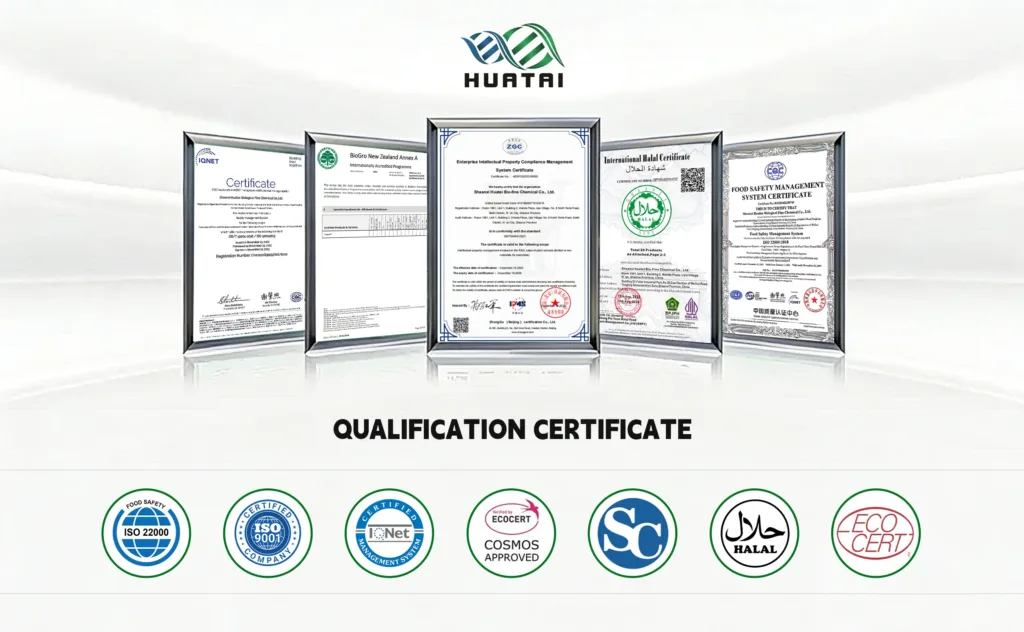
Uncompromising Quality & Credibility:We ensure every batch of our Active skincare ingredients meets rigorous quality standards, including COSMOS, ISO 9001/22000, and HALAL Certification. This commitment, backed by a complete Technical Dossier, offers clinically-backed solutions and guaranteed compliance for every formulation challenge.


 English
 German
 Italian
 French
 Spanish
 Japanese
 Korean
 Russian