
Totarol is a naturally occurring phenolic diterpene. It has been studied for many years in natural products chemistry and biological research. This article focuses on the identity, natural sources, and basic physicochemical characteristics of Totarol.
1. What Is Totarol?
Totarol is a phenolic diterpene found in several members of the Podocarpaceae family. One of the best-known natural sources is Podocarpus totara, a conifer native to New Zealand. The name Totarol is closely linked to this species.
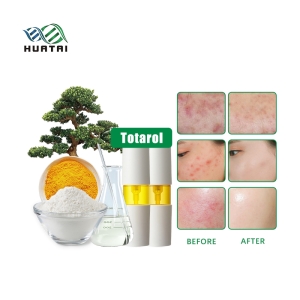
From a raw material perspective, there is an important distinction between Totarol and a Podocarpus extract. A plant extract is a mixture. Its composition depends on the plant material and extraction process. Purified Totarol, on the other hand, is a defined chemical compound with a specific molecular structure.
Basic chemical information is shown below:
| Property | Information |
|---|---|
| Chemical Name | Totarol |
| CAS Number | 511-15-9 |
| Molecular Formula | C20H30O |
| Molecular Weight | 286.45 g/mol |
| Chemical Class | Phenolic diterpene |
*These data describe the chemical identity of Totarol. They do not, by themselves, tell us whether a commercial batch is high quality. That requires analytical testing.
2. Where Does Totarol Come From?
Natural Totarol has been reported in the woody tissues of several Podocarpaceae species. Podocarpus totara is the source most closely associated with the compound. Other species, including Podocarpus nagi and Podocarpus macrophyllus, have also been reported as sources.
Does that mean the Totarol content is the same in every plant? No. Plant species, tissue, growing conditions, harvesting, and extraction can all affect the amount obtained. The extraction and purification process also has a direct impact on the composition of the final material.
This is why commercial Totarol is normally purified and standardized rather than treated simply as a botanical extract. For an ingredient buyer, the practical question is quite simple: what does the finished material actually contain? A COA (Certificate of Analysis) can provide part of that answer.
3. Chemical Structure and Physicochemical Characteristics
Totarol has a hydrophobic diterpene framework and one phenolic hydroxyl group. This structure helps explain an important formulation characteristic: Totarol is lipophilic and has limited solubility in water.
That matters during development. If a formulator is working on an aqueous serum, simply dispersing Totarol into the water phase is unlikely to be a practical solution. An oil phase or a suitable solvent system may be needed instead.
| Characteristic | Formulation Consideration |
|---|---|
| Lipophilic structure | Often more suitable for oil-containing systems |
| Limited water solubility | Direct incorporation into water is challenging |
| Phenolic hydroxyl group | Stability should be evaluated in the finished formula |
| Molecular weight: 286.45 g/mol | Useful for identification, but does not predict skin penetration on its own |
Note: Solubility and biological activity are not the same thing. A compound can show strong activity in a laboratory assay and still present practical challenges during formulation. That is why formulation data cannot simply be inferred from biological literature.
4. Why Has Totarol Attracted Scientific Interest?
Totarol has been studied for decades, particularly in natural products and microbiological research. Researchers have investigated several areas:
- Antimicrobial activity
- Antioxidant activity
- Anti-inflammatory activity
- Biofilm-related research
- Other biological effects under experimental conditions
A useful way to classify the evidence is by the type of study conducted:
| Evidence Type | What It Tells Us |
|---|---|
| In vitro studies | Activity under controlled laboratory conditions |
| Microbiological studies | Effects against selected microorganisms |
| Animal studies | Preclinical biological information |
| Human studies | Evidence closer to actual topical use |
This distinction becomes important when research findings are translated into cosmetic claims.
5. Totarol in Cosmetic Ingredient Research
Totarol has been explored for several personal care applications, including: Facial skincare, Cleansing products, Scalp care, and Deodorant.
The same ingredient can behave differently in different product formats. A low-water cream, an anhydrous system, and a clear aqueous serum do not create the same formulation environment. Solubility, concentration, processing conditions, and compatibility all need to be considered.
“Can Totarol be used in cosmetics?” is only the starting question.
The more useful question is: “Can it work in this particular formulation?”
6. Why Standardization Matters
Natural origin does not mean fixed composition. If Totarol is obtained from botanical material, differences in species, plant part, extraction, and purification can affect the final product. Commercial quality control therefore usually covers more than one test.
| Test Item | Common Analytical Approach |
|---|---|
| Assay | HPLC |
| Identification | HPLC and/or reference standard |
| Heavy Metals | ICP-MS or equivalent |
| Residual Solvents | Appropriate analytical method |
| Microbial Limits | Applicable microbiological methods |
| Moisture | Loss on Drying or equivalent |
When comparing two suppliers, purity is only one number. A 98% material and a 99% material should not automatically be treated as dramatically different products. The analytical method, specification limits, impurity profile, testing frequency, and batch consistency also matter.
7. What Should Be Considered When Evaluating Totarol?
For R&D and procurement teams, a practical evaluation can be divided into four areas:
| Evaluation Area | Key Questions |
|---|---|
| Identity | Is the material confirmed as Totarol? |
| Purity | What is the HPLC assay and acceptance criterion? |
| Quality | Are heavy metals, residual solvents, and microbiological limits controlled? |
| Formulation | Is the material compatible with the intended formulation system? |
The COA is particularly useful here. For a new supplier, it can also be useful to compare several batches rather than relying on a single test report. Batch consistency is a manufacturing question, not just a laboratory question.
8. Current Research and Industry Perspective
There is growing interest in plant-derived compounds with a clearly defined chemical identity. Purified natural molecules offer a different development route from complex botanical extracts. Their assay can be measured directly, and research results can be linked to a specific compound rather than an undefined group of extract constituents.
But purified does not automatically mean better. Extracts and purified compounds have different purposes. The right choice depends on the formulation, target application, available evidence, and regulatory requirements.
The gap between laboratory research and finished formulation is where ingredient science meets formulation science.
Frequently Asked Questions
Totarol is a naturally occurring phenolic diterpene found in several Podocarpaceae species, including Podocarpus totara.
No. Totarol is a defined chemical compound. It should be distinguished from a crude Podocarpus extract.
It has been reported in Podocarpus totara and several other Podocarpaceae species, including Podocarpus nagi and Podocarpus macrophyllus.
Totarol has limited water solubility and is generally considered lipophilic. Formulators need to consider an appropriate oil phase or solvent system.
Commercial specifications vary. High-purity materials, including 98% or higher grades, may be available. Confirm specific analytical methods with the supplier.
HPLC is commonly used for assay determination. Testing may also cover heavy metals, residual solvents, moisture, and microbiological limits.
Published research is largely based on laboratory and preclinical studies. Laboratory activity should not be treated as equivalent to proven finished-product efficacy.
Start with the technical specification and COA. Check the stated purity, analytical method, identity testing, manufacturing consistency, and regulatory documentation.
References
- PubChem. Totarol Compound Summary. National Center for Biotechnology Information. Chemical identity, molecular formula, molecular weight and structural information.
- Evans G.B., Furneaux R.H., Gravestock M.B., Lynch G.P., Scott G.K. The synthesis and antibacterial activity of totarol derivatives. Part 1: Modifications of ring-C and pro-drugs. Bioorganic & Medicinal Chemistry. 1999;7(9):1953-1964.
- Published research indexed in PubMed concerning Totarol, Podocarpus species, antimicrobial activity and related phenolic diterpenes.
- ISO 16128. Guidelines on technical definitions and criteria for natural and organic cosmetic ingredients and products.
- Supplier technical specifications and representative COA data. Used as supplementary information for commercial quality-control considerations. Specifications may differ between suppliers.


 English
 German
 Italian
 French
 Spanish
 Japanese
 Korean
 Russian