
Tocopherol for Skin: The Unseen Anchor of High-Performance Skincare
Let’s look at a common formulation disaster. You launch a premium botanical facial oil. Three months later on the retail shelf, it smells like rancid butter. The formula turned yellow. The culprit? Lipid peroxidation. The plant oils reacted with oxygen and light.
The fix is Tocopherol. It is not just another label claim to impress consumers. It is the chemical anchor that keeps your entire formula from falling apart. Do you want your active ingredients to survive until the consumer actually opens the bottle? You need to understand how Vitamin E behaves in complex matrices.
Let’s skip the basic marketing talk. We are going to look at the raw data, the exact specifications, and the chemical realities of formulation.
The Isomer Reality: Synthetic vs Natural
Many brands buy the cheapest Vitamin E available. That usually means synthetic dl-alpha-tocopheryl acetate. Does it work? Barely. The skin needs to convert the acetate form to active tocopherol. This biological conversion rate is extremely low. You are essentially putting a locked molecule on the skin and hoping the cellular enzymes find the key.
Natural Mixed Tocopherols contain four distinct isomers: alpha, beta, gamma, and delta. Here is the secret most formulators miss. Alpha-tocopherol is highly bioavailable for the human skin. However, Gamma-tocopherol and Delta-tocopherol are the true heavy lifters for protecting the formula itself in the bottle. Gamma targets nitrogen radicals that Alpha completely misses. You need the complete mixed matrix.
Specification Comparison: Natural vs Synthetic
| Feature | Synthetic (dl-alpha Acetate) | Natural Mixed Tocopherols (D-form) |
|---|---|---|
| Bioavailability | Low (Requires enzyme conversion) | High (Direct skin absorption) |
| In-Bottle Antioxidant Power | Very Poor (Molecule is capped) | Excellent (Active hydroxyl group) |
| Skin Antioxidant Power | Moderate | Superior |
| Source | Petrochemical derivatives | Vegetable oils (Soy, Sunflower) |
The Pro-Oxidant Trap: Why More is Not Better
Here is a rigorous correction to common formulation advice. Brands often think adding more Vitamin E equals better protection. This is chemically false.
When you push pure Tocopherol concentrations above 1.5 percent without a supporting antioxidant network, it can act as a pro-oxidant. It will actually accelerate lipid damage. For basic product preservation to prevent plant oils from oxidizing, use 0.1 percent to 0.5 percent. For active biological skin benefits like barrier repair and UV defense, formulate between 0.5 percent and 1.0 percent. Never blindly dump high percentages into a tank hoping for better results.
Real Application Case: The Vitamin C Multiplier
Vitamin C (L-Ascorbic Acid) is notoriously unstable. It breaks down rapidly in water. By itself, a 15 percent Vitamin C serum provides moderate protection against UV-induced damage.
We ran stability and efficacy models based on established dermatological data. When you add just 1 percent pure Natural Tocopherol to that 15 percent Ascorbic Acid base, a chemical regeneration loop occurs. When Vitamin E neutralizes a free radical, it becomes a depleted radical itself. Vitamin C then donates an electron to recharge the Vitamin E. They protect each other. This combination provides a 4-fold increase in photoprotection.
Formulation Insight: If you add 0.5 percent Ferulic Acid to this C plus E matrix, the photoprotection doubles again to an 8-fold increase. You are no longer just moisturizing the skin. You are actively shielding the cellular DNA from UV-induced apoptosis.
Product Data and Specifications
When sourcing cosmetic-grade tocopherol, purity and physical characteristics dictate how well it will blend into your emulsions. Below is standard batch data for our high-purity natural mixed tocopherols.
| Parameter | Specification Limit | Typical Test Result |
|---|---|---|
| Appearance | Clear, viscous, brownish-red oil | Complies |
| Total Tocopherols | Minimum 90.0 percent | 91.5 percent |
| d-Alpha Tocopherol | Minimum 10.0 percent | 14.2 percent |
| d-Gamma, d-Delta, d-Beta | Minimum 75.0 percent | 77.3 percent |
| Microbiological | Maximum 100 cfu/g | Less than 10 cfu/g |
Advanced Formulation Advice: Heat and Discoloration
Tocopherol is a thick oil. It loves lipids and hates water. Many formulators believe heat destroys Vitamin E instantly. This is not strictly true. Tocopherol can withstand temperatures up to 75 degrees Celsius for short periods during the oil phase melting process. However, to maximize its active lifespan in the final product, always add it during the cool-down phase strictly below 40 degrees Celsius.
Have you ever formulated a cream that slowly turned pink over three months? That pink hue is often Tocored, an oxidation by-product of Tocopherol. It means your Vitamin E did its job and sacrificed itself, but it also means your antioxidant system is overwhelmed. Fix this by adding a chelating agent like Disodium EDTA to bind free metals in your water phase, or lower the oxygen exposure during your mixing process.
Industry Trends and Global Compliance
Consumers read labels today. They flag synthetic additives immediately. The market is aggressively shifting away from petrochemical synthetics toward plant-derived sources. Furthermore, the industry is transitioning from soy-derived to sunflower-derived tocopherol. Sunflower eliminates GMO risks and bypasses soy allergen labeling requirements entirely, keeping your INCI list clean and dispute-free.
From a regulatory standpoint, Tocopherol is highly cooperative. The EU Cosmetic Regulation sets no strict upper safety limit for tocopherol. It is globally compliant across North America, Europe, and Asia.
Secure your formula’s shelf life and boost its UV defense profile simultaneously. We supply high-purity natural tocopherols built specifically for seamless cosmetic integration. Request a sample and put the raw oxidation data to the test in your own lab.
References and Public Data Sources:
- Lin, J.Y., Selim, M.A., Shea, C.R., et al. (2005). Ferulic acid stabilizes a solution of vitamins C and E and doubles its photoprotection of skin. Journal of Investigative Dermatology, 125(4), 826-832.
- Thiele, J.J., and Ekanayake-Mudiyanselage, S. (2007). Vitamin E in human skin: Organ-specific physiology and considerations for its use in dermatology. Molecular Aspects of Medicine, 28(5-6), 646-667.
- European Commission. CosIng database – Cosmetic ingredient information on Tocopherol and its regulatory status.
- Keen, M. A., and Hassan, I. (2016). Vitamin E in dermatology. Indian Dermatology Online Journal, 7(4), 311–315.
Empower Your Skin Science: Develop Next-Generation Formulations with Our Premium Active Ingredients.
Why choose us
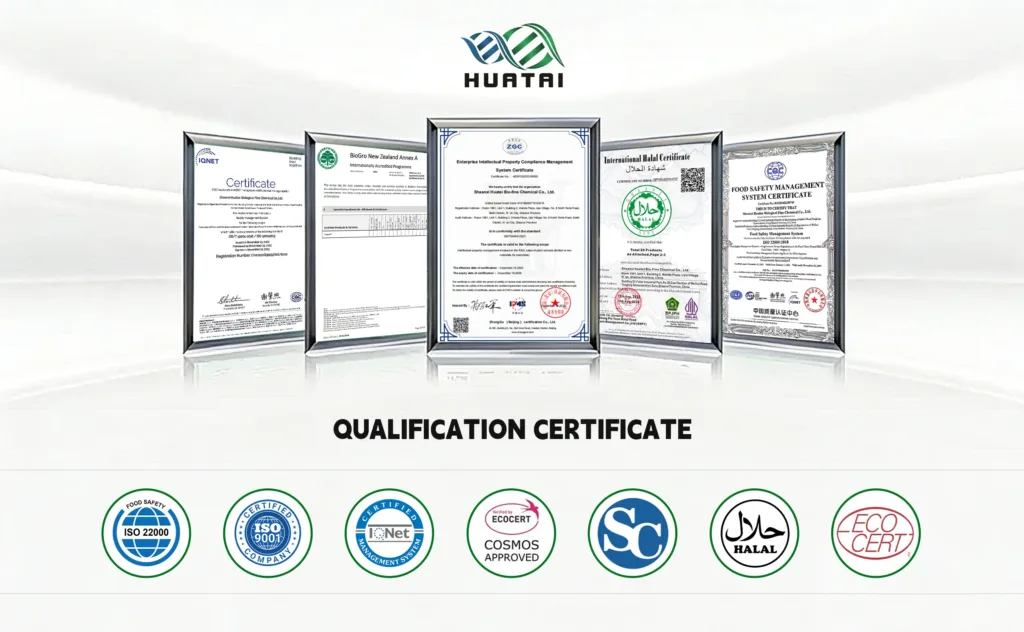
Huatai Bio provides a comprehensive portfolio of high-efficacy cosmetic active ingredients, empowering global brands to create next-generation skincare formulations for high-end skincare formulation needs.
Comprehensive Solutions & Innovation: Our categories cover the full spectrum of market requirements: Anti-aging & Firming, Oil-Control & Anti-acne, Anti-inflammatory & Soothing,Antioxidant Defense, Brightening,and Hydration & Barrier Repair.We offer both established classics and cutting-edge actives.
Driven by a passion for scientific excellence, our state-of-the-art R&D laboratory is dedicated to exploring the frontier of bio-active molecules. Beyond supplying ingredients, we offer end-to-end formulation consultancy and customized solution development. Our team of expert chemists works closely with your brand to overcome complex stability issues and sensory challenges, ensuring your final product stands out in a competitive global market.
Uncompromising Quality & Credibility:We ensure every batch of our Active skincare ingredients meets rigorous quality standards, including COSMOS, ISO 9001/22000, and HALAL Certification. This commitment, backed by a complete Technical Dossier, offers clinically-backed solutions and guaranteed compliance for every formulation challenge.


 English
 German
 Italian
 French
 Spanish
 Japanese
 Korean
 Russian