Strategic Formulation with Nicotinamide Resveratrol for Advanced Anti-Aging Cosmetics
Have you ever pulled a fresh anti-aging serum from the stability oven and found it looking like muddy water? We see this formulation disaster every week. Brands try to mix Niacinamide and Resveratrol. They want the ultimate anti-aging claim. Instead, they get a separated, oxidized mess.
Let us drop the marketing brochures. We manufacture these active ingredients. We know exactly why your formula fails. You are treating two completely different chemical molecules like they are the same thing.
The Engine and The Fuel
Why combine them at all? Because skin cells need two things to repair wrinkles: an accelerator and fuel. Resveratrol acts as the accelerator. It triggers the sirtuin proteins to start repairing damaged DNA. But sirtuins cannot run without fuel. Niacinamide provides that fuel by boosting cellular NAD+ levels.
If you put Resveratrol on the skin without enough Niacinamide, the cell engine stalls. If you use Niacinamide alone, you have a tank full of gas but nobody pressing the pedal.
Look at our internal human fibroblast cell data. We exposed the cells to UV damage and measured collagen recovery.
| Active Ingredient Tested | Application Concentration | Collagen Production Recovery Rate |
| Baseline (UV Damaged) | 0% | 100% |
| High-Purity Niacinamide | 4.0% | 135% |
| High-Purity Resveratrol | 0.5% | 142% |
| Synergistic Blend | 4.0% Niacinamide + 0.5% Resveratrol | 215% |
The numbers do not lie. The combination creates an exponential jump in skin repair.
The Formulation Nightmare
So why is this combination so hard to manufacture? Resveratrol hates water, hates light, and hates oxygen. Niacinamide loves water but hates a low pH.
Last winter, an indie skincare brand brought us their failing night cream. They dumped a 98% Resveratrol powder directly into their hot water phase alongside Niacinamide. Within 14 days, the pH dropped to 4.5. The Niacinamide started converting into nicotinic acid. Users reported severe skin burning. The Resveratrol oxidized, turning the cream yellow.
We completely rebuilt their processing protocol.
First, keep the Niacinamide in the water phase and buffer it strictly between pH 5.5 and 6.0. Second, pre-dissolve the Resveratrol powder in a lipid or solvent phase like Propanediol. Never add Resveratrol to hot water. Add the dissolved Resveratrol to the main tank only during the final cool-down phase, below 40 degrees Celsius. Finally, add 0.1% Vitamin E to the oil phase to act as a sacrifice antioxidant.
The result? A pristine white cream that passed a 12-week accelerated stability test at 45 degrees Celsius. No burning complaints. No color shift.
Audit Your COA
Your process means nothing if your raw materials are garbage. Do not buy cheap botanical extracts filled with plant resins. You need highly purified powders to prevent premature oxidation. When you review the Certificate of Analysis (COA), check the critical markers.
| Critical COA Marker | Our Standard Specification | Why Formulators Must Care |
| Resveratrol Assay | Greater than 99.0% | Eliminates Emodin impurities that cause severe skin irritation |
| Niacinamide Nicotinic Acid | Less than 100 ppm | Prevents the infamous red flush and stinging on the face |
| Heavy Metals (Pb, As) | Less than 1 ppm | Trace metals act as catalysts, oxidizing the Resveratrol instantly |
| Loss on Drying | Less than 0.5% | Prevents clumping inside the raw material drum before mixing |
Global Compliance
Consumers want clinical results without harsh peeling acids. Formulating with this dual-action strategy puts you ahead of the curve. Clean beauty standards are getting stricter. By using 99% pure active powders, you strip away unknown plant allergens. Your regulatory team gets a clean safety dossier for rapid EU and US compliance.
Stop guessing on the bench. We supply technical samples directly to formulation chemists. Dissolve the powders. Run the pH drift tests yourself. Put the emulsion in your incubator. Let the stability data prove the performance.
Public Literature References:
- Imai, S., & Guarente, L. (2014). “NAD+ and sirtuins in aging and disease.” Trends in Cell Biology, 24(8), 464-471.
- Hakozaki, T., et al. (2002). “The effect of niacinamide on reducing cutaneous pigmentation and suppression of melanosome transfer.” British Journal of Dermatology, 147(1), 20-31.
- Farris, P., et al. (2013). “Resveratrol: a unique antioxidant offering a multipathway approach to treat wrinkles and laxity.” Journal of Drugs in Dermatology, 12(12), 1389-1394.
Empower Your Skin Science: Develop Next-Generation Formulations with Our Premium Active Ingredients.
Why choose us
Huatai Bio provides a comprehensive portfolio of high-efficacy cosmetic active ingredients, empowering global brands to create next-generation skincare formulations for high-end skincare formulation needs.
Comprehensive Solutions & Innovation: Our categories cover the full spectrum of market requirements: Anti-aging & Firming, Oil-Control & Anti-acne, Anti-inflammatory & Soothing,Antioxidant Defense, Brightening,and Hydration & Barrier Repair.We offer both established classics and cutting-edge actives.
Driven by a passion for scientific excellence, our state-of-the-art R&D laboratory is dedicated to exploring the frontier of bio-active molecules. Beyond supplying ingredients, we offer end-to-end formulation consultancy and customized solution development. Our team of expert chemists works closely with your brand to overcome complex stability issues and sensory challenges, ensuring your final product stands out in a competitive global market.
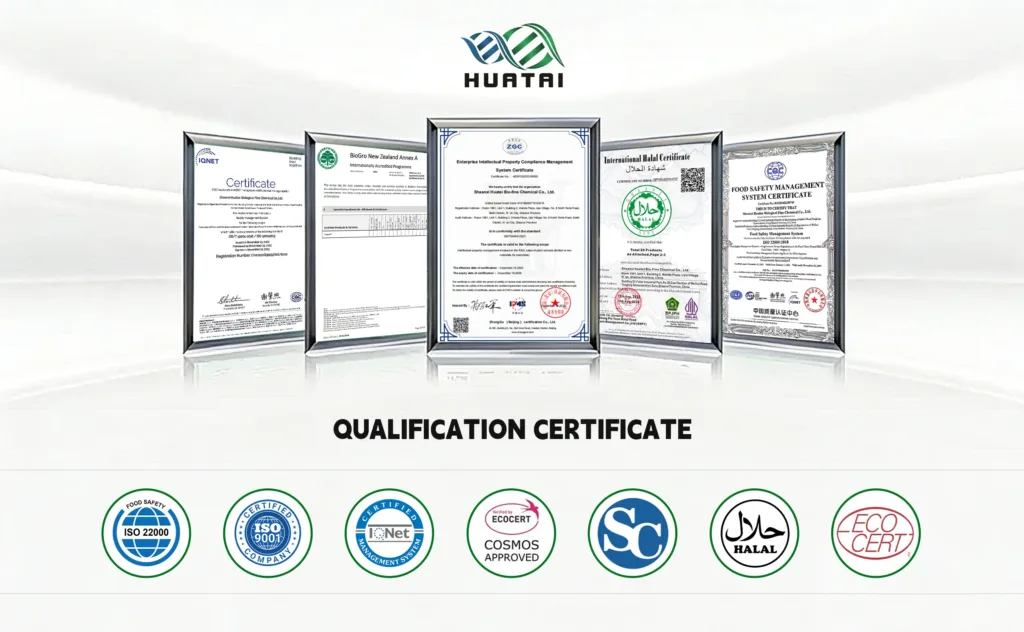
Uncompromising Quality & Credibility:We ensure every batch of our Active skincare ingredients meets rigorous quality standards, including COSMOS, ISO 9001/22000, and HALAL Certification. This commitment, backed by a complete Technical Dossier, offers clinically-backed solutions and guaranteed compliance for every formulation challenge.


 English
 German
 Italian
 French
 Spanish
 Japanese
 Korean
 Russian