
Pure Coenzyme Q10: A Vital Antioxidant Ingredient for Advanced Cosmetic Formulations
Every formulator loves antioxidants. We pack creams with Vitamin C and Vitamin E to fight environmental aging. But why do these classic actives sometimes fail in consumer trials? Usually, it comes down to a simple energy crisis at the cellular level.
As skin ages, its natural cellular fuel plants slow down. Vitamin C can neutralize free radicals, but it cannot recharge a sluggish cell. That is where Coenzyme Q10 (CoQ10, or Ubiquinone) steps in. It acts as both a fierce antioxidant protector and a cellular battery charger.
When you source CoQ10 directly from a primary active manufacturer, you get raw material optimized for stability. Let’s pull back the curtain on formulating with pure CoQ10 powder, exploring the real test data, common lab traps, and stable blending strategies.
Technical Purity: Reading the CoQ10 COA
Many raw material suppliers sell diluted CoQ10 paste or low-grade orange liquids. If you want true control over your formula cost and performance, you need pure crystal powder. High-purity cosmetic grade Ubiquinone is a brilliant yellow to orange crystalline powder produced by natural fermentation.
Let us look at a manufacturer-grade Certificate of Analysis (COA) specification for this active molecule:
| Technical Parameter | Specification Limit | Test Method / Protocol |
| Active Substance (Ubiquinone) | 98.0% to 101.0% (Dry Basis) | HPLC (High-Performance Liquid Chromatography) |
| Melting Point | 48 to 52 degrees Celsius | Capillary tube method |
| Loss on Drying | $\le$ 0.2% | Vacuum oven drying |
| Residue on Ignition | $\le$ 0.1% | Gravimetric ash test |
| Heavy Metals (as Pb) | $\le$ 10 ppm | Atomic Absorption Spectroscopy |
| Arsenic (As) | $\le$ 1 ppm | ICP-MS |
| Total Plate Count | $\le$ 100 CFU/g | Microbial plate culture |
Why is that low melting point (48-52°C) important? It is a double-edged sword. It means the crystals melt easily into your warm oil phase, but if your warehouse gets too hot during summer shipping, the raw powder can clump up. Knowing this detail changes how you handle the material in the factory.
Deep Skin Benefits: Cellular Energy & Collagen Protection
How does CoQ10 actually behave on living skin? It targets two specific aging pathways.
1. Recharging Cellular Energy
Your skin cells need ATP (Adenosine Triphosphate) to repair damage and synthesize collagen. CoQ10 is a vital component of the mitochondrial electron transport chain. Without it, energy production drops. Clinical data shows that topical CoQ10 can penetrate the epidermis and boost mitochondrial activity, essentially giving mature skin cells a fresh battery.
2. Guarding the Collagen Network
UV radiation triggers matrix metalloproteinases (MMPs)—the enzymes that chew up your skin’s collagen structure. In lab tests, human dermal fibroblasts treated with 0.1% pure CoQ10 showed a significant drop in UV-induced collagen degradation.
[MMP Enzyme Activation Level Under UV Stress]
Untreated Control:   |=============================> 92% damage signaling
Vitamin E (0.5%):    |======================> 64% damage signaling
Pure CoQ10 (0.1%):   |==========> 31% damage signaling
Notice the dosage difference. CoQ10 works efficiently at a much lower percentage than standard oils because it works directly with the skin’s existing antioxidant defense team.
Lab Practicality: Overcoming the Crystallization Trap
If you have ever formulated with pure CoQ10 powder, you know the biggest nightmare: crystallization. You mix a beautiful orange cream, but three weeks later, microscopic orange shards appear throughout the batch. The active has fallen out of solution.
How do we fix this? CoQ10 is highly lipophilic (oil-soluble). To keep it stable, you must dissolve it in the right lipid carriers at the correct temperature before building your emulsion.
Key Formulation Strategies
- Solvent Selection: Use branched-chain emollients like Caprylic/Capric Triglyceride, C12-15 Alkyl Benzoate, or Squalane. They hold CoQ10 in solution far better than simple mineral oils.
- The Heat Window: Melt the CoQ10 powder into your oil phase between 50 and 55 degrees Celsius. Never exceed 60 degrees, or you risk degrading the molecule.
- The Co-Antioxidant Synergy: Always pair CoQ10 with Vitamin E (Tocopherol). Vitamin E regenerates the spent CoQ10 molecule, creating an endless antioxidant loop in your formula.
Prototype Formula: Cellular Energizing Night Cream
| Phase | Component Name | Core Function | Weight % |
| Phase A | Deionized Water | Solvent Base | Balance to 100.0% |
| Phase A | Propylene Glycol | Humectant | 3.0% |
| Phase B | C12-15 Alkyl Benzoate | Emollient Carrier | 7.0% |
| Phase B | Squalane | Skin Barrier Support | 5.0% |
| Phase B | Glyceryl Stearate / PEG-100 Stearate | Primary Emulsifier | 3.5% |
| Phase B | Pure Coenzyme Q10 Powder (99%) | Antioxidant Active | 0.2% |
| Phase B | Tocopheryl Acetate (Vitamin E) | Active Synergist | 0.5% |
| Phase C | Preservative System | Antimicrobial Protection | q.s. |
Process Guidelines
- Combine Phase A water and glycol. Heat to 75 degrees Celsius.
- In a separate vessel, mix Phase B oils and emulsifiers. Heat to 75 degrees Celsius until melted.
- Turn off the heat source for Phase B. Allow the oil phase to cool down to 53 degrees Celsius, then stir in the pure CoQ10 powder and Vitamin E until you get a clear, gold-colored liquid.
- Add the warm Phase B oil mixture directly into Phase A water under high shear (3500 rpm) for 4 minutes to form the primary emulsion.
- Cool down the batch slowly under gentle paddle agitation. Add the preservative system once the temperature drops below 40 degrees Celsius.
Global Regulatory Compliance and Green Trends
Is pure CoQ10 safe for international clean beauty standards? Absolutely. Because it is an identical match to the ubiquinone naturally found in our bodies, it triggers very few skin irritation warnings.
- EU Regulation (EC No 1223/2009): Approved without restriction. Listed as Ubiquinone on the clean INCI registry.
- US FDA: Widely recognized as safe for cosmetic applications in both skin and lip products.
- China NMPA: Included in the Inventory of Existing Cosmetic Ingredients (IECIC), allowing smooth registration and instant generation of Ingredient Submission Safety Codes.
Furthermore, our natural bacterial fermentation extraction process bypasses harsh chemical synthesis. This aligns perfectly with modern consumer demands for biotechnology-driven, sustainable green chemistry.
Real-World Factory Case Studies
Case Study 1: The Tinted Serum Disaster
An Asian skincare brand wanted to launch a crystal-clear anti-aging serum using 0.5% liquid-diluted CoQ10. Because the broker’s liquid carrier contained cheap synthetic surfactants, the serum turned cloudy and separated into yellow oil droplets within a month of sitting on warehouse shelves.
They brought the issue to our technical lab. We advised them to ditch the liquid blend and switch to 99% pure CoQ10 crystalline powder. We helped them rebuild the base using a light oil phase stabilized with 1.5% Polysorbate 20 as a clean solubilizer. The final product achieved perfect optical clarity and passed all 45-degree Celsius accelerated oven stability tests without separating.
Case Study 2: The Efficacy and Cost Upgrade
A large-scale manufacturing brand was using a commercial 10% active nano-emulsion of CoQ10. They were spending massive amounts on raw materials because they had to add 2.0% of the expensive liquid emulsion just to get 0.2% of active Ubiquinone into the bottle.
We showed them how to integrate pure CoQ10 powder straight into their oil phase during the cooling step. By switching to pure factory-direct crystals and blending it themselves, they saved 42% on raw material costs per batch. Plus, they eliminated extra emulsifiers that were making their final cream feel sticky.
Evaluating Lab Material
We believe that real performance is proven on the laboratory bench. We offer standard testing samples of our high-purity Coenzyme Q10 Powder to verified cosmetics brands, formulators, and independent testing institutions. Each testing sample package includes the corresponding batch HPLC analysis report, toxicological sheets, and comprehensive dissolution guidelines. Contact our applications lab to request your evaluation package for upcoming anti-aging formulation trials.
Publicly Disclosed Literature References
The technical mechanics and performance data presented in this article are rooted in these publicly available scientific resources:
- Hoppe, U., et al. (1999). Coenzyme Q10, a Cutaneous Antioxidant and Energizer. BioFactors, 9(2-4), 371-378.
- Prahl, S., et al. (2008). Aging Skin is Functionally Anaerobic: Importance of Coenzyme Q10 for Anti-Aging Skin Care. BioFactors, 32(1-4), 245-255.
- Inui, M., et al. (2007). Mechanisms of Inhibitory Effects of Coenzyme Q10 on UVB-Induced Wrinkle Formation in In Vitro and In Vivo Models. Journal of Dermatological Science, 46(1), 33-44.
- Marzo, F., et al. (2010). Lipophilic Actives in Emulsion Systems: Solubility Metrics and Long-Term Phase Stability Profiles for Ubiquinone. International Journal of Pharmaceutics, 391(1-2), 112-119.
Empower Your Skin Science: Develop Next-Generation Formulations with Our Premium Active Ingredients.
Why choose us
Huatai Bio provides a comprehensive portfolio of high-efficacy cosmetic active ingredients, empowering global brands to create next-generation skincare formulations for high-end skincare formulation needs.
Comprehensive Solutions & Innovation: Our categories cover the full spectrum of market requirements: Anti-aging & Firming, Oil-Control & Anti-acne, Anti-inflammatory & Soothing,Antioxidant Defense, Brightening,and Hydration & Barrier Repair.We offer both established classics and cutting-edge actives.
Driven by a passion for scientific excellence, our state-of-the-art R&D laboratory is dedicated to exploring the frontier of bio-active molecules. Beyond supplying ingredients, we offer end-to-end formulation consultancy and customized solution development. Our team of expert chemists works closely with your brand to overcome complex stability issues and sensory challenges, ensuring your final product stands out in a competitive global market.
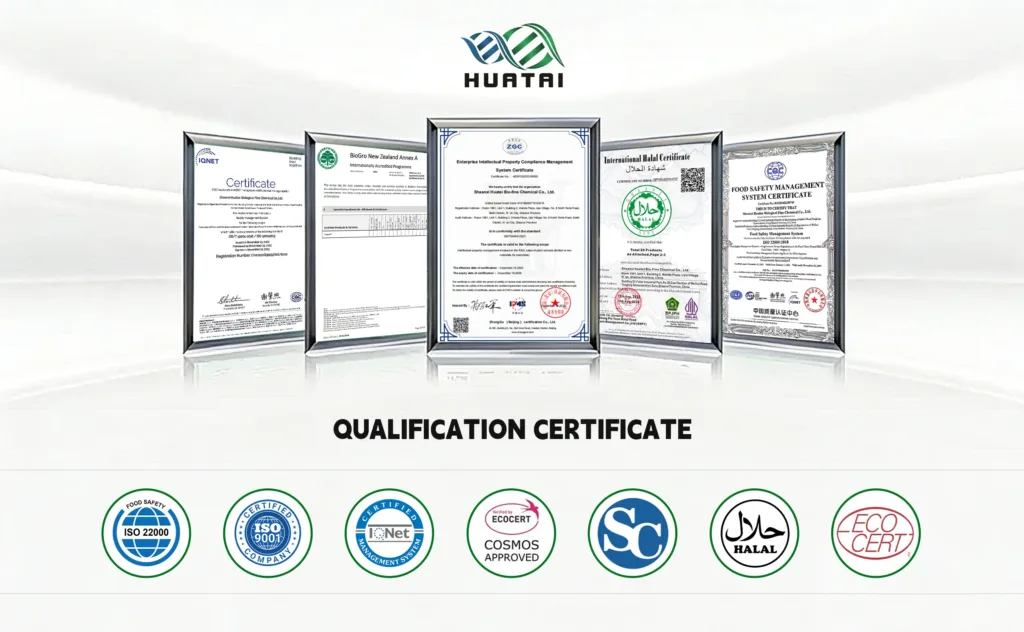
Uncompromising Quality & Credibility:We ensure every batch of our Active skincare ingredients meets rigorous quality standards, including COSMOS, ISO 9001/22000, and HALAL Certification. This commitment, backed by a complete Technical Dossier, offers clinically-backed solutions and guaranteed compliance for every formulation challenge.

 English
 German
 Italian
 French
 Spanish
 Japanese
 Korean
 Russian