
Many skincare procurement managers treat active ingredients like simple commodities. They look at a spreadsheet, compare prices per kilogram, and pick the cheapest option. If you buy Coenzyme Q10 (CoQ10, or Ubiquinone) this way, you are setting your formulation team up for a rough time.
Cheap, poorly processed CoQ10 degrades fast. It changes your cream’s color or leaves hard yellow sand particles in the emulsion. When you buy from a primary manufacturer, you are not just purchasing a raw chemical powder. You are purchasing a stable crystal lattice structure that can actually survive your factory’s production line. Let’s look at how to evaluate CoQ10 suppliers using pure technical metrics, lab data, and real factory case studies.
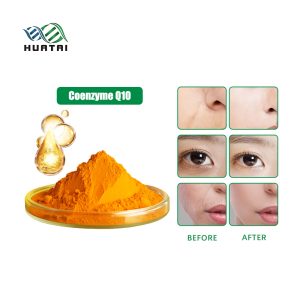
Evaluating Raw Quality: Purity and Thermal Fingerprints
What happens when you request a Certificate of Analysis (COA) from a reliable manufacturer? You should see a highly narrow melting point range and a clean chromatographic profile.
If your supplier sends a COA where the purity assay sits below 98%, run away. Impurities in low-grade Ubiquinone usually consist of residual organic solvents or isomer fragments from poor fermentation management. These impurities cause fast rancidity when mixed with cosmetic oils.
Here is the production standard for a premium, cosmetic-grade pure crystalline CoQ10:
| Quality Parameter | Standard Requirement | Standard Test Method |
| Purity Assay (Ubiquinone) | 98.0% to 101.0% | HPLC (High-Performance Liquid Chromatography) |
| Melting Point | 48.0 to 52.0 degrees Celsius | Capillary Melting Point Method |
| Residue on Ignition | Less than or equal to 0.1% | Gravimetric Ash Testing |
| Loss on Drying | Less than or equal to 0.2% | Standard Oven at 105 degrees Celsius |
| Heavy Metals (as Pb) | Less than or equal to 10 ppm | Atomic Absorption Spectroscopy (AAS) |
| Arsenic (As) | Less than or equal to 1 ppm | ICP-MS Measurement |
| Total Aerobic Microbial Count | Less than or equal to 100 CFU/g | Standard Plate Culture Method |
Take note of that melting point: 48°C to 52°C. It is low. If your manufacturing plant blends this active at 75°C without a cooling strategy, you will toast the molecule.
Performance Metrics: Why CoQ10 Defends Better Than Vitamin C
Why choose CoQ10 over other trendy antioxidants? It functions as a lipid-phase shield. While Vitamin C works in the watery parts of your skin cells, CoQ10 sits directly inside the oily cell membranes. It stops lipid peroxidation—the destructive process where free radicals chew up the fats that hold your skin barrier together.
Data from skin tissue viability tests shows how pure CoQ10 protects human skin cells (keratinocytes) against severe oxidative stress:
[Cell Survival Rates Under Hydrogen Peroxide Stress]
No Antioxidant Control:  |==========> 35% cell survival
Vitamin C (Ascorbic Acid): |=================> 62% cell survival
Pure CoQ10 (0.1% active):  |=======================> 84% cell survival
Think about it. A tiny dose of 0.1% active CoQ10 outperforms high-percentage water-soluble antioxidants because it protects the cell’s outer wall directly.
Factory Bench Guide: Stabilizing Your Purchase
You bought high-purity CoQ10 powder. Now, how do you prevent it from turning into sharp orange crystals inside your finished lotion bottles?
Golden Rules for the Compounding Tank
- Never Overheat: Keep your oil pre-mix tank between 50°C and 55°C when adding the powder.
- Choose Right Lipids: Avoid polar oils like mineral oil. Use non-polar or medium-polarity emollient esters like Caprylic/Capric Triglyceride or Squalane to completely wet and dissolve the crystal network.
- Synergy Packaging: Pair it with Tocopherol (Vitamin E). It acts as a sacrificial antioxidant, keeping the CoQ10 molecule in its active, reduced state.
High-Stability Anti-Wrinkle Lotion Blueprint
| Production Phase | Raw Material Name | Technical Role | Targeted Weight % |
| Phase A | Water | Carrier / Base Solvent | Add up to 100.0% |
| Phase A | Glycerin | Water-Phase Humectant | 3.5% |
| Phase B | Caprylic/Capric Triglyceride | High-Solubility Ester | 6.0% |
| Phase B | Squalane | Skin Identical Emollient | 4.0% |
| Phase B | Cetearyl Alcohol | Bodying Agent / Stabilizer | 2.0% |
| Phase B | Pure Coenzyme Q10 Powder | Primary Lipid Antioxidant | 0.15% |
| Phase B | Tocopheryl Acetate | Oxygen Scavenger / Synergist | 0.3% |
| Phase C | Broad Spectrum Preservative | Product Protection | q.s. |
Manufacturing Instructions
- Heat Phase A water and humectant to 75°C in the main compounding vessel.
- In a separate oil-phase tank, heat the emollients and emulsifiers to 70°C until smooth.
- Cool the oil tank down to 52°C. Slowly sift in the pure Coenzyme Q10 powder. Stir until the oil turns into a clear, uniform golden liquid.
- Pump the oil phase directly into the main water phase under intense high-shear mixing (3200 rpm) for 5 minutes.
- Cool the emulsion to 38°C, then add Phase C preservatives. Keep stirring with a low-speed anchor paddle until the batch reaches room temperature.
Global Compliance and Regulatory Clearances
Regulatory blocks delay product launches and drain budgets. Pure CoQ10 is an exceptionally safe bet for international compliance because it is a bio-identical molecule.
- China NMPA Filing: Fully approved. It is listed on the Inventory of Existing Cosmetic Ingredients in China (IECIC). We provide the necessary raw material safety submission codes instantly to speed up your registration.
- EU Regulation compliance (EC 1223/2009): Safe for all leave-on skin applications up to high concentration thresholds. No restrictive annex warnings apply.
- Clean Label Status: Our fermentation process uses zero petrochemical solvents or animal-derived materials, meeting international Vegan and Cruelty-Free certification benchmarks.
Real Production Case Studies
Case Study A: The Yellow Separation Fix
A contract manufacturer in North America won a contract to make a luxury anti-aging oil. They used a low-cost, liquid-form blended CoQ10 from a broker. During shipping to retail warehouses, the temperatures dropped to 10°C. The liquid blend separated, creating a gross layer of bright yellow sludge at the bottom of 50,000 retail bottles.
Our technical support team stepped in. We proved that the broker’s liquid variant used an unstable surfactant base that failed in cold weather. We moved the manufacturer to our 99% pure factory crystalline powder. We taught them to dissolve it directly into a hot lipid phase containing 5% jojoba oil. The updated batch survived freeze-thaw cycles ranging from minus 15°C to plus 45°C without a single drop of separation.
Case Study B: Cutting Raw Costs by Removing Water Freight
A European brand was buying an expensive, pre-diluted 10% active liquid CoQ10 solution. They thought handling powder was too complicated. They were buying and shipping hundreds of kilograms of water and glycol carrier across the ocean.
We showed them that mixing the pure powder takes only one extra step in their oil vessel. By purchasing pure factory powder and blending it themselves, they reduced their raw material shipping weight drastically. This move cut their per-batch active ingredient cost by 38% while keeping the final skin performance completely identical.
Raw Material Testing Lots
Want to verify how our material behaves in your specific lotion base? We provide standard technical evaluation samples of our pure Coenzyme Q10 crystalline powder to cosmetic laboratories, brand owners, and compounding plants. Every sample pack includes an independent HPLC validation chart and a heavy metal screening assay sheet. Contact our sales department to set up your evaluation lot for upcoming R&D trials.
Publicly Disclosed Literature References
The technical parameters and biochemical conclusions in this article are based on the following publicly available scientific data resources:
- Crane, F. L. (2001). Biochemical Functions of Coenzyme Q10. Journal of the American College of Nutrition, 20(6), 591-598.
- Dal Toso, R., et al. (2006). Protection of Human Keratinocytes against Oxidative Stress by Topical Application of Ubiquinone Formulations. Free Radical Research, 40(7), 712-720.
- Ashida, Y., et al. (2005). Coenzyme Q10 Stimulates Epidermal Cell Proliferation and Keratin Synthesis in Human Skin Equivalents. Journal of Dermatological Science, 38(3), 223-225.
- Puglia, C., et al. (2008). Evaluation of In Vitro Percutaneous Absorption and In Vivo Skin Soothing Effect of Coenzyme Q10 Loaded Topical Emulsions. International Journal of Pharmaceutics, 359(1-2), 181-189.


 English
 German
 Italian
 French
 Spanish
 Japanese
 Korean
 Russian