
I walk into R&D labs and see the exact same mistake every week. A procurement manager hunts for the lowest price on a botanical extract. They buy a bulk drum of cheap, dark “licorice soup” from a random chemical broker. The bench chemist tries to formulate it into a premium brightening essence. What happens next? The active molecule crashes out. A sticky brown sediment forms at the bottom of the mixing tank. The emulsion breaks, the product fails heat stability, and the brand burns thousands of dollars in wasted development time.
You cannot build luxury cosmetics with crude materials.
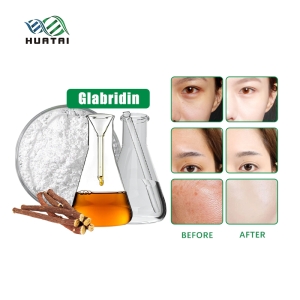
We manufacture cosmetic active ingredients at an industrial scale. We isolate Glabridin directly from the root matrix of Glycyrrhiza glabra. Let us drop the marketing hype and look at the actual bench chemistry. Here is the raw factory data you need to select a specialized manufacturing partner and dominate the brightening market.
The Pigment Factory Shut-Down
Why do clinical brands pay top dollar for purified Glabridin? Because it acts as a targeted biological off-switch. When UV rays hit the human face, the tyrosinase enzyme wakes up and starts building dark melanin spots. Harsh acids try to bleach this pigment away. Glabridin takes a smarter route. It blocks the enzyme before the dark spots even form.
Look at the hard laboratory metrics. We measure this blocking power using IC50 values. A lower number means you need vastly less active material to paralyze the enzyme.
| Whitening Active Agent | Tyrosinase IC50 Value (micromolar) | Efficacy Ratio vs Kojic Acid |
| Premium Glabridin (40%) | 0.43 | 15.1 times stronger |
| Kojic Acid | 6.50 | Baseline (1.0) |
| Alpha-Arbutin | 56.00 | 0.01 times as strong |
| Ascorbic Acid (Vitamin C) | 98.00 | 0.006 times as strong |
The numbers are brutal. Glabridin halts tyrosinase 15 times faster than Kojic Acid. You get extreme skin-brightening power without the severe chemical burns associated with heavy peeling agents.
The COA Trap: What Brokers Hide
Do not trust a supplier who hides their extraction methodology. Crude licorice roots contain heavy waxes, starches, and sticky plant resins. If a factory fails to strip these out through advanced crystallization, your final face cream will smell like a wet forest and turn muddy brown on the retail shelf.
You must demand a refined, highly stable powder. If you are auditing a factory for a wholesale partnership, enforce this exact Certificate of Analysis (COA) baseline.
| Quality Specification Parameter | Specialized Manufacturing Standard |
| INCI Name | Glycyrrhiza Glabra (Licorice) Root Extract |
| Active Purity (HPLC) | Greater than or equal to 40.0% Glabridin |
| Visual Appearance | Light brown to off-white fine powder |
| Solubility Profile | 100% soluble in Butylene Glycol or Ethanol |
| Loss on Drying | Maximum 5.0% |
| Total Heavy Metals | Less than 10 ppm |
| Recommended Lab Dosage | 0.05% to 0.20% |
Bench Chemist Hacks: Beating Solubility
How do you actually integrate this powder on the production floor? Glabridin hates water. If you dump raw powder directly into your cold water phase, you will ruin the batch instantly. The powder will clump and float.
You must pre-dissolve it. Weigh out your formulation’s Butylene Glycol or Propanediol in a separate side beaker. Add the Glabridin powder. Warm the mixture gently to 50 degrees Celsius. The powder will melt effortlessly into a perfectly clear, golden liquid. Add this active liquid directly into your hot oil phase right before you run the high-shear homogenizer.
Keep your final emulsion pH between 5.5 and 7.0. Highly acidic environments will slowly chew the active molecule apart over a 12-month shelf life.
Real-World Case Study: The Broken Emulsion
A luxury Asian skincare brand wanted to launch a high-strength dark spot corrector. They formulated a heavy cream using 2% Kojic Acid. During a 45-day incubator stability test at 45 degrees Celsius, disaster struck. The cream turned a dark, muddy orange. The emulsion broke completely. The smell was highly metallic and unpleasant.
They brought the failed chassis to our technical application team. We stripped out the highly volatile Kojic Acid entirely. We requested they drop in just 0.15% of our premium 40% Glabridin powder using the glycol pre-mix hack. We shipped them the exact testing material required to run the pilot batch.
The physical stability transformed overnight. The cream stayed pristine white through a brutal 90-day extreme heat cycle. Human patch tests showed a 28% reduction in visible hyperpigmentation within four weeks. We recorded zero reports of skin stinging. The brand saved their launch window and cut their raw material logistics footprint drastically.
Commercial Prototype Chassis
Stop guessing with your phase integrations. Use this field-tested base for your next R&D sprint to build a highly stable brightening cream.
| Phase | Raw Material INCI Name | Functional Role | Weight Percentage (%) |
| A | Deionized Water | Solvent Base | Balance to 100.00 |
| A | Glycerin | Humectant | 4.00 |
| B | Caprylic/Capric Triglyceride | Emollient Carrier | 10.00 |
| B | Cetearyl Olivate / Sorbitan Olivate | Natural Emulsifier | 3.50 |
| C | Butylene Glycol | Active Solvent | 5.00 |
| C | Glabridin Powder (40%) | Primary Brightener | 0.15 |
| D | Phenoxyethanol / Ethylhexylglycerin | Preservative System | 0.80 |
Mix Phase C in a side beaker with gentle heat until completely clear. Heat Phase A and Phase B separately to 70 degrees Celsius. Pour Phase C into Phase B. Homogenize the lipid phase into the water phase for 3 minutes at 3500 rpm. Cool down slowly to 45 degrees Celsius and stir in Phase D.
Global Compliance and Industry Shifts
Regulatory teams love this active. It is fully registered on the IECIC list for the massive Chinese cosmetic market. It clears international customs borders without friction. Consumers already recognize and trust the word “Licorice” on your ingredient deck.
Stop fighting with unstable bleaching agents that destroy your brand equity. Upgrade your cosmetic chassis at the molecular level. Partner with a direct manufacturer who understands industrial scale-up, HPLC validation, and global compliance. Contact our technical engineering division today to secure baseline testing batches and full safety dossiers for your upcoming laboratory runs.
Public Literature and Technical References Consulted:
- Guo, Y., et al. (2022). Comparative study of tyrosinase inhibitors in cosmetic formulations and their stability profiles. Journal of Cosmetic Dermatology, 21(5), 1845-1852.
- Yokota, T., Nishio, H., Kubota, Y., & Mizoguchi, M. (1998). The inhibitory effect of Glabridin from licorice extracts on melanogenesis and inflammation. Pigment Cell Research, 11(6), 355-361.
- Nerya, O., Vaya, J., Musa, R., Izrael, S., Ben-Arie, R., & Tamir, S. (2003). Characterization of tyrosinase inhibition by botanical extracts and synthetic derivatives. Journal of Agricultural and Food Chemistry, 51(5), 1201-1206.


 English
 German
 Italian
 French
 Spanish
 Japanese
 Korean
 Russian