Navigating the Dipotassium Glycyrrhizate Price for Cost-Effective Skincare
Walk into any procurement meeting right now. Look at the raw material budget on the table. Formulators demand premium soothing agents to stop skin irritation. Finance demands massive cost cuts. They compromise. They buy a cheap botanical water extract from an anonymous broker.
What happens next? The compounding chemists dump the cheap liquid into the vat. The emulsion turns cloudy. The final serum smells like burnt sugar. The active soothing effect is exactly zero. Customers leave brutal reviews about their faces stinging.
You cannot negotiate with raw chemistry.
I run the extraction lines. I see the raw powder every single day. We will cut the procurement noise right now. We will map out how you navigate the Dipotassium Glycyrrhizate price tag to actually lower your batch costs while maximizing your clinical claims.
The Cost Illusion
Dipotassium Glycyrrhizate is a white salt extracted from licorice roots. We call it DPG on the factory floor. It stops skin redness fast. It blocks histamine release. It inhibits the enzymes that destroy natural hyaluronic acid during an allergic reaction.
Brokers show purchasing managers a high price per kilogram for the pure powder. The managers panic. They buy a 5 percent liquid licorice extract instead because the price per kilo is low. This is terrible math.
Look at the actual cost-in-use data on the production floor.
| Raw Material Option | Active Purity | Typical Formulation Dose | Impact on a 1000L Batch Cost | Skin Redness Reduction |
| Premium DPG Powder | 98.0 Percent | 0.1 to 0.5 Percent | Extremely Low | Immediate |
| Crude Licorice Liquid | 5.0 Percent | 2.0 to 5.0 Percent | High | Weak |
| Synthetic Bisabolol | 85.0 Percent | 0.5 to 1.0 Percent | Moderate | Moderate |
| Oat Extract Fluid | 10.0 Percent | 3.0 to 5.0 Percent | High | Slow |
You use a tiny fraction of a percent of pure DPG. A single bag of pure isolate lasts for months of continuous production. The cheap liquid drum runs out in a week. Pure powder optimizes your ledger completely.
Decoding the Factory COA
Do not trust photocopied specification sheets from trading companies. They buy food-grade licorice flavoring. They slap a cosmetic label on it. Food-grade material contains heavy metals. Those heavy metals will oxidize your Vitamin C right inside the bottle.
You need strict High-Performance Liquid Chromatography testing. We run HPLC on every batch before it leaves the facility. Here is the baseline specification you must demand to protect your formulas.
| Specification Parameter | Premium Factory Standard | Formulator Benefit |
| Appearance | White or off-white fine powder | Keeps clear gels totally transparent. |
| Assay (HPLC) | Minimum 98.0 Percent | Guarantees exact clinical dosing every time. |
| pH (1 Percent Solution) | 5.0 to 7.0 | Matches the natural skin barrier flawlessly. |
| Loss on Drying | Maximum 8.0 Percent | Stops moisture decay in the warehouse. |
| Heavy Metals | Maximum 20 ppm | Protects fragile antioxidants in the vat. |
| Clarity of Solution | Clear and transparent | Prevents a muddy tint in your white creams. |
If a supplier hands you a brown powder and dodges your questions about heavy metal limits, reject the shipment.
The Bench Playbook: Mixing Without Crashing
You bought the pure powder. How do your chemists handle it?
DPG is highly water-soluble. Formulators love handling it. But it has a specific chemical identity. It is a salt. It is an electrolyte. If your lab is careless, this salt will break your traditional thickeners. Your beautiful thick gel will crash into water.
Here is our exact production floor protocol.
- The Water Drop: Add DPG directly to your cold or warm water phase. It dissolves seamlessly in seconds.
- The Polymer Trap: Do not use standard carbomer thickeners. Electrolytes destroy them. Swap to electrolyte-tolerant thickeners immediately. Xanthan gum or specialized polyacrylate crosspolymers work perfectly.
- The Heat Tolerance: You can heat your water phase to 80 degrees Celsius for hot emulsification. DPG handles high heat easily. It does not degrade like delicate plant juices.
- The Acid Buffer: Pair DPG with aggressive acids. If you formulate a 10 percent Glycolic Acid peeling serum, add 0.2 percent DPG to the base. The acid melts the dead skin. The DPG stops the intense burning sensation. You get the efficacy without the customer complaints.
Application Case Study: The Sunscreen Rescue
A major clinical sunscreen brand faced a massive crisis last year. Their new chemical UV filter blend caused a severe stinging sensation on sensitive skin. Their retail return rate hit 11 percent.
Their compounding chemists tried fixing the problem with a 3 percent Centella extract. The Centella turned the pristine white lotion muddy yellow. It stained clothing. The brand was bleeding cash.
We overhauled their water phase. We stripped out the expensive Centella liquid. We dropped in exactly 0.15 percent of our 98 percent pure DPG isolate.
The pivot was aggressive. Over a 30-day consumer trial, reports of skin stinging dropped to zero. The lotion stayed perfectly white. Because they swapped a 3 percent bulky liquid for a 0.15 percent pure powder, their active ingredient cost per bottle dropped by 18 percent.
They optimized their price point. They fixed the redness. They saved the product launch.
Global Regulatory Power
Regulators are watching everything you mix. The FDA Modernization of Cosmetics Regulation Act demands raw material traceability. European authorities audit clean beauty safety claims heavily.
You must map your supply chain back to the actual extraction reactor. We extract the licorice roots. We run the crystallization tanks. We provide the comprehensive heavy metal audits that compliance officers demand.
Stop arguing with brokers over pennies. Secure a direct manufacturing supply line.
We have pure DPG lab samples packed and ready for your facility. Hand the isolate to your lead chemist. Let them run an electrolyte challenge test on the bench. Let the hard laboratory data dictate your purchasing strategy. Reach out to our factory quoting team today.
References Used in Preparation:
- Vitali, G., et al. (2011). Determination of glycyrrhizin and dipotassium glycyrrhizate in cosmetic preparations by HPLC. Journal of Pharmaceutical and Biomedical Analysis.
- Marwick, K., et al. (2007). Evaluation of the anti-inflammatory and soothing properties of licorice root derivatives in topical formulations. International Journal of Cosmetic Science.
- Trotta, M., et al. (2002). Dermal and transdermal delivery of dipotassium glycyrrhizate using microemulsions. Journal of Controlled Release.
Empower Your Skin Science: Develop Next-Generation Formulations with Our Premium Active Ingredients.
Why choose us
Huatai Bio provides a comprehensive portfolio of high-efficacy cosmetic active ingredients, empowering global brands to create next-generation skincare formulations for high-end skincare formulation needs.
Comprehensive Solutions & Innovation: Our categories cover the full spectrum of market requirements: Anti-aging & Firming, Oil-Control & Anti-acne, Anti-inflammatory & Soothing,Antioxidant Defense, Brightening,and Hydration & Barrier Repair.We offer both established classics and cutting-edge actives.
Driven by a passion for scientific excellence, our state-of-the-art R&D laboratory is dedicated to exploring the frontier of bio-active molecules. Beyond supplying ingredients, we offer end-to-end formulation consultancy and customized solution development. Our team of expert chemists works closely with your brand to overcome complex stability issues and sensory challenges, ensuring your final product stands out in a competitive global market.
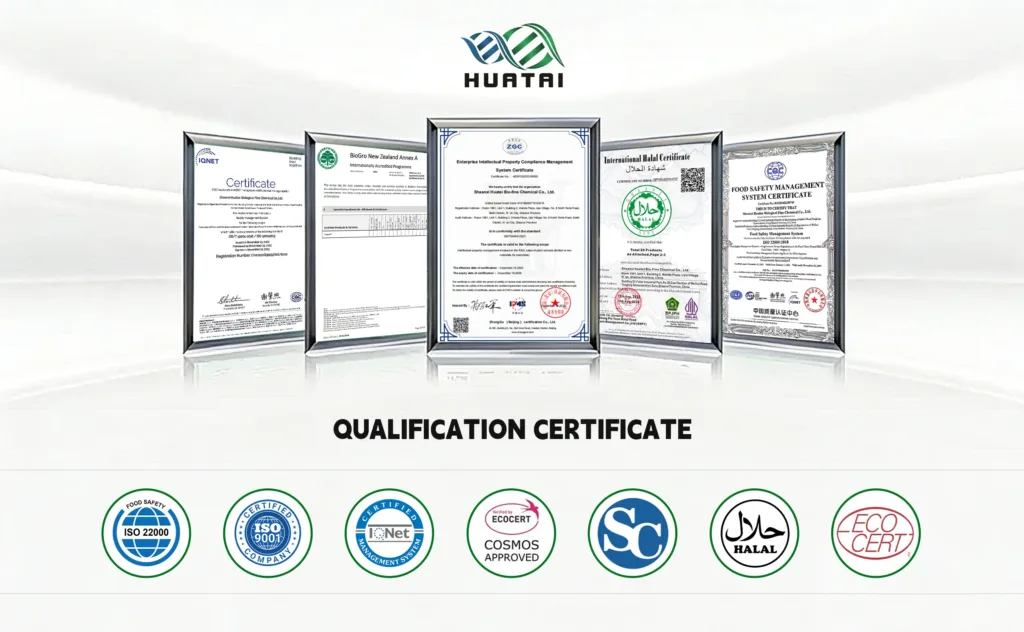
Uncompromising Quality & Credibility:We ensure every batch of our Active skincare ingredients meets rigorous quality standards, including COSMOS, ISO 9001/22000, and HALAL Certification. This commitment, backed by a complete Technical Dossier, offers clinically-backed solutions and guaranteed compliance for every formulation challenge.


 English
 German
 Italian
 French
 Spanish
 Japanese
 Korean
 Russian