
In the competitive landscape of cosmetic ingredients, particle size specification represents one of the most critical yet frequently overlooked factors determining an active ingredient’s performance and bioavailability. For Licochalcone A—a potent anti-inflammatory and soothing compound derived from licorice root—particle size distribution directly influences not only formulation stability and sensory characteristics but, more importantly, its biological efficacy and skin penetration capabilities. Understanding this relationship is essential for brands seeking to develop truly effective skincare products that deliver measurable results to consumers.
The transition from simply incorporating active ingredients to optimizing their delivery and performance represents a significant advancement in cosmetic science. Particle engineering has emerged as a key discipline in this evolution, enabling formulators to overcome traditional challenges associated with botanical extracts.

The Fundamental Relationship Between Particle Size and Performance
Particle size affects multiple aspects of ingredient performance, from initial formulation through final biological activity. For Licochalcone A, these relationships are particularly significant due to its specific mechanisms of action and application in sensitive skin formulations.
Physical Stability Considerations:
- Sedimentation Rate: Larger particles settle more quickly, potentially leading to inhomogeneous formulations and inconsistent dosing
- Aggregation Tendency: Particle size distribution influences the potential for clumping and aggregation during storage
- Dispersion Characteristics: Smaller particles typically disperse more uniformly through formulations
Sensory Impact:
- Texture and Feel: Particle size directly affects perceived texture, with smaller particles generally providing smoother application
- Visual Appearance: Larger particles may cause visible particulates or affect product opacity
- Skin Feel: Optimal particle size contributes to positive sensory experiences during application
Particle Size Specifications and Measurement Standards
Professional manufacturers utilize standardized systems for defining and controlling particle size specifications.
Common Specification Parameters:
- D50 Value: The median particle size where 50% of particles are smaller and 50% are larger
- Size Distribution Range: The range between D10 and D90 values, indicating distribution width
- Maximum Particle Size: The largest allowable particle size in the distribution
Measurement Methodologies:
- Laser Diffraction: Provides comprehensive size distribution analysis
- Dynamic Light Scattering: Suitable for sub-micron particle measurement
- Microscopic Analysis: Offers visual verification and shape assessment
Bioavailability Optimization Through Particle Engineering
The relationship between particle size and bioavailability represents the most significant consideration for formulators seeking maximum efficacy.
Skin Penetration Mechanisms:
- Transepidermal Absorption: Smaller particles demonstrate enhanced ability to penetrate the stratum corneum
- Follicular Delivery: Optimal particle sizes can target hair follicles for alternative absorption pathways
- Cellular Uptake: Particle size influences intracellular delivery and biological activity
Enhanced Bioavailability Strategies:
- Nanoization: Reduction to sub-micron sizes significantly increases surface area and dissolution rate
- Surface Modification: Chemical treatments can enhance wettability and compatibility
- Advanced Dispersion Technologies: Innovative processing methods improve distribution and stability
Formulation Considerations for Different Particle Sizes
The optimal particle size varies depending on specific formulation types and application methods.
Serums and Lightweight Formulations:
- Recommended Size: 1-20 micrometers for optimal dispersion and absorption
- Considerations: Balance between stability and penetration enhancement
- Special Requirements: Often benefit from smaller particle sizes for rapid absorption
Creams and Emulsions:
- Recommended Size: 10-50 micrometers for stability in complex systems
- Considerations: Compatibility with emulsifier systems and other ingredients
- Special Requirements: May require specific surface treatments for optimal distribution
Specialized Delivery Systems:
- Encapsulated Forms: Particle size considerations for both core and shell materials
- Liposomal Formulations: Size optimization for vesicle stability and delivery efficiency
- Advanced Carriers: Considerations for particulate carriers and their size requirements
Quality Control and Consistency Assurance
Maintaining consistent particle size distribution requires sophisticated manufacturing controls and quality systems.
Manufacturing Process Controls:
- Milling and Processing Parameters: Precise control of grinding and classification processes
- Environmental Conditions: Temperature and humidity control during processing
- Equipment Calibration: Regular verification of processing equipment performance
Quality Verification Methods:
- Routine Testing: Batch-by-batch particle size analysis
- Stability Monitoring: Assessment of particle size changes during storage
- Comparative Analysis: Regular comparison against reference standards
Regulatory and Safety Considerations
Particle size specifications may have regulatory implications depending on target markets and applications.
Safety Assessment:
- Dermal Penetration: Understanding how particle size affects skin absorption and potential systemic exposure
- Microbiological Considerations: Potential impact on preservative efficacy and microbial growth
- Stability Implications: Relationship between particle size and chemical stability
Documentation Requirements:
- Specification Justification: Scientific rationale for chosen particle size ranges
- Safety Data: Evidence supporting safety of the specified particle size
- Quality Controls: Documentation of manufacturing controls and testing methods
Shaanxi Huatai Bio-Fine Chemical Co., Ltd.: Precision Engineered Particle Solutions
At Shaanxi Huatai Bio-Fine Chemical Co., Ltd., we recognize that particle size optimization is essential for maximizing ingredient performance and formulation success. Since our establishment in 2008, we have developed advanced particle engineering capabilities that ensure our Licochalcone A extracts deliver optimal bioavailability and formulation characteristics.
Our particle size management includes:
- Precision Engineering: Advanced milling and classification technologies that allow precise control over particle size distribution
- Comprehensive Testing: Rigorous particle size analysis using laser diffraction and other advanced methodologies
- Customization Options: Ability to provide specific particle size ranges tailored to individual formulation requirements
- Stability Assurance: Processes designed to maintain particle size stability throughout product shelf life
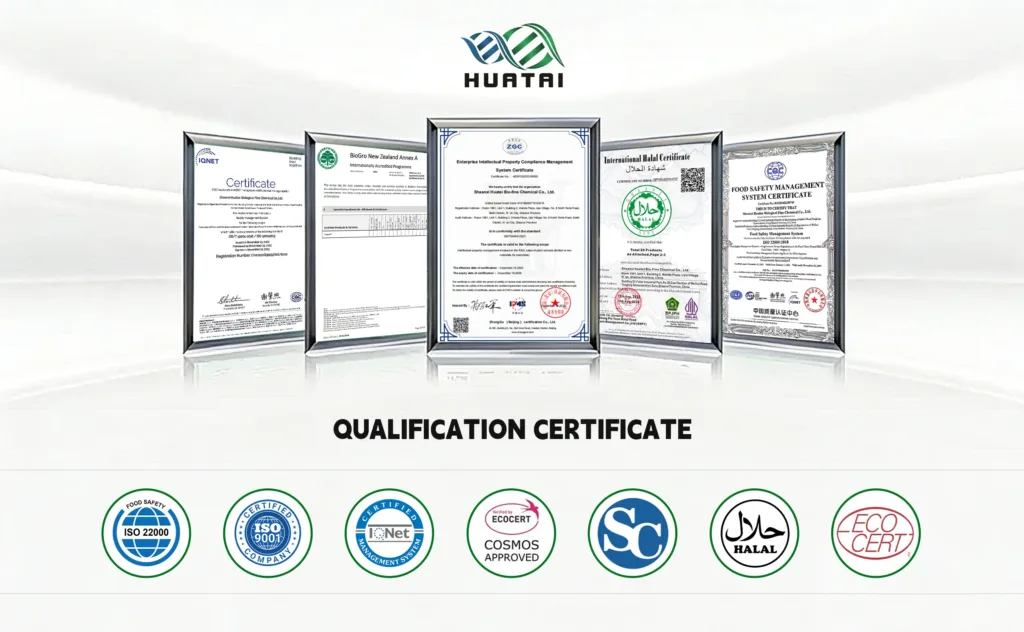
Our commitment to quality excellence is demonstrated through our COSMOS, ISO 9001/22000, and HALAL certifications, ensuring that every batch of Licochalcone A meets the highest international standards for quality and performance.
Our core portfolio includes Glabridin, Licochalcone A, Totarol, and Dipotassium Glycyrrhizate, widely recognized for their effectiveness in whitening, anti-inflammatory, anti-aging, and repairing formulations. As a leading manufacturer, we are dedicated to empowering skincare brands and OEMs with innovative, reliable, and sustainable actives for next-generation skincare solutions.
Making Informed Particle Size Decisions
Selecting the appropriate particle size specification requires careful consideration of formulation goals, application methods, and performance requirements.
Key Decision Factors:
- Formulation Type: Different product forms have optimal particle size ranges
- Target Application: Leave-on versus rinse-off products have different requirements
- Performance Goals: Balancing immediate effects with long-term benefits
- Consumer Preferences: Sensory characteristics and application experience
Implementation Strategy:
- Prototype Testing: Evaluating different particle sizes in formulation prototypes
- Performance Validation: Conducting bioavailability and efficacy testing
- Scale-up Considerations: Ensuring manufacturing feasibility and consistency
Conclusion: Optimizing Performance Through Particle Science
Particle size specification represents a powerful tool for enhancing Licochalcone A performance and bioavailability. By understanding and leveraging the relationship between particle characteristics and biological activity, brands can develop superior products that deliver measurable benefits to consumers.
The investment in proper particle size optimization provides significant returns through improved product efficacy, enhanced consumer satisfaction, and stronger market positioning.
Ready to explore how particle size optimization can enhance your formulations? Contact Shaanxi Huatai Bio-Fine Chemical Co., Ltd. today. Our technical team is ready to provide detailed information about our particle engineering capabilities and support your formulation development.
Reach out to us to discuss your specific requirements, request technical documentation, and discover how our precision-engineered Licochalcone A can elevate your product performance.




 English
 German
 Italian
 French
 Spanish
 Japanese
 Korean
 Russian