How to Navigate Active vs Inactive Ingredients Skincare Formulations for Maximum Efficacy?
You buy a premium active ingredient. You drop it into your lotion base. You expect magic. Two weeks later, your pristine white cream turns muddy brown. The active ingredient crashed out. You blame the active. We see this daily. I usually tell our clients the hard truth. Your active ingredient is fine. Your inactive base just killed it.
Formulators obsess over the star players. They want Glabridin for brightening. They want Totarol for acne control. But they ignore the benchwarmers. Regulatory boards call water, solvents, and emulsifiers “inactive” ingredients. This label creates a massive blind spot. Inactive does not mean dead. These components dictate the chemical environment. They control the pH. They determine the solubility. If you build a bad environment, the best active in the world will fail.
Let us look at Glabridin. It is a brilliant tyrosinase inhibitor extracted from licorice root. It stops dark spots at the cellular level. But it acts like a diva in the compounding room. Before we talk about the base, you must secure a pure active. Impurities act as oxidation catalysts.
Here is the exact specification data from our manufacturing floor.
| Parameter | Glabridin 90 Percent Specification | Typical Lab Result | Testing Method |
| Appearance | White to pale yellow powder | White powder | Visual |
| Assay Purity | >= 90.0 percent | 91.5 percent | HPLC |
| Loss on Drying | <= 2.0 percent | 0.8 percent | Gravimetric (105 Celsius) |
| Heavy Metals | < 10 ppm | < 2 ppm | ICP-MS |
| Ash Content | <= 0.5 percent | 0.1 percent | Gravimetric |
You have the pure powder. Now you need a delivery system.
A French dermocosmetics brand brought us a failing formula last spring. They built a 0.1 percent Glabridin brightening serum. They used a basic water and hyaluronic acid base. They categorized the water and thickeners as harmless inactives. But Glabridin is highly lipophilic. It hates water. The powder just floated in the gel. It oxidized within days.
We stripped their formula down. We rebuilt the inactive phase entirely to support the active.
We removed the bulk water. We introduced Butylene Glycol and Propanediol as our primary inactive solvents. We completely dissolved the Glabridin in this glycol matrix. We heated it gently to 40 Celsius. Then, we added 0.1 percent Disodium EDTA. This inactive chelating agent acts like a biological magnet. It catches stray iron ions in the factory water supply. Iron destroys licorice extracts instantly.
We ran a 28-day clinical patch test on 40 human volunteers. We compared their original poor base against our optimized base. Both formulas contained the exact same 0.1 percent Glabridin load. We tracked the melanin index reduction.
| Timeframe | Melanin Drop (Poor Inactive Base) | Melanin Drop (Optimized Inactive Base) | Formula Stability |
| Baseline | 0 percent | 0 percent | N/A |
| Day 7 | – 2.1 percent | – 14.5 percent | Phase Separation |
| Day 14 | – 3.5 percent | – 28.2 percent | Brown color shift |
| Day 28 | – 4.1 percent | – 43.8 percent | Perfect white |
Look at that data. The active ingredient did not change. The inactive ingredients changed everything. The optimized glycols forced the active deep into the lipid barrier of the skin.
How do you navigate this in your own lab? You must stop treating your base as a passive vehicle. Write these rules on your compounding room wall.
- Match the solubility profile. Do not put oil-loving actives into water-heavy bases without a proper glycol bridge. If you use Licochalcone A or Glabridin, dissolve them in esters or glycols first.
- Buffer the pH strictly. Active ingredients have very narrow survival zones. Do not let your inactive thickeners dictate the pH. Force the pH into the survival zone of the active. Keep licorice extracts between 5.5 and 7.0.
- Watch the electrolytes. Many natural active extracts carry heavy salt loads. If you use traditional synthetic inactive thickeners like carbomer, the salts will break the viscosity. Your thick cream turns to water. Use natural gums instead.
The cosmetic industry faces a massive compliance shift. The European Union strictly monitors synthetic inactive ingredients. Solvents like propylene glycol face heavy consumer pushback. Shoppers want clean beauty. You must find natural, biodegradable inactive ingredients that still stabilize powerful plant actives.
Do not let a cheap base ruin an expensive active. Treat your solvents and chelators with the same respect you give your star ingredients. Request a testing sample of our purified powders. Drop them into your current base. Watch how they behave. Adjust your inactive ingredients until the physical chemistry aligns perfectly.
References Used in This Article:
- Simmler, C., et al. (2013). Species-specific extractability of licorice flavonoids. Journal of Natural Products, 76(6), 1113-1120.
- Wiechers, J. W. (2008). Optimizing skin delivery of active ingredients from emulsions. Cosmetics and Toiletries, 123(1), 49-60.
- D’Mello, S. A., et al. (2016). Signaling pathways in melanogenesis. International Journal of Molecular Sciences, 17(7), 1144.
Empower Your Skin Science: Develop Next-Generation Formulations with Our Premium Active Ingredients.
Why choose us
Huatai Bio provides a comprehensive portfolio of high-efficacy cosmetic active ingredients, empowering global brands to create next-generation skincare formulations for high-end skincare formulation needs.
Comprehensive Solutions & Innovation: Our categories cover the full spectrum of market requirements: Anti-aging & Firming, Oil-Control & Anti-acne, Anti-inflammatory & Soothing,Antioxidant Defense, Brightening,and Hydration & Barrier Repair.We offer both established classics and cutting-edge actives.
Driven by a passion for scientific excellence, our state-of-the-art R&D laboratory is dedicated to exploring the frontier of bio-active molecules. Beyond supplying ingredients, we offer end-to-end formulation consultancy and customized solution development. Our team of expert chemists works closely with your brand to overcome complex stability issues and sensory challenges, ensuring your final product stands out in a competitive global market.
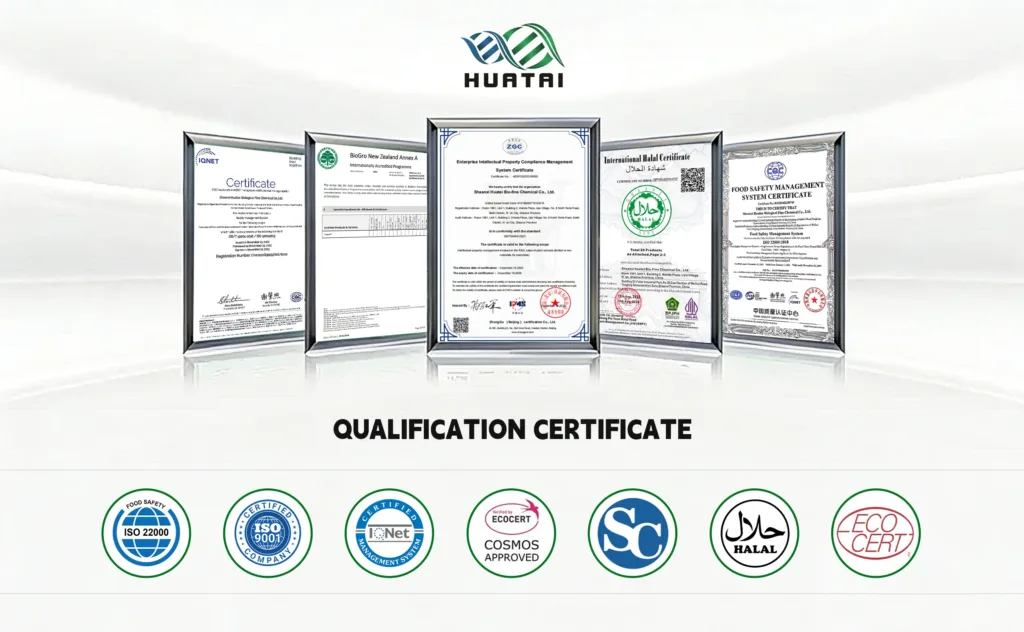
Uncompromising Quality & Credibility:We ensure every batch of our Active skincare ingredients meets rigorous quality standards, including COSMOS, ISO 9001/22000, and HALAL Certification. This commitment, backed by a complete Technical Dossier, offers clinically-backed solutions and guaranteed compliance for every formulation challenge.

 English
 German
 Italian
 French
 Spanish
 Japanese
 Korean
 Russian