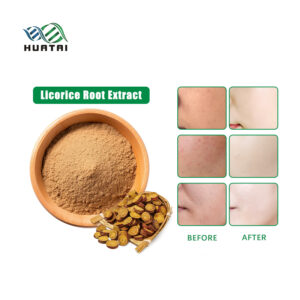
Licorice root extract (Glycyrrhiza glabra) is frequently misunderstood as a simple, mild botanical “soothing” agent. In reality, it is a sophisticated, multi-functional tool for high-performance skincare. To leverage it effectively, you must treat it not as a bulk extract, but as a source of specific, high-purity bioactive molecules.
Decoding the Extract Profile: Beyond “Soothing”
Generic licorice extracts contain hundreds of compounds, leading to significant batch-to-batch inconsistency. Professional formulations require standardized isolates where marker compounds are verified by HPLC.
| Component | Target Biological Mechanism | Solubility | Primary Function |
| Glabridin | Tyrosinase inhibition | Lipophilic (Oil) | Intensive Brightening |
| Glycyrrhizin | Inflammatory cascade | Hydrophilic (Water) | Redness/Irritation relief |
| Liquiritin | Melanin dispersion | Hydrophilic (Water) | Skin tone homogenization |
| Licochalcone A | Sebum regulation | Lipophilic (Oil) | Acne/Sebum management |
Strategic Selection for Formulation
You must decide which fraction of the plant matches your product’s goal. Using a generic water-soluble extract for a brightening serum will yield poor results because the key molecule, Glabridin, is oil-soluble and will not reach the target depth in an aqueous system.
The Formulator’s Decision Tree:
- For Pigmentation: Focus on Glabridin. It is a selective tyrosinase inhibitor. Unlike medical bleaching agents, it does not induce melanocyte cytotoxicity (cell death).
- For Sensitive/Reactive Skin: Focus on Dipotassium Glycyrrhizinate. It works at pH 5.5 and remains stable in complex emulsion systems.
- For Oily/Blemish-Prone Skin: Focus on Licochalcone A. This compound manages the low-grade inflammation that signals sebaceous glands to produce excess oil.
Performance Data: The Inhibition Gap
When comparing the brightening efficacy of various licorice-derived fractions, the data shows a clear difference between crude powders and high-purity isolates.
| Ingredient Variant | Melanin Inhibition (%) | Recommended Usage |
| Standard Root Powder | < 5% | Low efficacy |
| 10% Glabridin Extract | 45% | Targeted brightening |
| 40% Glabridin Isolate | > 85% | Clinical/Luxury serums |
| Dipotassium Glycyrrhizinate | N/A (Soothing only) | Anti-inflammatory |
Data Note: Inhibition percentages are based on B16 melanoma cell line assays compared to control.
The shift toward higher concentration isolates is the new industry trend. Professional brands are moving away from “contains licorice” marketing toward results-based claims supported by 40% standardized Glabridin.
Formulation Blueprint: Integrating for Stability
Licorice actives are notoriously sensitive to pH and light.
The Stability Checklist:
- pH Control: Keep your finished product between pH 4.5 and 5.5. Licorice flavonoids are prone to structural degradation in alkaline environments (pH > 7.0).
- Light Protection: Always use opaque, airless packaging. Clear glass containers will cause the active fraction to oxidize and turn the product brown.
- Metal Chelation: Add 0.1% Disodium EDTA to your water phase. Licorice actives are highly sensitive to metal ions (like Iron and Copper), which act as catalysts for oxidation.
Quality Control: What the COA Must Reveal
Professional sourcing requires a higher level of scrutiny. A simple “purity” percentage is not enough.
- Residual Pesticides: Licorice is a root crop. Ensure your supplier provides a multi-residue pesticide screening report.
- Color Integrity: Pure, high-performance Glabridin should be a light tan to white powder. Deep brown material indicates oxidation—the active fraction is already broken.
- Heavy Metals: Total heavy metals (Lead, Arsenic, Mercury) must be <10 ppm to meet global compliance standards.
Practical Troubleshooting
- Issue: The formula turns pink or brown over time.
- Root Cause: Oxidation of the flavonoid fraction.
- Fix: Add 0.1% Sodium Metabisulfite as an auxiliary stabilizer if your pH allows, and ensure airless packaging is utilized.
- Issue: Grainy texture in a cream.
- Root Cause: Recrystallization of lipophilic markers.
- Fix: Increase the polarity of your oil phase. Add a small percentage of Dicaprylyl Carbonate to keep the active locked in the lipid phase.
References
- Yokota, T., et al. (Pigment Cell Research): The inhibitory effects of glabridin on melanogenesis.
- Saeedi, M., et al. (Journal of Cosmetic Dermatology): Licorice root extracts and anti-inflammatory properties.
- International Journal of Molecular Sciences: Molecular mechanisms of Licochalcone A in skin health.

 English
 German
 Italian
 French
 Spanish
 Japanese
 Korean
 Russian