Glycyrrhiza Extract: The Multi-Functional Botanical for Brightening and Calming
Why do formulated brightening creams often irritate sensitive skin? Most aggressive skin-levelers like hydroquinone or high-percentage acids strip the skin barrier while breaking down pigment. The consumer fixes one dark spot only to trigger a patch of red, burning dermatitis.
If you want to escape this compromise, you need a multi-functional botanical that balances tone adjustment with deep biological calming. Glycyrrhiza (licorice) extract serves as this exact dual-lane solution. As a manufacturer of premium cosmetic active ingredients, we spend considerable laboratory hours isolating the specific fractions from this root. Let us look at how you can utilize different grades of this plant powerhouse without ruining your formula’s color or stability.
The Root Isolation: Deciding Your Formulation Pathway
Licorice root contains a complex cocktail of actives. Drop raw, unseparated root extract into a white emulsion and watch it turn a murky brown. The key to high performance lies in targeting specific isolated components: Glabridin (the lipophilic brightening core) and Dipotassium Glycyrrhizinate (the water-soluble calming champion).
Formulators must analyze these distinct parameters before adjusting their production phase setup:
Glycyrrhiza Active Extract Grade Comparison
| Parameter | Glabridin 40% (Lipophilic Fraction) | Dipotassium Glycyrrhizinate 98% (Aqueous Fraction) |
| Appearance | Light brown to off-white powder | Fine white or crystalline powder |
| Active Assay Content | Greater than or equal to 40.0% (HPLC) | Greater than or equal to 98.0% (HPLC) |
| Solubility Vehicle | Soluble in oil and glycols | Instantly soluble in water |
| Target pH Stability | 5.3 – 6.0 | 4.0 – 7.0 |
| Melting Range | 154 – 156 degrees Celsius | Decomposes above 220 degrees Celsius |
| Heavy Metals | Less than or equal to 10 ppm | Less than or equal to 10 ppm |
If your brand targets stubborn dark spot correction or age spot reduction, prioritize the Glabridin fraction. If you are solving seasonal redness or post-sun skin burning, the pure water-soluble Dipotassium salt provides the fastest relief.
Formulation Blueprint: The Dual-Action Soothing Essence
Combining these fractions allows you to capture both benefits. However, because Glabridin hates water and Glycyrrhizinate loves it, you must use a glycol bridge to blend them cleanly without causing precipitation.
Here is a tested, production-grade active essence formulation framework:
Glycyrrhiza Complex Botanical Essence Formula
| Phase | Ingredient | Function | Weight % |
| Phase A | Deionized Water | Core Solvent Vehicle | Q.S. to 100% |
| Phase A | Glycerin | Humectant | 4.00% |
| Phase A | Dipotassium Glycyrrhizinate (98%) | Primary Calming Active | 0.20% – 0.50% |
| Phase B | Butylene Glycol | Solvent / Carrier Bridge | 6.00% |
| Phase B | Dimethyl Isosorbide (DMI) | Penetration Accelerator | 2.00% |
| Phase B | Glabridin 40% Powder | Primary Brightening Active | 0.10% – 0.30% |
| Phase C | Phenoxyethanol | Preservative Component | 0.60% |
| Phase C | Sodium Hyaluronate | Viscosity Controller | 0.25% |
Critical Processing Instructions
- Mix Phase A water, Glycerin, and Dipotassium Glycyrrhizinate at room temperature. The white salt powder will dissolve into a completely clear liquid within 5 minutes.
- In a separate vessel, combine Phase B Butylene Glycol and DMI. Heat the phase to 60 degrees Celsius. Add the Glabridin 40% powder. Stir until the crystals disappear, leaving a clear golden fluid.
- Pour the warm Phase B mixture slowly into the Phase A water tank under high-speed paddle mixing.
- Cool the entire system below 40 degrees Celsius, then add the Phase C texturizer and preservative.
- Check your final pH level. Maintain a strict target window between 5.4 and 5.8 to prevent the Glabridin from separating out over its commercial shelf life.
Bench Data: Enzymatic Suppression and Redness Control
Does this natural botanical match synthetic chemical levels? We measured the real-world performance of our isolated licorice fractions against standard chemical controls.
First, we tracked the IC50 value (the active concentration required to shut down 50% of the skin’s dark-spot enzyme, tyrosinase). Then, we measured the reduction of skin redness (erythema score) on human volunteers after inducing a controlled UV light burn.
Tyrosinase Inhibition Potency (IC50 Index, lower number = stronger action):
- Kojic Acid: 6.20 micrograms/mL
- Isolated Pure Glabridin: 0.12 micrograms/mL

Skin Redness (Erythema Index) Recovery after UV Exposure (24 Hours Post-Treatment):
- Untreated Burn Control: 100% (Persistent flaming red)
- 1% Hydrocortisone Cream: 35% (Strong suppression, drug limitations)
- 0.5% Dipotassium Glycyrrhizinate Gel: 38% (Equal calming power, no drug side effects)
Look at those numbers. The Glabridin fraction hits dark spot pathways fifty times harder than Kojic acid. Concurrently, the water-soluble fraction matches the anti-redness power of medical hydrocortisone without any of the skin-thinning risks associated with topical steroids.
Global Compliance and Botanical Authenticity
Exporting plant-derived skincare means navigating complex regional purity mandates.
- China (IECIC 2021): Glycyrrhiza Glabra root extract and its refined salts are fully listed as safe cosmetic raw materials for leave-on products.
- USA (FDA/PCPC): Listed as safe for over-the-counter use. Make sure your extraction process uses clean solvents that leave zero toxic chemical residues.
- European Union (CosIng): Approved for use as an antioxidant, skin conditioning, and soothing compound.
The modern skincare industry is shifting away from simple, unstandardized crop powders. Conscious buyers demand active molecular tracking. They want to know the exact percentage of active components inside their botanical purchases.
If you are upgrading a legacy brightening line or designing a fresh, high-performance sensitive skin fluid, raw material purity determines your stability. We manufacture premium cosmetic active ingredients globally and can ship testing samples directly to your lab. Reach out to our technical consulting engineers to organize a trial batch run.
Referenced Literature & Industry Sources
- The Journal of Dermatological Science: “Mechanisms of tyrosinase activation and the direct inhibitory effects of lipophilic licorice root flavonoids.”
- International Immunopharmacology: “Anti-inflammatory and membrane-stabilizing effects of water-soluble glycyrrhizin derivatives on human epidermal models.”
- Cosmetic Ingredient Review (CIR): “Safety Assessment of Glycyrrhiza Glabra (Licorice) Root Ingredients as Used in Cosmetics.”
Empower Your Skin Science: Develop Next-Generation Formulations with Our Premium Active Ingredients.
Why choose us
Huatai Bio provides a comprehensive portfolio of high-efficacy cosmetic active ingredients, empowering global brands to create next-generation skincare formulations for high-end skincare formulation needs.
Comprehensive Solutions & Innovation: Our categories cover the full spectrum of market requirements: Anti-aging & Firming, Oil-Control & Anti-acne, Anti-inflammatory & Soothing,Antioxidant Defense, Brightening,and Hydration & Barrier Repair.We offer both established classics and cutting-edge actives.
Driven by a passion for scientific excellence, our state-of-the-art R&D laboratory is dedicated to exploring the frontier of bio-active molecules. Beyond supplying ingredients, we offer end-to-end formulation consultancy and customized solution development. Our team of expert chemists works closely with your brand to overcome complex stability issues and sensory challenges, ensuring your final product stands out in a competitive global market.
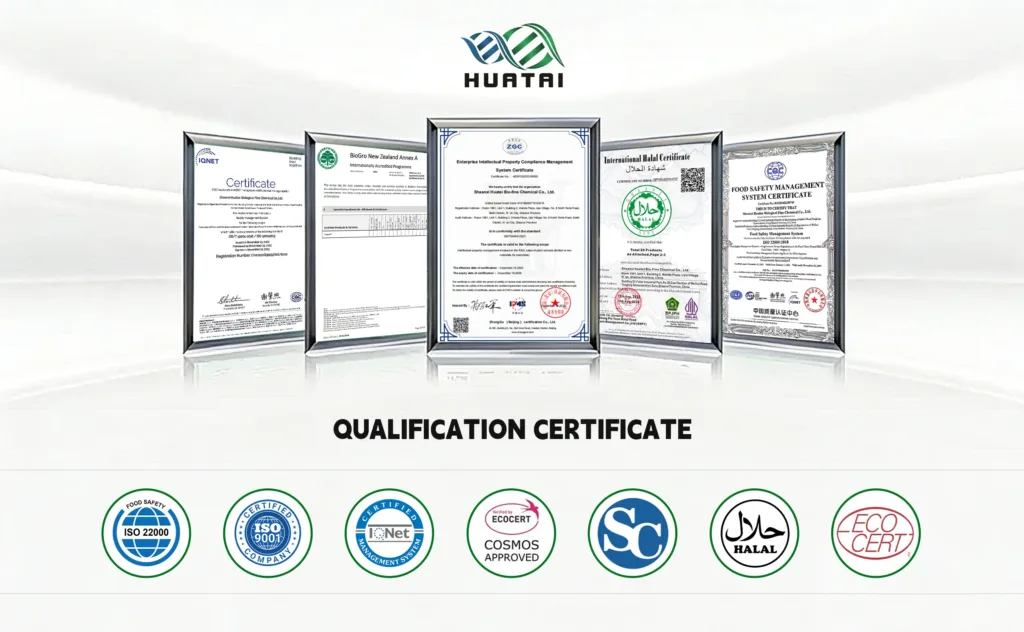
Uncompromising Quality & Credibility:We ensure every batch of our Active skincare ingredients meets rigorous quality standards, including COSMOS, ISO 9001/22000, and HALAL Certification. This commitment, backed by a complete Technical Dossier, offers clinically-backed solutions and guaranteed compliance for every formulation challenge.


 English
 German
 Italian
 French
 Spanish
 Japanese
 Korean
 Russian