Why do so many anti-aging moisturizers flop during consumer trials? Brands rush to ride the “plant-derived retinol alternative” wave. They print flashy labels. They make bold promises. Then the customer feedback hits: “The cream turned orange,” “It pills under sunscreen,” or “My skin is breaking out.”
As active cosmetic ingredient manufacturers, we analyze these technical failures every single week. Formulators blame the Bakuchiol molecule itself. We blame poor raw material sourcing and incorrect processing on the factory floor. If you drop a crude, low-grade plant extract into a basic emulsion, your product will fail. Let us look at the actual data and figure out how to build a high-performance Bakuchiol moisturizer that stays stable for two full years.
The Raw Truth About Purity
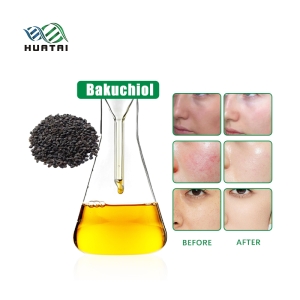
Bakuchiol is a terpenophenol extracted from the seeds of Psoralea corylifolia. The commercial market is flooded with cheap extracts. Suppliers label them as “Bakuchiol,” but they are actually unrefined oils containing only 50% to 60% of the active molecule. What makes up the rest? Dark plant resins, volatile compounds that smell like tar, and a dangerous group of chemicals called psoralens.
Psoralens are highly phototoxic. If a customer applies a moisturizer containing trace psoralens and walks into the sun, their skin can blister. You need a high-purity monomer grade, not a raw herbal extract.
| Sourcing Parameter | Crude Babchi Oil | High-Purity Bakuchiol Oil | Formulation Impact |
| Purity Assay (HPLC) | 20% – 50% | 99.0% Minimum | Directly controls wrinkle-reducing efficacy |
| Psoralen Content | Dangerous Levels | Less than 5 ppm (Trace) | Controls skin irritation and phototoxicity risk |
| Material Appearance | Dark brown, sticky oil | Light yellow, clear liquid | Determines the color and aesthetic of your cream |
| Scent Profile | Sharp, medicinal odor | Extremely mild, earthy | Dictates the need for heavy masking fragrances |
A Real-World Emulsion Rescue
Let us look at a real manufacturing issue we solved last winter. A European skincare brand came to us with a failing anti-wrinkle moisturizer prototype. Their formula split into two layers after four weeks in the 45-degree Celsius incubator. The color shifted from white to a muddy orange. Worse, it felt greasy on the skin.
We audited their processing steps and made three immediate changes:
First, their contract manufacturer was dumping the active into the oil phase at 75 degrees Celsius. Bakuchiol is highly heat-sensitive. High temperatures break down the molecule and trigger rapid browning. We forced them to move the addition to the cool-down phase, strictly below 50 degrees Celsius.
Second, we looked at their lipid carrier. They used heavy mineral oil, which fought the oily nature of Bakuchiol, causing the greasy skin feel. We replaced it with lightweight Sugarcane Squalane. Squalane mimics natural human sebum. It dissolves the Bakuchiol perfectly and accelerates skin absorption.
Third, we introduced a targeted antioxidant matrix. Bakuchiol resists light much better than traditional retinol, but it still hates open oxygen in the mixing tank. We added 0.1% Vitamin E (Tocopherol) to the oil phase to act as a sacrifice antioxidant.
The new batch passed the 12-week stress test flawlessly. The moisturizer retained a luxurious, pearl-white appearance and absorbed cleanly without pilling.
Decoding the Certificate of Analysis (COA)
Never let a raw material broker hand you a generic specification document. Your regulatory team must demand a batch-specific Certificate of Analysis. When you read the test results, audit these exact numbers to prevent manufacturing disasters:
| Critical COA Marker | Required Value | Production Floor Purpose |
| Assay (HPLC) | Greater than 99.0% | Ensures consistent clinical collagen production |
| Specific Gravity (20°C) | 0.950 – 0.970 | Verifies the absence of cheap lipid diluents |
| Heavy Metals (as Pb) | Less than 1 ppm | Stops metal ions from catalyzing rapid oxidation |
| Total Plate Count | Less than 100 cfu/g | Ensures your preservative system does not fail early |
Next-Generation Formulation Blueprints
You get the highest market success when you combine high-purity Bakuchiol with complementary actives. It plays beautifully across a wide pH range of 3.5 to 6.5. This gives you massive flexibility compared to retinol, which requires a narrow alkaline window.
- The Retinol Buffer System: Use 0.5% Bakuchiol alongside 0.1% pure Retinol. Research shows Bakuchiol stabilizes fragile retinol molecules in the presence of UV light. This combination maximizes wrinkle reduction while completely eliminating the redness and peeling associated with high-dose retinoids.
- The Melanin Double-Blocker: Combine 1.0% Bakuchiol with 2.0% Alpha Arbutin in a neutral emulsion base (pH 5.0). The Bakuchiol accelerates cellular turnover to clear old pigment, while the Alpha Arbutin stops the tyrosinase enzyme from making new dark spots.
- The Sensitive Barrier Repair: Mix 0.5% Bakuchiol with 0.2% Ceramide NP and 0.1% Dipotassium Glycyrrhizinate. This blueprint creates a powerful anti-aging cream designed specifically for rosacea-prone or highly sensitive skin types.
Market Trends and Global Compliance
The global regulatory environment is shifting fast. The European Commission is actively tightening restrictions on traditional retinol due to concerns over systemic vitamin A overload. Brands need an immediate compliance escape hatch.
Bakuchiol fits this market shift perfectly. Sourcing a 99% pure grade ensures your formula contains zero regulated plant allergens. It gives your brand a clean pass for global distribution. It allows your marketing team to legally claim “Clean Beauty,” “Pregnancy-Safe Anti-Aging,” and “Non-Phototoxic Daily Wear.”
Stop buying active ingredients based on the lowest bid or glossy marketing claims. Request a technical validation sample. Put it through your own HPLC machine. Check the moisture level. Let your lab data dictate your procurement decisions.
References from Public Literature
- Dhaliwal, S., et al. (2019). “Prospective, randomized, double-blind assessment of topical bakuchiol and retinol for facial photoageing.” British Journal of Dermatology, 180(2), 289-296.
- Chaudhuri, R. K., & Bojanowski, K. (2014). “Bakuchiol: a retinol-like functional compound revealed by gene expression profiling and clinically proven to have anti-aging effects.” International Journal of Cosmetic Science, 36(3), 221-230.
- Bluemke, A., et al. (2022). “Multidirectional action of bakuchiol against cellular mechanisms of facial ageing—Experimental evidence for a holistic in vitro approach.” International Journal of Molecular Sciences, 23(3), 1254.

 English
 German
 Italian
 French
 Spanish
 Japanese
 Korean
 Russian