Dual-Action Precision: Kojic and Salicylic Acid for Acne and Pigmentation Control
A product developer from a fast-growing acne brand sat in my office last month. He had a massive headache. His team wanted to launch a dual-action serum for acne and post-inflammatory hyperpigmentation (PIH)—the dark marks left behind after a breakout. Their early prototypes looked great in the lab on day one. By day thirty, the mixture turned dark brown, smelled like sulfur, and thinned out like water. He looked at me and asked, “How do we force Kojic Acid and Salicylic Acid to coexist without killing the formula?”
I told him the brutal truth. They were treating highly reactive raw materials like basic cooking ingredients.
We manufacture and supply cosmetic active ingredients for a living. We see this exact disaster weekly. Brands love the marketing power of pairing Kojic Acid (the ultimate spot fader) with Salicylic Acid (the pore cleaner). It makes total sense for the oily, acne-prone demographic. But if you do not understand the raw physical chemistry behind this dual-action system, your mixing tanks will turn into a costly graveyard of ruined batches.
Let us look at the baseline specifications we enforce at our facility for these two core materials. If your raw material purity slips even half a percent, your formula is doomed from the start.
| Parameter | Our Kojic Acid Specification | Our Salicylic Acid Specification | Test Method |
| Assay (Purity) | ≥ 99.0% | ≥ 99.5% | HPLC |
| Appearance | White or off-white crystals | White crystalline powder | Visual |
| Melting Point | 152°C to 156°C | 158°C to 161°C | Melting Apparatus |
| Loss on Drying | ≤ 0.5% | ≤ 0.5% | USP <731> |
| Heavy Metals Total | < 10 ppm | < 10 ppm | ICP-MS |
| Iron (Fe) Impurity | < 5 ppm | < 5 ppm | Atomic Absorption |
Look closely at that iron impurity limit. Why do we keep it under 5 ppm? Because Kojic Acid acts like a magnet for metal ions. If your factory water or your salicylic acid contains trace iron, the Kojic Acid binds to it instantly. The result? Your pure white lotion turns a horrific rusty red.
Why build this dual-action system in the first place? Because acne and pigmentation are biological partners. When a pimple inflames the skin, it triggers the cells to pump out excess melanin. Salicylic acid drops into the pore, breaks down the dead skin cells, and kills the bacteria. Meanwhile, Kojic Acid blocks the tyrosinase enzyme—the factory boss that manufactures the dark spots.
Let us look at the performance data when we benchmark this combined system against standalone treatments in our application lab.
| Target Efficacy Metric | Combined System (1% Kojic + 2% Salicylic) | 2% Salicylic Acid Alone | 1% Kojic Acid Alone |
| Pore Clog Clearance | Excellent | Excellent | Poor |
| Melanin Inhibition (IC50) | 12.8 ug/mL | Baseline | 14.5 ug/mL |
| Inflammatory Redness Drop | 72% in 14 days | 45% in 14 days | Minimal |
| 90-Day Color Stability | Pure White (Protected) | Pure White | Turns Muddy Brown |
Do you see the magic number? The combined system actually lowers the IC50 value for melanin inhibition. Salicylic acid gently peels away the top dead skin layers. This allows the Kojic Acid to penetrate deeper into the skin where the pigment cells hide. You get faster spot fading with a lower dose of active ingredients.
Let me share a real factory case study. A clinical brand in Southeast Asia wanted to create an oil-free clarifying gel. They initially used a generic, low-grade salicylic acid and a cheap kojic powder from a local trader. The gel thinned out, and the active ingredients crystallized at the bottom of the transparent glass bottles.
We shipped a sample of our high-purity actives to their R&D lab. We didn’t just give them the drums. We gave them our internal engineering blueprint.
Salicylic acid hates water. It loves oil and glycols. We told their chemists to pre-dissolve the salicylic acid in Propylene Glycol and Ethoxydiglycol at 60 degrees Celsius until perfectly clear. In a separate tank, we had them dissolve our 99% Kojic Acid in water at room temperature along with 0.2% Disodium EDTA. The EDTA acts as a chemical cage, locking up any rogue metal ions. Finally, they blended the two phases together during the cool-down phase, strictly below 38 degrees Celsius.
They followed our protocol. The crystallization stopped completely. They ran a 12-week accelerated stability trial in our testing ovens. Look at the real retention data.
| Oven Storage (40°C for 90 Days) | Active Kojic Retention | Active Salicylic Retention | Visual Profile |
| Unprotected Prototype | 64.2% | 91.0% | Dark Brown, Thin |
| Our Protected System | 95.8% | 99.1% | Pure Crystal Clear |
If you are designing an acne-brightening formula right now, write down these three lab rules:
Keep your final formula pH strictly between 4.0 and 4.5. If your pH goes above 5.0, your salicylic acid loses its peeling power. If it drops below 3.5, the Kojic Acid molecule degrades rapidly.
Always add a water-soluble antioxidant like Sodium Metabisulfite at 0.1%. It acts as a shield, soaking up oxygen so your Kojic Acid doesn’t brown.
Use opaque, airless packaging. Sunlight and oxygen are the absolute enemies of this system.
The global regulatory environment is tightening fast. The EU SCCS strictly limits Kojic Acid to a maximum concentration of 1.0% in face formulations due to safety concerns. Salicylic acid is capped at 2.0% for acne treatments. If you try to overshoot these limits, your product will be seized by customs. You must maximize efficacy through smart pairing, not by overloading the formula with illegal percentages.
Stop wasting your research and development budget on unstable, separated batches that alienate your customers. Sourcing high-purity, low-metal raw materials is the only way to win this market. Shield your formula from metal ions, respect the strict pH window, and protect the actives from heat. Your stability trials will pass with flying colors, and your customers will get clear, radiant skin without the chemical burn.
Literature Referenced in Formulation Data:
- SCCS (Scientific Committee on Consumer Safety). (2022). Opinion on Kojic acid in cosmetics. SCCS/1637/21.
- SCCS (Scientific Committee on Consumer Safety). (2021). Opinion on Salicylic acid in cosmetic products. SCCS/1601/18.
- Cabanes, J., et al. (1994). Kojic acid, a cosmetic skin whitening agent, is a slow-binding inhibitor of catecholase activity of tyrosinase. Journal of Pharmacy and Pharmacology, 46(12), 982-985.
Empower Your Skin Science: Develop Next-Generation Formulations with Our Premium Active Ingredients.
Why choose us
Huatai Bio provides a comprehensive portfolio of high-efficacy cosmetic active ingredients, empowering global brands to create next-generation skincare formulations for high-end skincare formulation needs.
Comprehensive Solutions & Innovation: Our categories cover the full spectrum of market requirements: Anti-aging & Firming, Oil-Control & Anti-acne, Anti-inflammatory & Soothing,Antioxidant Defense, Brightening,and Hydration & Barrier Repair.We offer both established classics and cutting-edge actives.
Driven by a passion for scientific excellence, our state-of-the-art R&D laboratory is dedicated to exploring the frontier of bio-active molecules. Beyond supplying ingredients, we offer end-to-end formulation consultancy and customized solution development. Our team of expert chemists works closely with your brand to overcome complex stability issues and sensory challenges, ensuring your final product stands out in a competitive global market.
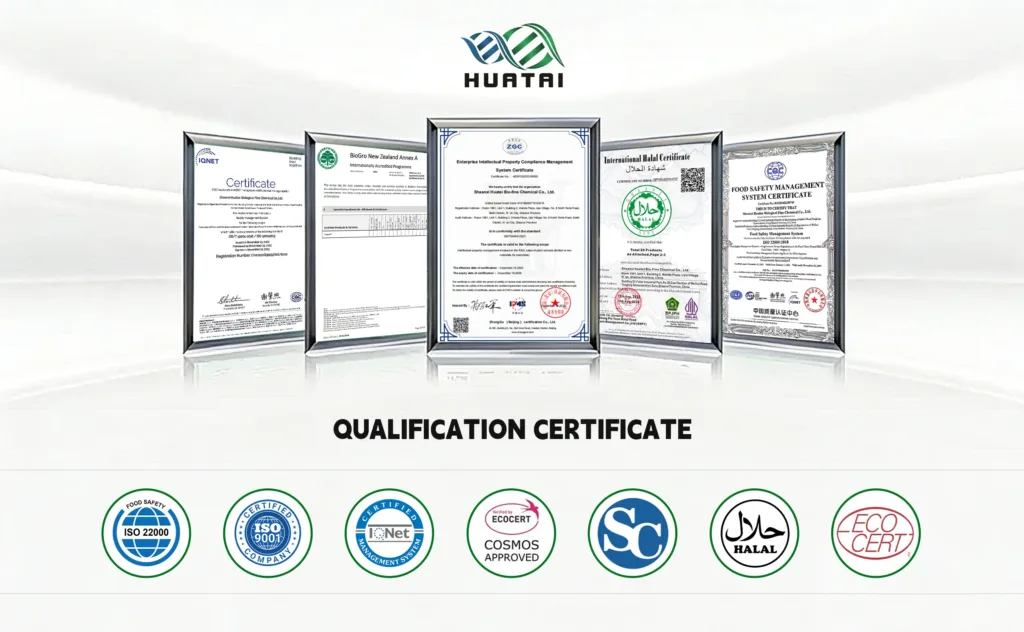
Uncompromising Quality & Credibility:We ensure every batch of our Active skincare ingredients meets rigorous quality standards, including COSMOS, ISO 9001/22000, and HALAL Certification. This commitment, backed by a complete Technical Dossier, offers clinically-backed solutions and guaranteed compliance for every formulation challenge.


 English
 German
 Italian
 French
 Spanish
 Japanese
 Korean
 Russian