Let us talk about the elephant in the R&D lab. Retinol is a headache. You formulate a beautiful 1.0% retinol cream. Six months later, the customer opens the jar. It is yellow. It smells like old paint. The customer applies it, walks into the sun, and their face peels off. Formulators hate working with it. Marketing departments love selling it.
What is the compromise? We look at a seed from India. We look at Bakuchiol.
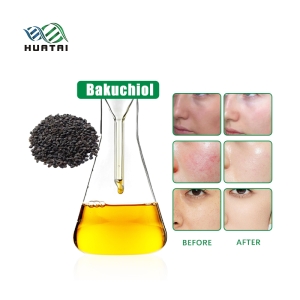
Is it just another “plant-based alternative” marketing gimmick? No. British dermatologists put Bakuchiol head-to-head with retinol in a double-blind clinical trial. The results shocked the legacy brands. It builds collagen just as well. But it does not cause the peeling, the severe redness, or the burning.
I run the extraction lines. I see the raw chemistry every day. Let us cut the fluff and look at how you actually build a stable, compliant anti-aging product without burning your customers.
The Genomic Skeleton Key
How does a plant molecule mimic a synthetic vitamin? Chemically, Bakuchiol does not look like retinol at all. But it acts like a cellular skeleton key. It fits right into the exact same retinoic acid receptors in the human skin. It tells the fibroblasts to wake up and produce Collagen Type I, III, and IV.
Let us look at the baseline efficacy. This is what happens in the skin cells.
| Metric | Synthetic Retinol (1%) | Pure Bakuchiol (1%) | Formulator Reality |
| Collagen Upregulation | Very High | Very High | You keep identical anti-aging claims on the box. |
| Erythema (Redness) Risk | Severe | Zero | Bakuchiol actually reduces localized skin inflammation. |
| Phototoxicity | High (Night use only) | None (Day use safe) | Massive marketing advantage. You can sell daytime serums. |
| Oxidation Rate in Vat | Extreme | Low to Moderate | Bakuchiol saves your shelf-life stability and PET tests. |
Data reflects standard clinical observations from comparative dermatological studies.
The Dirty Secret: The Psoralen Trap
Here is the dark side of the cosmetic supply chain. You go to a bulk chemical trading site. You buy cheap “Bakuchiol extract.” You formulate a premium face oil. Two weeks later, a customer walks outside in the sun and their face blisters.
Why did your product fail? Because you bought unrefined Psoralea corylifolia oil.
The babchi plant contains defensive compounds called psoralens. Psoralens are highly phototoxic. If UV light hits human skin treated with psoralens, it causes massive irritation and hyperpigmentation. If your supplier does not molecularly strip them out, you are bottling a lawsuit.
We are a primary manufacturer. We run high-vacuum molecular distillation. We strip those toxins out. Look at this specification sheet comparison. This is what separates a safe cosmetic active from a dangerous crude extract.
| Parameter | Cheap Broker Extract | Premium Manufacturer Isolate | R&D Impact on Your Formula |
| Appearance | Dark brown, heavy odor | Pale yellow, slight odor | Dark powders turn your white emulsions muddy. |
| Assay (HPLC) | 60.0% to 70.0% | Minimum 99.0% | Exact purity guarantees repeatable clinical efficacy. |
| Psoralen Content | Over 500 ppm | Maximum 1 ppm | 1 ppm is the strict safety threshold to prevent burns. |
| Acid Value | Greater than 5.0 | Maximum 2.0 | Low acid prevents your emulsion from splitting over time. |
Case Study: The Dermatitis Rescue
A major European clinical brand came to our factory last year. Their new overnight regenerative oil was causing contact dermatitis. Consumers were furious. The brand blamed their preservative system.
We tested their lipid phase in our analytical lab. Their “pure” Bakuchiol raw material had 800 ppm of residual psoralens. The broker lied on the paperwork.
We swapped their raw material for our 99% isolate. The brand kept the exact same 1% clinical dose in the formula. The irritation reports dropped to zero in the next quarter. Skin elasticity metrics improved. They kept their aggressive anti-aging claims and saved a multi-million dollar product line. Purity is not just about performance. It is about legal liability.
The Compounding Playbook: Beating the Iron Reaction
You bought the 99% pure isolate. Do not ruin it in the mixing tank. Bakuchiol is oil-soluble. It hates water. It also has a bizarre chemical quirk you must prepare for.
Here is the exact protocol our R&D chemists give to brands:
- The Oil Phase Drop: Pre-mix your Bakuchiol with Squalane, Rosehip Oil, or Caprylic/Capric Triglyceride. It dissolves seamlessly into lipids.
- Temperature Control: Drop it into the tank during the cool-down phase. Keep the vat below 50 degrees Celsius. Do not blast this molecule with high heat for hours.
- Kill the Iron: This is critical. Bakuchiol turns blood-red if it touches iron or copper ions. If your municipal water supply has trace iron, your pristine white cream will turn bright pink overnight. You must use a chelating agent. Add 0.1% Disodium EDTA or Phytic Acid to your water phase to lock up those rogue metals.
- pH Reality: It is highly stable between pH 4.0 and 6.5. This gives your chemists massive flexibility. You can safely stack it with mild exfoliating acids, which you can never do with synthetic retinol.
The Regulatory Guillotine
Why is this ingredient exploding on procurement sheets right now? Because regulators are coming for Retinol.
The European Union’s Scientific Committee on Consumer Safety (SCCS) recently dropped the hammer. They restricted Retinol to a maximum of 0.3% in face products. You cannot make a high-strength retinol legally in Europe anymore.
Bakuchiol has no such restrictions. It bypasses the regulatory red tape entirely. It gives brands the ultimate loophole: deliver high-performance, aggressive anti-aging results while remaining fully compliant with global clean beauty standards.
We do not broker powders from unknown farms. We extract, distill, and test every single batch via HPLC. We control the psoralen limits tightly. Stop risking your R&D budget and brand reputation on dirty botanical extracts.
We have pure isolate samples ready for your formulation team. Put it in your next emulsion base. Run a stability challenge test. Let the lab results tell the truth. Reach out directly to our production team to secure your benchmark sample.
References Used in Preparation:
- Dhaliwal, S., et al. (2019). Prospective, randomized, double-blind assessment of topical bakuchiol and retinol for facial photoageing. British Journal of Dermatology.
- Chaudhuri, R. K., & Bojanowski, K. (2014). Bakuchiol: a retinol-like functional compound revealed by gene expression profiling and clinically proven to have anti-aging effects. International Journal of Cosmetic Science.
- SCCS (Scientific Committee on Consumer Safety). (2022). Revision of the scientific opinion on Vitamin A (Retinol, Retinyl Acetate, Retinyl Palmitate). European Commission.
- Bluemke, A., et al. (2022). Multidirectional activity of bakuchiol against cellular mechanisms of facial ageing. Experimental Dermatology.



 English
 German
 Italian
 French
 Spanish
 Japanese
 Korean
 Russian