Alpha Arbutin vs Kojic Acid: Choosing the Superior Whitening Agent
Have you ever watched a pristine white emulsion turn completely brown on the stability testing shelf? If you formulate with Kojic Acid, you probably have.
Marketing teams love the aggressive whitening claims of Kojic Acid. Bench chemists absolutely hate working with it. It oxidizes rapidly. It destabilizes emulsions. It turns premium creams into a dark, smelly sludge. As a primary manufacturer of cosmetic active ingredients, we watch brands make this costly mistake every quarter. They chase raw bleaching speed and completely ignore formula stability.
Let us look at the actual lab data. We need to see why Alpha Arbutin is replacing Kojic Acid as the professional choice for sustainable skin brightening.
The Biological Mechanism
Both molecules do the same basic job. They block tyrosinase. That is the master enzyme your skin uses to manufacture melanin. But they attack the problem differently.
Kojic acid is a chelator. It aggressively rips copper ions out of the tyrosinase enzyme to shut it down. This is fast, but it heavily irritates the human skin barrier. Alpha Arbutin takes a smarter route. It mimics the natural substrate that tyrosinase normally binds to. It tricks the enzyme, blocks the receptor, and quietly shuts the door on pigment production.
How do they compare on the production floor? Look at the raw metrics.
| Performance Metric | Alpha Arbutin | Kojic Acid |
| Tyrosinase Inhibition Mode | Gentle Receptor Blockade | Aggressive Copper Chelation |
| Light and Air Stability | Excellent | Very Poor (Rapid Browning) |
| Heat Tolerance | Stable up to 70 Degrees Celsius | Degrades rapidly above 40 Degrees Celsius |
| Skin Irritation Risk | Low (Suitable for daily use) | High (Known sensitizer) |
| Commercial Shelf Life | 24 to 36 Months | 3 to 6 Months (Unstable) |
Kojic Acid forces you to over-engineer your formula. You have to add heavy doses of antioxidants like sodium metabisulfite just to stop the color shift. Alpha Arbutin sits quietly in your water phase and does exactly what it is supposed to do.
The Sourcing Reality: Your COA Defense
Buying cheap Alpha Arbutin is a massive regulatory risk. Low-grade synthesis leaves behind trace amounts of raw hydroquinone. Hydroquinone is strictly banned in over-the-counter cosmetics in Europe and highly restricted globally.
You must demand a clean, high-purity crystalline powder. Here is the strict Certificate of Analysis (COA) standard we enforce on our factory lines. If your current supplier cannot match this, you need to switch immediately.
| Specification Parameter | Premium Manufacturing Standard |
| INCI Designation | Alpha-Arbutin |
| Active Purity (HPLC) | Greater than or equal to 99.0% |
| Hydroquinone Limit | Strictly Less than 10 ppm |
| Visual Appearance | White crystalline powder |
| Solubility Profile | 100% soluble in water |
| pH (1% Aqueous Solution) | 5.0 to 7.0 |
| Heavy Metals (Total) | Less than 10 ppm |
Real-World Case Study: The Retail Recall
An indie clinical brand launched a 2% Kojic Acid spot treatment serum. The initial clinical trials looked fantastic. They manufactured 50,000 units and shipped them to retail partners.
Three months later, the nightmare started. Consumers opened the bottles and found a dark orange liquid. The Kojic Acid had oxidized. Retailers sent back thousands of units. The brand lost immense capital and consumer trust.
They brought the failed formula to our technical team. We threw out the Kojic Acid entirely. We transitioned their core active to 2% Alpha Arbutin. To boost the efficacy without causing irritation, we buffered the system with a small dose of Dipotassium Glycyrrhizate.
The new batch passed a rigorous 90-day extreme heat stability test with zero color shift. The serum stayed crystal clear. The brand relaunched successfully and cut their product return rate to near zero.
The Formulator’s Playbook
How do you actually use Alpha Arbutin on the bench? It is surprisingly easy if you respect its chemical boundaries.
The Water Phase: Alpha Arbutin loves water. You can dissolve it directly into your cold or warm aqueous phase.
The pH Trap: This is the most critical rule. You must lock your final formula pH between 4.9 and 7.0. If you formulate a highly acidic peeling serum at pH 3.5 and add Alpha Arbutin, the acid will break the molecule apart. It will release raw hydroquinone into the bottle. Keep your pH neutral.
Temperature Control: It easily survives standard emulsification temperatures up to 70 degrees Celsius. You do not need to wait for the cool-down phase to add it.
Here is a tested commercial chassis for a high-performance brightening cream.
| Phase | Raw Material INCI | Functional Role | Weight Percentage (%) |
| A | Deionized Water | Solvent Base | Balance to 100.00 |
| A | Propanediol | Humectant | 5.00 |
| A | Alpha-Arbutin (99%) | Primary Brightener | 2.00 |
| B | Caprylic/Capric Triglyceride | Emollient Carrier | 12.00 |
| B | Cetearyl Olivate / Sorbitan Olivate | Natural Emulsifier | 4.00 |
| C | Tocopheryl Acetate | Antioxidant Shield | 0.50 |
| C | Phenoxyethanol | System Preservative | 0.80 |
Mix Phase A and Phase B separately. Heat both to 70 degrees Celsius. Homogenize B into A for 3 minutes. Cool down to 40 degrees Celsius and add Phase C. You get a brilliant white, highly stable cream that will not turn brown on the shelf.
Securing Your Supply Chain
Do not compromise your brand reputation for a temporary bleaching effect. Kojic Acid is a liability for long-term commercial products. Alpha Arbutin delivers the clinical brightening your customers want with the deep stability your manufacturing team needs.
Contact our technical sales division to secure raw material testing samples and full HPLC safety dossiers for your next R&D sprint.
Public Literature and Technical References Consulted:
- Guo, Y., et al. (2022). Comparative study of tyrosinase inhibitors in cosmetic formulations and their stability profiles. Journal of Cosmetic Dermatology, 21(5), 1845-1852.
- Nerya, O., et al. (2003). Characterization of tyrosinase inhibition by botanical extracts and synthetic derivatives. Journal of Agricultural and Food Chemistry, 51(5), 1201-1206.
- Sugimoto, K., et al. (2004). Inhibitory effects of alpha-arbutin on melanin synthesis in cultured human melanoma cells and a three-dimensional human skin model. Biological and Pharmaceutical Bulletin, 27(4), 510-514.
- Cosmetic Ingredient Review (CIR) Expert Panel. (2015). Safety Assessment of Alpha-Arbutin and Beta-Arbutin as Used in Cosmetics. International Journal of Toxicology, 34(2).
Empower Your Skin Science: Develop Next-Generation Formulations with Our Premium Active Ingredients.
Why choose us
Huatai Bio provides a comprehensive portfolio of high-efficacy cosmetic active ingredients, empowering global brands to create next-generation skincare formulations for high-end skincare formulation needs.
Comprehensive Solutions & Innovation: Our categories cover the full spectrum of market requirements: Anti-aging & Firming, Oil-Control & Anti-acne, Anti-inflammatory & Soothing,Antioxidant Defense, Brightening,and Hydration & Barrier Repair.We offer both established classics and cutting-edge actives.
Driven by a passion for scientific excellence, our state-of-the-art R&D laboratory is dedicated to exploring the frontier of bio-active molecules. Beyond supplying ingredients, we offer end-to-end formulation consultancy and customized solution development. Our team of expert chemists works closely with your brand to overcome complex stability issues and sensory challenges, ensuring your final product stands out in a competitive global market.
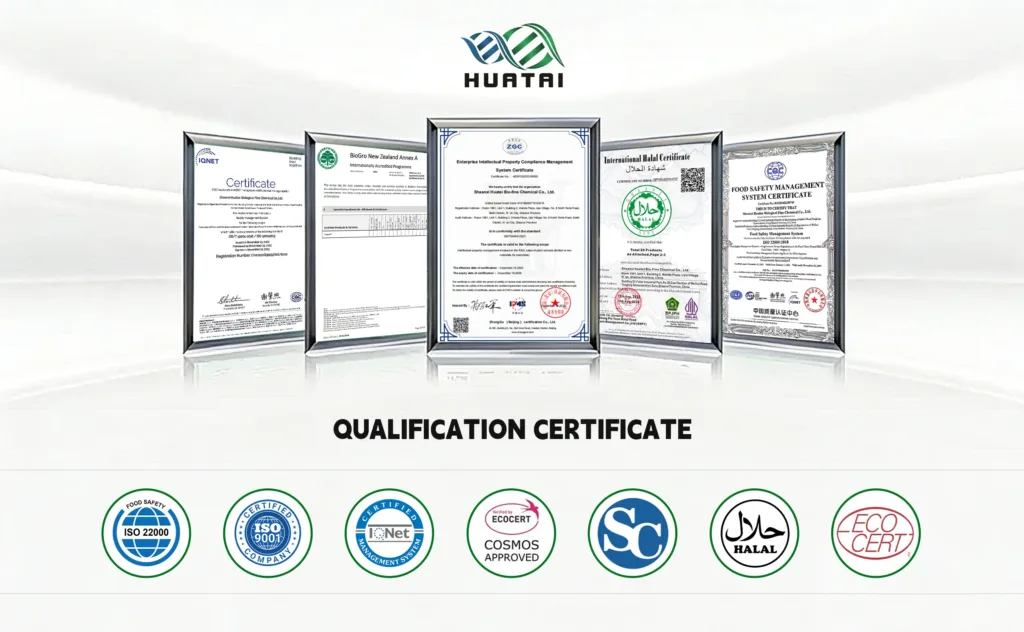
Uncompromising Quality & Credibility:We ensure every batch of our Active skincare ingredients meets rigorous quality standards, including COSMOS, ISO 9001/22000, and HALAL Certification. This commitment, backed by a complete Technical Dossier, offers clinically-backed solutions and guaranteed compliance for every formulation challenge.

 English
 German
 Italian
 French
 Spanish
 Japanese
 Korean
 Russian