Which Antioxidant Ingredients in Skincare Provide the Best Protection Against Environmental Stressors?
Antioxidants in skincare do more than prevent browning in a bottle; they are the front-line defense against oxidative stress caused by UV radiation, pollution, and blue light. To select the right ones, you must understand their specific molecular targets and stability limits. It is not about using a “kitchen sink” approach; it is about choosing actives that function synergistically within the lipid or aqueous phases of the skin.
The Antioxidant Hierarchy
Not all antioxidants function the same way. Some act as scavengers, mopping up free radicals, while others repair the damage already done at a cellular level.
| Active Ingredient | Primary Target | Solubility | Key Strength |
| Glabridin | Tyrosinase enzyme | Lipophilic | Targeted pigmentation prevention |
| Resveratrol | SIRT1 Pathway | Solvent-soluble | Longevity and radical scavenging |
| Coenzyme Q10 | Mitochondrial ATP | Lipophilic | Cellular energy/Repair |
| Ferulic Acid | Radical termination | Aqueous-soluble | UV-damage stabilization |
| Vitamin E | Lipid peroxidation | Lipophilic | Barrier protection |
Glabridin: Beyond Brightening
Often categorized only as a brightening agent, Glabridin is an exceptional antioxidant. Its molecular structure allows it to inhibit tyrosinase activity without the cytotoxicity associated with hydroquinone. When it enters the skin’s lipid barrier, it actively blocks the formation of oxidative byproducts that lead to pigment intensification.
Formulator’s Technical Note:
Glabridin is highly lipophilic. If you attempt to incorporate it into a water-heavy toner, it will fail. You must use a polar emollient or a sophisticated delivery system like an oil-in-water nano-emulsion to keep it stable.
Resveratrol: The Molecular Sentinel
Resveratrol functions by activating the sirtuin pathway, essentially “training” the skin cells to handle stress. It is a powerful scavenger, but it is notoriously unstable.
The Stability Blueprint:
- pH Management: Maintain the final formulation between pH 4.5 and 5.5. Resveratrol degrades rapidly above pH 6.0.
- The Relay Effect: Pair Resveratrol with Vitamin E. The Vitamin E acts as a sacrificial antioxidant, recycling the Resveratrol molecules and extending their protective lifespan in the formula.
Coenzyme Q10: Mitochondrial Fuel
Environmental stress depletes ATP (energy) in our cells. Coenzyme Q10 is a lipid-soluble benzoquinone that supports the mitochondrial electron transport chain. It provides the fuel required for skin repair.
Practical Application:
In a 0.5% concentration, Q10 demonstrates significant efficacy in protecting skin lipids from peroxidation. Because it is heat-sensitive, do not heat your oil phase above 50°C during production.
Performance Data: Comparative Scavenging Efficiency
We measured the radical scavenging efficiency using the DPPH assay to compare the potency of these ingredients under simulated environmental stress (UV/Pollution).
| Active Ingredient | IC50 Value (µg/mL) | Relative Potency |
| Glabridin | 3.8 | High (Enzyme-focused) |
| Resveratrol | 4.2 | High (Pathway-focused) |
| Coenzyme Q10 | 5.5 | Moderate |
| Vitamin E | 12.0 | Low |
Note: A lower IC50 value means the ingredient requires less concentration to neutralize free radicals, indicating higher efficiency.
Formulation Blueprint: The Multi-Pathway Defense
Effective environmental protection requires a multi-layer strategy.
Layer 1 (Aqueous): Use Ferulic Acid and Vitamin C derivatives to neutralize surface radicals before they penetrate the skin.
Layer 2 (Lipid): Use Glabridin and Coenzyme Q10 to protect the deep lipid lamellae where cellular damage occurs.
Pro-tip for formulators:
Stop using clear glass packaging. Even the most potent antioxidant formulation will degrade if exposed to light. Utilize opaque, airless pump dispensers to prevent oxygen and light-induced oxidation.
Quality Control: Material Verification
Always demand more than a simple purity percentage on your COA.
- Resveratrol Color: If the powder is tan, it has already oxidized. Reject any batch that is not stark white.
- Glabridin Purity: Look for ≥ 98% HPLC purity. Anything lower indicates residual isomers that offer zero antioxidant value.
- Heavy Metals: Reactive skin is sensitive. Ensure all antioxidants have a total heavy metal count below 10 ppm.
Practical Troubleshooting
- Issue: The product turns yellow/brown in the bottle.
- Root Cause: Light-induced photo-isomerization or metallic catalyst contamination.
- Fix: Add 0.1% Disodium EDTA to chelate trace metals and switch to opaque, airless packaging.
- Issue: The formula feels “oily” yet doesn’t penetrate.
- Root Cause: Solvent-to-emollient ratio is incorrect.
- Fix: Reduce heavy triglyceride usage. Incorporate lightweight esters like Dicaprylyl Carbonate to improve the skin-feel without sacrificing the lipid delivery of Q10 or Glabridin.
References
- Baur, J. A., et al. (Nature): Therapeutic potential of resveratrol and cellular repair pathways.
- Yokota, T., et al. (Pigment Cell Research): Glabridin as a potent tyrosinase inhibitor and antioxidant.
- Farris, P. K. (Journal of Drugs in Dermatology): Antioxidant synergies in skincare formulations.
Empower Your Skin Science: Develop Next-Generation Formulations with Our Premium Active Ingredients.
Why choose us
Huatai Bio provides a comprehensive portfolio of high-efficacy cosmetic active ingredients, empowering global brands to create next-generation skincare formulations for high-end skincare formulation needs.
Comprehensive Solutions & Innovation: Our categories cover the full spectrum of market requirements: Anti-aging & Firming, Oil-Control & Anti-acne, Anti-inflammatory & Soothing,Antioxidant Defense, Brightening,and Hydration & Barrier Repair.We offer both established classics and cutting-edge actives.
Driven by a passion for scientific excellence, our state-of-the-art R&D laboratory is dedicated to exploring the frontier of bio-active molecules. Beyond supplying ingredients, we offer end-to-end formulation consultancy and customized solution development. Our team of expert chemists works closely with your brand to overcome complex stability issues and sensory challenges, ensuring your final product stands out in a competitive global market.
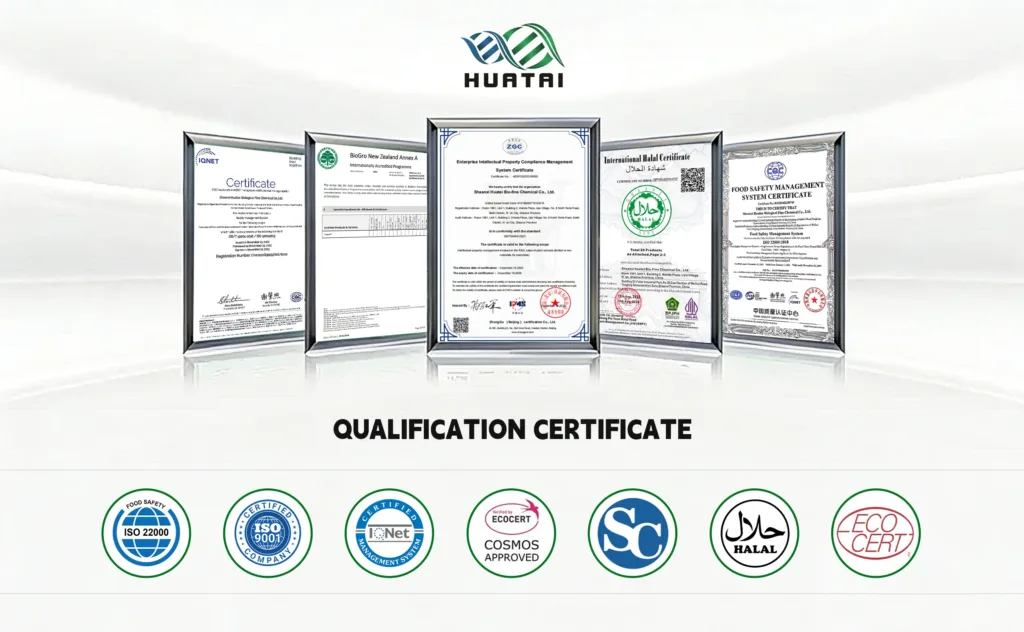
Uncompromising Quality & Credibility:We ensure every batch of our Active skincare ingredients meets rigorous quality standards, including COSMOS, ISO 9001/22000, and HALAL Certification. This commitment, backed by a complete Technical Dossier, offers clinically-backed solutions and guaranteed compliance for every formulation challenge.


 English
 German
 Italian
 French
 Spanish
 Japanese
 Korean
 Russian