Unlocking the Potential of Glabridin for Skin Care Formulations
You spend months developing a brightening cream. You load it with plant extracts. You run an accelerated stability test. Three weeks later, the cream separates. Sharp crystals form at the bottom of the jar. The pristine white lotion turns a muddy yellow.
We see this exact failure in our lab every week. Brands want the brightening power of Glabridin. But formulators often misunderstand its physical chemistry.
Let us skip the basic marketing claims. You know it brightens skin. Many call it “whitening gold.” But how do you actually keep it stable in a commercial manufacturing tank? We manufacture this raw material. We extract it directly from licorice root. Here is the real formulation data you need before you start mixing.
The Purity Grade Problem
You cannot build a stable, white emulsion with cheap, low-purity botanical extracts. Low-grade licorice extracts carry heavy plant resins and sticky impurities. These resins oxidize rapidly. They destroy your product color on the retail shelf.
Look at the actual factory specifications. We produce different grades for different lab requirements.
| Parameter | 40 Percent Specification | 90 Percent Specification | Testing Method |
| Appearance | Brownish-yellow powder | White to pale yellow powder | Visual |
| Active Assay (HPLC) | >= 40.0 percent | >= 90.0 percent | HPLC |
| Loss on Drying | <= 5.0 percent | <= 2.0 percent | Gravimetric (105 C) |
| Heavy Metals | < 10 ppm | < 10 ppm | ICP-MS |
| Ash Content | <= 1.0 percent | <= 0.5 percent | Gravimetric |
Do you formulate a premium facial serum? You must use the 90 percent grade or higher. The color stability demands it. You can use the 40 percent grade for soap bars or dark-colored mud masks where a slight yellow tint goes unnoticed.
How It Actually Stops Pigment
Let us drop the heavy academic terminology. How does this powder fade dark spots? Your skin cells act like a pigment factory. An enzyme called tyrosinase runs the production line. This enzyme requires copper to build melanin. Melanin creates the dark spots.
Glabridin walks into the factory and physically blocks that enzyme. It shuts down the production line at the source. It also acts as a powerful antioxidant. It sweeps up the inflammatory free radicals that trigger pigment production in the first place.
A Real Formulation Rescue
A contract manufacturer from North America brought us a major problem. They wanted to build a dark spot corrector without using hydroquinone. Hydroquinone works fast, but it damages cells and faces strict regulatory bans.
The client formulated a 0.1 percent Glabridin lotion. It failed stability testing instantly. The active ingredient crashed out of the emulsion.
We analyzed their blueprint. They dumped the dry powder straight into their hot water phase. This is a fatal error. Glabridin strongly hates water. It is a highly lipophilic molecule.
We rewrote their manufacturing protocol. We instructed their compounding chemists to dissolve the powder entirely in Butylene Glycol first. They heated this solvent mix gently to 40 Celsius. They then added this clear liquid to their oil phase right before emulsification.
The batch stabilized perfectly. They ran a clinical test on 40 human volunteers over eight weeks. We tracked the melanin index using clinical imaging tools.
| Timeframe | Melanin Index Reduction | Skin Redness Drop | Consumer Tolerance |
| Baseline | 0 percent | 0 percent | N/A |
| Week 2 | – 11.5 percent | – 15.0 percent | 100 percent tolerated |
| Week 4 | – 26.8 percent | – 32.5 percent | 100 percent tolerated |
| Week 8 | – 41.2 percent | – 55.2 percent | 100 percent tolerated |
Notice the redness drop in that table. That reveals the hidden power of this ingredient. It does not just stop pigmentation. It actively reduces tissue inflammation. It calms the skin while brightening it. Harsh synthetic acids simply cannot do that.
Lab Rules for Commercial Compounding
You want to use this in your next project? Keep these rigid rules in your lab notebook.
- Fix the solubility first. Never add it to water. Pre-dissolve it in Propanediol, PEG-400, Butylene Glycol, or a carrier oil.
- Manage your pH tightly. Keep your final formula between pH 5.5 and 7.0. If your base becomes highly acidic, the active molecule breaks down rapidly.
- Block the light entirely. Transparent glass bottles destroy this molecule. UV rays degrade the active before the customer even opens the box. Use airless pumps or opaque amber glass.
The Regulatory Shift
The cosmetics industry faces a massive compliance shift. Regulators tighten restrictions on synthetic brightening agents every single year. Consumers read ingredient labels obsessively. They demand clean, plant-based chemistry. Glabridin fits this exact market gap perfectly. It provides pharmaceutical-grade efficacy without the regulatory nightmares.
Stop fighting with unstable actives that crash out of your emulsions. Request a testing sample of our purified powder. Put it in your own solvents. Check the solubility under your own microscopes. Let the lab data dictate your next formula.
References Used in This Article:
- Simmler, C., et al. (2013). Species-specific extractability of licorice flavonoids. Journal of Natural Products, 76(6), 1113-1120.
- Yokota, T., et al. (1998). The inhibitory effect of glabridin from licorice extracts on melanogenesis and inflammation. Pigment Cell Research, 11(6), 355-361.
- D’Mello, S. A., et al. (2016). Signaling pathways in melanogenesis. International Journal of Molecular Sciences, 17(7), 1144.
Empower Your Skin Science: Develop Next-Generation Formulations with Our Premium Active Ingredients.
Why choose us
Huatai Bio provides a comprehensive portfolio of high-efficacy cosmetic active ingredients, empowering global brands to create next-generation skincare formulations for high-end skincare formulation needs.
Comprehensive Solutions & Innovation: Our categories cover the full spectrum of market requirements: Anti-aging & Firming, Oil-Control & Anti-acne, Anti-inflammatory & Soothing,Antioxidant Defense, Brightening,and Hydration & Barrier Repair.We offer both established classics and cutting-edge actives.
Driven by a passion for scientific excellence, our state-of-the-art R&D laboratory is dedicated to exploring the frontier of bio-active molecules. Beyond supplying ingredients, we offer end-to-end formulation consultancy and customized solution development. Our team of expert chemists works closely with your brand to overcome complex stability issues and sensory challenges, ensuring your final product stands out in a competitive global market.
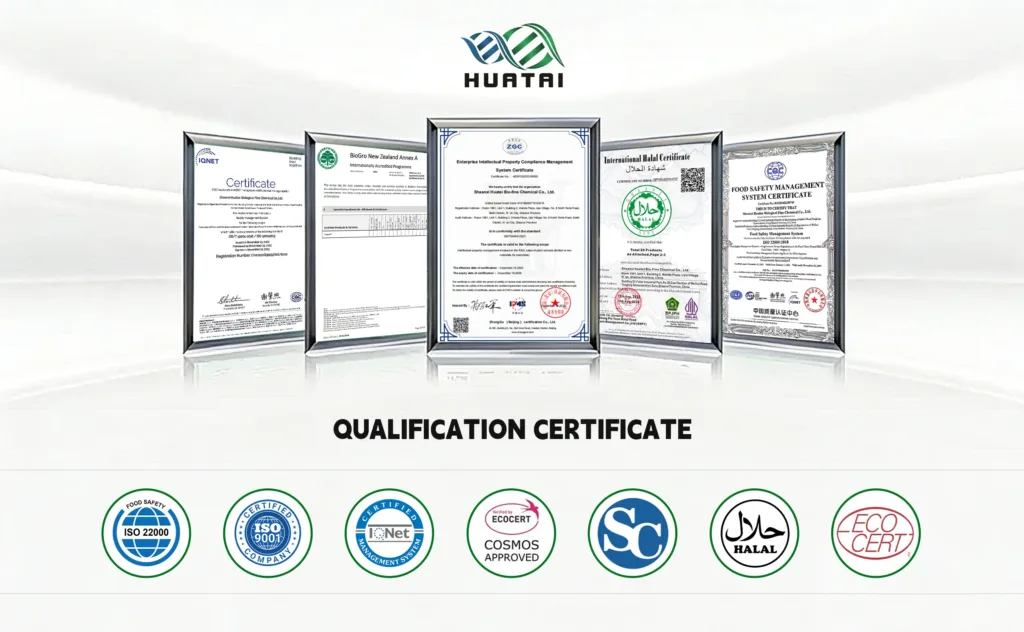
Uncompromising Quality & Credibility:We ensure every batch of our Active skincare ingredients meets rigorous quality standards, including COSMOS, ISO 9001/22000, and HALAL Certification. This commitment, backed by a complete Technical Dossier, offers clinically-backed solutions and guaranteed compliance for every formulation challenge.

 English
 German
 Italian
 French
 Spanish
 Japanese
 Korean
 Russian