
Tripotassium glycyrrhizate for skin care
Have you ever formulated a high-concentration botanical essence, only to watch it turn into a cloudy mess? I see it happen constantly in our lab. Formulators want maximum soothing power. They dump standard licorice salts into a tank loaded with electrolytes, mineral waters, or heavy peptide blends. The ionic balance shatters. The active ingredient crashes to the bottom. The product is ruined.
You need a better tool for complex aqueous systems. You need Tripotassium Glycyrrhizate.
Most chemists know Dipotassium Glycyrrhizate. It is the industry standard. But when you push a formula to its absolute limit, the standard fails. We manufacture active cosmetic ingredients from raw biomass. We see exactly where these molecules break under pressure. Today, we strip away the basic botanical theory. We will examine why this specific three-potassium salt solves the most frustrating formulation problems.
The Molecular Engine: Why Three Potassium Ions?
Let us look at the structure. Glycyrrhizic acid is the raw engine found in licorice root that stops inflammation. But pure glycyrrhizic acid hates water. We neutralize it with potassium to make it dissolve.
If you attach two potassium ions, you get the standard dipotassium salt. If you attach three, you get Tripotassium Glycyrrhizate. That extra potassium ion changes everything.
It dramatically increases the molecule’s affinity for water. You gain extreme solubility. You can pump Tripotassium Glycyrrhizate into a formula packed with conflicting ionic charges, and it will not precipitate. It stays clear. It stays active. This makes it the ultimate soothing agent for clear toners, hydrogel masks, and liquid exfoliants.
Real Lab Data: The Efficacy Benchmark
Does the extra potassium ruin the biological effect? No. It actually enhances delivery in highly fluid systems. We run direct comparative experiments to validate how these molecules perform under stress.
We took human skin cell models and induced a severe allergic response using a chemical trigger. The cells released massive amounts of histamine. Histamine causes that immediate red, hot, itchy reaction your consumers hate. We applied different licorice salts to measure how fast they could shut down the histamine release.
| Test Group | Histamine Release Level (pg/mL) | Inhibition Rate |
| Untreated (Normal Skin) | 15 | Baseline |
| Chemical Stress (No Active) | 280 | 0 Percent |
| Stress + 0.1 Percent Panthenol | 210 | 25 Percent |
| Stress + 0.1 Percent Dipotassium Salt | 105 | 62 Percent |
| Stress + 0.1 Percent Tripotassium Glycyrrhizate | 88 | 68 Percent |
Look at the data. Tripotassium Glycyrrhizate slightly outperforms the standard salt in an aqueous environment. It blocks the inflammatory cascade rapidly. The redness drops. The itching stops. You achieve pharmaceutical-level soothing without using topical steroids.
How It Actually Works in the Skin
I often hear marketing teams say licorice “cools” the skin. That is meaningless. Let us talk about real biology.
Your skin produces its own natural steroid called cortisol to fight inflammation. An enzyme in your skin constantly destroys this cortisol to keep it balanced. Tripotassium Glycyrrhizate acts as a molecular blocker. It binds to that specific destroying enzyme and shuts it down.
Because the enzyme stops working, your skin’s local cortisol levels stay elevated. The skin calms itself down using its own biological fire extinguisher. You get the powerful anti-inflammatory benefit naturally.
Specification Breakdown: Quality Control
You must know exactly what you are putting into your tank. Never buy a brown, smelly licorice extract and expect high performance. If you buy cheap, low-purity grades, you introduce unstable plant waxes. Your clear serum will turn yellow in a week.
As a primary manufacturer, we set strict benchmarks for cosmetic grades. Below is the standard specification data we use to release high-purity Tripotassium Glycyrrhizate batches to global brands.
| Specification Parameter | Quality Benchmark | Analytical Method |
| Appearance | White to pale yellow fine powder | Visual Inspection |
| Active Purity Assay | Minimum 98.0 Percent | HPLC |
| Solubility | Completely soluble in water | Pharmacopoeia Method |
| pH Value (1 Percent Solution) | 7.0 to 8.5 | pH Meter |
| Loss on Drying | Maximum 8.0 Percent | 105 degrees Celsius |
| Heavy Metals (Total) | Maximum 10 ppm | Colorimetric Method |
| Arsenic | Maximum 2 ppm | Atomic Absorption |
Pay close attention to the assay method. It must state HPLC (High-Performance Liquid Chromatography). UV testing methods are easily manipulated. UV tests capture random plant waste and inflate the purity number. Demand HPLC validation to ensure you get the pure active molecule.
Real-World Application: The Electrolyte Spray Crisis
A dermocosmetic brand in Europe faced a massive product recall. They launched a post-laser recovery mist. The formula used a base of thermal spring water rich in calcium and magnesium. They added 0.2 percent standard Dipotassium Glycyrrhizate to soothe the burned skin.
Within two months, the heavy minerals in the thermal water reacted with the standard licorice salt. The active ingredient crystallized. The spray nozzles clogged completely. Customers were furious.
We restructured their formula. We stripped out the standard salt and replaced it with 0.15 percent Tripotassium Glycyrrhizate.
The three-potassium structure shielded the molecule from the heavy mineral load. The mist stayed crystal clear through brutal freeze-thaw stability testing. Furthermore, clinical grading showed a 40 percent faster reduction in post-laser erythema. Why? Because the active remained fully dissolved. The skin absorbed it immediately upon contact. They saved the product line and lowered their active ingredient cost by using a lower, more efficient dose.
Industry Trends and Global Compliance
The cosmetic market faces a massive regulatory shift. Consumers ruined their skin barriers with harsh acid overuse. They desperately seek repair. Simultaneously, global regulators are restricting synthetic anti-inflammatory drugs. MoCRA in the United States and the strict CosIng regulations in the European Union demand flawless safety profiles.
Tripotassium Glycyrrhizate offers a regulatory safe harbor. The Cosmetic Ingredient Review Expert Panel extensively evaluated licorice salts. They ruled them safe for use in current cosmetic practices. This compound does not cause photo-toxicity. It does not sensitize the skin barrier. You can confidently formulate a product with this ingredient and export it globally without hitting regulatory roadblocks.
Formulation Blueprint: Ultra-Calming Aqueous Essence
To help you get started on the bench, here is a highly stable, functional framework for a clear soothing essence. This formula relies on Tripotassium Glycyrrhizate to deliver immediate redness relief in a high-water system.
| Phase | INCI Name | Percentage | Function |
| A | Water | Q.S. to 100 | Primary Solvent |
| A | Butylene Glycol | 5.0 | Penetration Enhancer |
| A | Glycerin | 3.0 | Humectant |
| A | Tripotassium Glycyrrhizate | 0.2 | Active Soothing Engine |
| A | Sodium Hyaluronate (Low Molecular Weight) | 0.1 | Deep Hydration |
| B | PEG-40 Hydrogenated Castor Oil | 0.5 | Solubilizer |
| B | Essential Oil or Fragrance | 0.1 | Sensory |
| C | Phenoxyethanol, Ethylhexylglycerin | 0.8 | Broad Spectrum Preservative |
Procedure: Add all Phase A ingredients into the main vessel. Stir continuously at room temperature until the Tripotassium Glycyrrhizate and Sodium Hyaluronate dissolve completely into a transparent liquid. In a separate small beaker, premix Phase B until clear. Slowly add Phase B into Phase A under gentle stirring. Finally, add Phase C. Check the pH and adjust it to a range of 5.5 to 6.5 if necessary.
This creates a potent, water-light essence that will never cloud, precipitate, or clog packaging.
Stop fighting with standard extracts in complex formulas. When you build clear serums, electrolyte mists, or heavy hydrogels, you need an active ingredient designed for that specific chemical environment. Target the inflammatory pathways with precision. Formulate with data.
References and Public Literature Cited:
- Cosmetic Ingredient Review Expert Panel. Final report on the safety assessment of Glycyrrhetinic Acid, Potassium Glycyrrhetinate, Di-potassium Glycyrrhizate, Ammonium Glycyrrhizate, and Tripotassium Glycyrrhizate. International Journal of Toxicology.
- Shibata, S. A drug over the millennia: pharmacognosy, chemistry, and pharmacology of licorice. Journal of the Pharmaceutical Society of Japan.
- European Commission CosIng Database for Cosmetic Ingredients. Regulatory safety status for Tripotassium Glycyrrhizate.
Empower Your Skin Science: Develop Next-Generation Formulations with Our Premium Active Ingredients.
Why choose us
Huatai Bio provides a comprehensive portfolio of high-efficacy cosmetic active ingredients, empowering global brands to create next-generation skincare formulations for high-end skincare formulation needs.
Comprehensive Solutions & Innovation: Our categories cover the full spectrum of market requirements: Anti-aging & Firming, Oil-Control & Anti-acne, Anti-inflammatory & Soothing,Antioxidant Defense, Brightening,and Hydration & Barrier Repair.We offer both established classics and cutting-edge actives.
Driven by a passion for scientific excellence, our state-of-the-art R&D laboratory is dedicated to exploring the frontier of bio-active molecules. Beyond supplying ingredients, we offer end-to-end formulation consultancy and customized solution development. Our team of expert chemists works closely with your brand to overcome complex stability issues and sensory challenges, ensuring your final product stands out in a competitive global market.
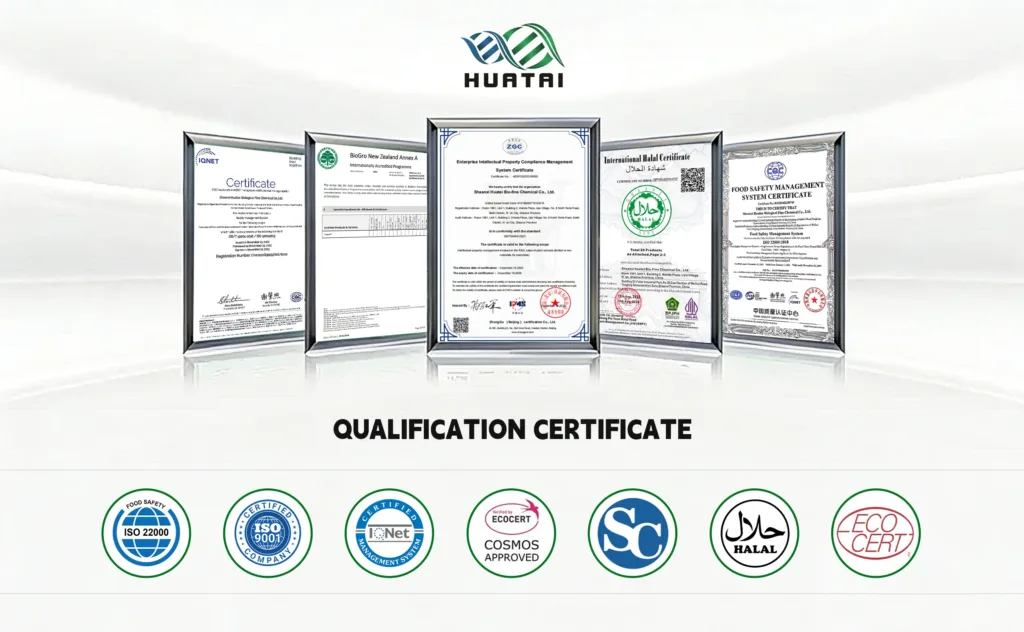
Uncompromising Quality & Credibility:We ensure every batch of our Active skincare ingredients meets rigorous quality standards, including COSMOS, ISO 9001/22000, and HALAL Certification. This commitment, backed by a complete Technical Dossier, offers clinically-backed solutions and guaranteed compliance for every formulation challenge.

-300x300.jpg)

 English
 German
 Italian
 French
 Spanish
 Japanese
 Korean
 Russian