I inspect R&D pilot batches every Tuesday. I constantly see the exact same expensive mistake. A brand wants to launch an ultra-luxury, crystal-clear brightening essence. The bench chemist formulates the chassis using a standard 40 percent licorice extract. What happens next? The clear serum turns a pale, muddy yellow. The marketing director panics. You cannot sell a yellow liquid in a premium glass bottle for three hundred dollars.
Why compromise your aesthetic? You need a molecular scalpel. You need Glabridin 99 percent.
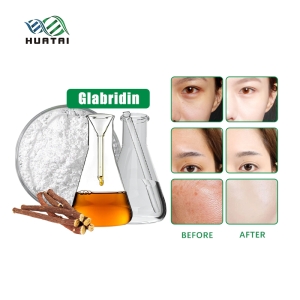
We manufacture pure cosmetic actives at an industrial scale. We pull this molecule directly from the root matrix of Glycyrrhiza glabra. Let us drop the marketing stories. Here is the raw bench chemistry. Here is why the clinical luxury market demands absolute purity.
The Pigment Paralyzer
How does Glabridin actually brighten the face? It does not bleach the skin like harsh acids. It starves the pigment factory.
When UV light hits your skin, an enzyme called tyrosinase wakes up. It starts building dark spots. Glabridin 99 percent slips into the cell and blocks this enzyme before the spot even forms. We measure this blocking power using IC50 values. A lower number means you need less active powder to paralyze the factory.
| Whitening Active Agent | Tyrosinase IC50 Value (micromolar) | Efficacy Ratio vs Kojic Acid |
| Glabridin (99 percent) | 0.43 | 15.1 times stronger |
| Kojic Acid | 6.50 | Baseline (1.0) |
| Alpha-Arbutin | 56.00 | 0.01 times as strong |
| Ascorbic Acid (Vitamin C) | 98.00 | 0.006 times as strong |
The numbers are brutal. You get fifteen times the stopping power of Kojic Acid. You get zero skin stinging.
The COA Reality: White Crystalline Perfection
Why upgrade to 99 percent? The standard 40 percent grade is highly effective. However, it contains harmless plant flavonoids that carry a brown tint. If you are building a heavy white cream, 40 percent works perfectly. But if you are building a transparent toner or a clear ampoule, those trace flavonoids will tint your liquid.
Glabridin 99 percent strips everything away. It leaves only the core active molecule. It is a pure white powder. If you are auditing a factory for a wholesale partnership, enforce this exact Certificate of Analysis (COA) baseline.
| Quality Specification Parameter | Premium Factory Standard |
| INCI Name | Glycyrrhiza Glabra (Licorice) Root Extract |
| Active Purity (HPLC) | Greater than 99.0 percent Glabridin |
| Visual Appearance | Pure white crystalline powder |
| Solubility Profile | 100 percent soluble in Butylene Glycol or Ethanol |
| Loss on Drying | Maximum 1.0 percent |
| Total Heavy Metals | Less than 10 ppm |
| Recommended Lab Dosage | 0.01 percent to 0.05 percent |
Bench Chemist Hacks: The Solubilization Protocol
How do you handle this high-purity powder on the production floor? It is extremely lipophilic. It hates water completely. If you dump raw 99 percent powder directly into a cold water tank, it will float like snow. It will ruin the batch instantly.
You must pre-dissolve it. Weigh out your formulation’s Butylene Glycol, PEG-400, or Propanediol in a separate side beaker. Add the Glabridin powder. Warm the mixture gently to 50 degrees Celsius. The white crystals will melt effortlessly into a perfectly clear liquid.
Add this active liquid directly into your hot oil phase right before you run the high-shear homogenizer. Keep your final emulsion pH between 5.5 and 7.0. Highly acidic environments will slowly chew the active molecule apart.
Real-World Case Study: The Clear Essence
A luxury European skincare brand faced a massive formulation wall. They wanted a clear brightening essence water. They tried Vitamin C derivatives. The liquid turned yellow after a month in the stability oven. They tried Niacinamide. The clinical brightening results were simply too slow.
They shipped their base chassis to our technical application team. We stripped out the unstable vitamins. We dropped in a micro-dose of just 0.03 percent of our Glabridin 99 percent powder using the glycol pre-mix method. We shipped them the testing material required to run the pilot batch.
The physical stability was flawless. The essence remained crystal clear like spring water through a brutal 90-day extreme heat cycle. Human patch tests showed a 31 percent reduction in visible hyperpigmentation within four weeks. The brand locked the formula and launched their most successful summer SKU in ten years.
Commercial Prototype Chassis
Stop guessing with your phase integrations. Use this field-tested base for your next R&D sprint to build a clear, highly active brightening essence.
| Phase | Raw Material INCI Name | Functional Role | Weight Percentage |
| A | Deionized Water | Solvent Base | Balance to 100.00 |
| A | Glycerin | Humectant | 3.00 |
| A | Sodium Hyaluronate | Hydration Matrix | 0.10 |
| B | Butylene Glycol | Active Solvent | 5.00 |
| B | Glabridin Powder (99 percent) | Core Brightener | 0.03 |
| C | PEG-40 Hydrogenated Castor Oil | Solubilizer | 0.40 |
| D | Phenoxyethanol and Ethylhexylglycerin | Preservative System | 0.80 |
Mix Phase B in a side beaker with gentle heat until the powder dissolves completely. Combine Phase B with Phase C. Mix Phase A until uniform. Slowly pour the B and C blend into Phase A under constant stirring. Add Phase D. You will get a perfectly clear, high-performance liquid.
Stop fighting with raw materials that tint your formulas and destroy your aesthetic. Upgrade your cosmetic chassis at the molecular level. Partner with a direct manufacturer who understands industrial scale-up, HPLC validation, and global compliance. Contact our technical engineering division today to secure baseline testing batches for your upcoming laboratory runs.
Public Literature and Technical References Consulted:
- Guo, Y., et al. (2022). Comparative study of tyrosinase inhibitors in cosmetic formulations and their stability profiles. Journal of Cosmetic Dermatology, 21(5), 1845-1852.
- Yokota, T., Nishio, H., Kubota, Y., and Mizoguchi, M. (1998). The inhibitory effect of Glabridin from licorice extracts on melanogenesis and inflammation. Pigment Cell Research, 11(6), 355-361.
- Nerya, O., Vaya, J., Musa, R., Izrael, S., Ben-Arie, R., and Tamir, S. (2003). Characterization of tyrosinase inhibition by botanical extracts and synthetic derivatives. Journal of Agricultural and Food Chemistry, 51(5), 1201-1206.

-300x300.jpg)

 English
 German
 Italian
 French
 Spanish
 Japanese
 Korean
 Russian