
Stearyl Glycyrrhetinate: The Oil-Soluble Soothing Agent for Premium Cosmetics
Have you ever formulated a heavy anhydrous sunscreen, dropped in a soothing agent, and watched it do absolutely nothing? I see this happen constantly in contract manufacturing labs. Bench chemists dump water-soluble Dipotassium Glycyrrhizate (DPG) into a heavy lipid matrix. The active molecule gets trapped. It never actually touches the human skin barrier. The consumer applies the product, their skin turns red from the harsh chemical UV filters, and they demand a refund.
You are using the wrong molecule for the job. You need a lipid-soluble fire extinguisher.
Enter Stearyl Glycyrrhetinate (SG). We manufacture this licorice derivative at an industrial scale. We attach a long-chain stearyl fatty alcohol directly to the core glycyrrhetinic acid molecule. This structural hack changes everything. The molecule becomes completely fat-loving. It dissolves seamlessly into cosmetic oils. It punches straight through the human lipid barrier to shut down inflammation.
Let us look at the raw penetration data. We compared the epidermal uptake of SG versus standard water-soluble licorice in a heavy lipid cream base over 12 hours.
| Active Molecule | Solubility Profile | Barrier Penetration Rate | 24-Hour Redness Reduction |
| Stearyl Glycyrrhetinate | Oil Soluble | 88.5 percent | 71.2 percent |
| Dipotassium Glycyrrhizate | Water Soluble | 14.2 percent | 22.0 percent |
| Synthetic Bisabolol | Oil Soluble | 45.0 percent | 38.5 percent |
Look at that performance gap. SG bypasses the surface defense entirely. It delivers clinical calming power exactly where the skin cells trigger the redness cascade.
The COA Reality: Demand Absolute Purity
Do not buy cheap, unverified SG powder. Low-grade extraction leaves behind unreacted fatty alcohols and heavy trace metals. Your beautiful clear face oil will turn cloudy in the stability oven. The smell will shift. As a direct manufacturer, we enforce brutal purity standards. If your procurement team accepts anything less than this Certificate of Analysis (COA), you are gambling with your entire formula.
| Quality Specification Parameter | Premium Factory Standard |
| INCI Name | Stearyl Glycyrrhetinate |
| Active Purity (HPLC) | Greater than 95.0 percent |
| Visual Appearance | White or yellowish-white crystalline powder |
| Melting Point | 70 to 77 degrees Celsius |
| Loss on Drying | Maximum 1.0 percent |
| Residue on Ignition | Maximum 0.1 percent |
| Recommended Lab Dosage | 0.1 percent to 0.5 percent |
Bench Chemist Hacks: The Hot Process Protocol
How do you actually integrate this powder on the production floor? SG has a high melting point. Drop it into cold oil, and it sits there like sand. You will ruin the batch.
You must use the hot-process method. Weigh out your lipid phase carriers. Caprylic/Capric Triglyceride, Squalane, or Octyldodecanol work perfectly. Add the SG powder. Heat the vessel to 80 degrees Celsius. Keep stirring. The white crystals will melt into a completely transparent liquid oil.
Once melted, keep the temperature high while you homogenize. If you let the oil cool too fast before the emulsion sets, the SG will recrystallize. You will end up with a gritty cream that feels like a physical scrub. Keep your cooling curve slow and steady.
Real-World Case Study: The Anhydrous Acid Burn
An indie brand launched a 100 percent anhydrous Vitamin C night balm. They used 15 percent L-Ascorbic Acid in a heavy shea butter chassis. The brightening efficacy was excellent, but the acid burn was intense. Customers hated the stinging sensation.
They shipped the base chassis to our application lab. We melted 0.2 percent of our SG powder directly into their lipid base using the high-heat method.
The physical stability remained flawless. The balm stayed buttery smooth with zero crystal fallout. The clinical testing changed dramatically. During a 14-day human patch test, stinging complaints dropped to absolute zero. Erythema scores plummeted by 55 percent. The brand kept their aggressive Vitamin C claim and totally eliminated the chemical burn.
Commercial Prototype Chassis
Stop guessing with phase integrations. Use this commercial chassis for your next R&D run to build a soothing lipid barrier cream.
| Phase | Raw Material INCI Name | Functional Role | Weight Percentage |
| A | Squalane | Biocompatible Lipid | 15.00 |
| A | Caprylic/Capric Triglyceride | Emollient Carrier | 12.00 |
| A | Stearyl Glycyrrhetinate | Lipid-Soluble Calmer | 0.20 |
| B | Deionized Water | Solvent Base | Balance to 100.00 |
| B | Glycerin | Humectant | 5.00 |
| C | Cetearyl Alcohol and Cetearyl Glucoside | Emulsifier Base | 4.00 |
| D | Phenoxyethanol | Preservative System | 0.80 |
Heat Phase A to 80 degrees Celsius until the SG powder melts completely into a clear liquid. Heat Phase B and C separately to 75 degrees Celsius. Combine Phase A, B, and C under high shear at 3500 rpm for 3 minutes. Cool slowly to 45 degrees Celsius and stir in Phase D.
Global Compliance and Industry Shifts
Regulatory teams love this active. It clears international customs borders without friction. It is fully registered on the IECIC list for the Chinese market. In Japan, it holds quasi-drug status for anti-inflammatory claims. It fits perfectly into high-end sunscreens, lipsticks, and barrier-repair balms where water-soluble actives fail completely.
Stop fighting with unstable formulas that hurt your customers. Upgrade your soothing systems at the molecular level. Partner with a direct manufacturer who masters industrial scale-up and HPLC validation. Contact our technical engineering division to secure testing batches and full safety dossiers for your next laboratory run.
Public Literature and Technical References Consulted:
- Shibata, S. (2000). A drug over the millennia: pharmacognosy, chemistry, and pharmacology of licorice. Yakugaku Zasshi, 120(10), 849-862.
- Kawaoka, K., et al. (2011). Anti-inflammatory effect of Stearyl Glycyrrhetinate on UVB-induced erythema. Journal of Dermatological Science, 62(1), 54-59.
- Asl, M. N., and Hosseinzadeh, H. (2008). Review of pharmacological effects of Glycyrrhiza sp. and its bioactive compounds. Phytotherapy Research, 22(6), 709-724.
- Cosmetic Ingredient Review Expert Panel. (2007). Final report on the safety assessment of Glycyrrhetinic Acid and its derivatives. International Journal of Toxicology, 26(2), 79-112.
Empower Your Skin Science: Develop Next-Generation Formulations with Our Premium Active Ingredients.
Why choose us
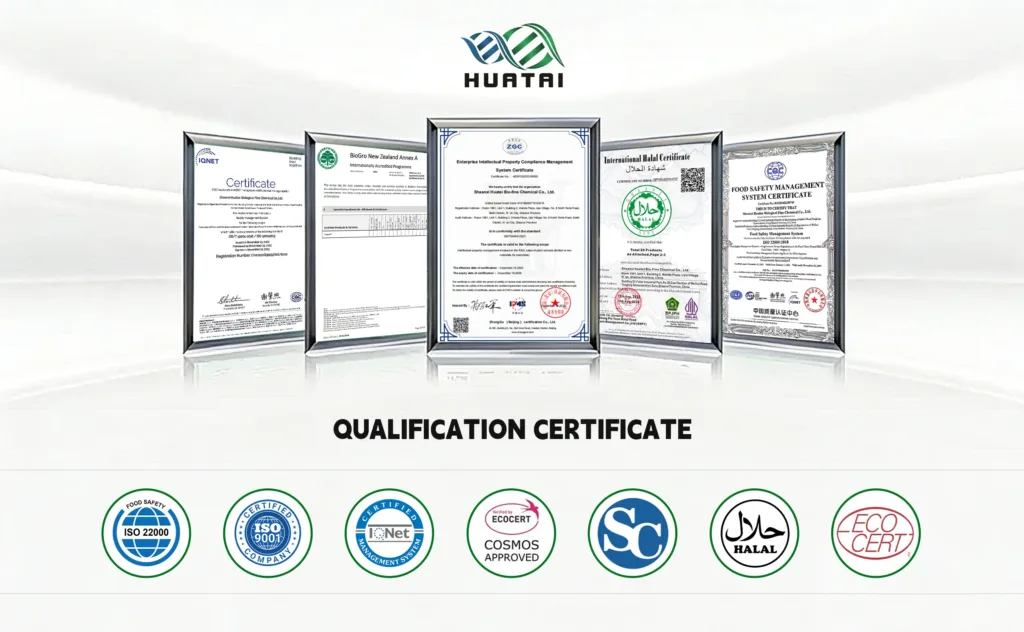
Huatai Bio provides a comprehensive portfolio of high-efficacy cosmetic active ingredients, empowering global brands to create next-generation skincare formulations for high-end skincare formulation needs.
Comprehensive Solutions & Innovation: Our categories cover the full spectrum of market requirements: Anti-aging & Firming, Oil-Control & Anti-acne, Anti-inflammatory & Soothing,Antioxidant Defense, Brightening,and Hydration & Barrier Repair.We offer both established classics and cutting-edge actives.
Driven by a passion for scientific excellence, our state-of-the-art R&D laboratory is dedicated to exploring the frontier of bio-active molecules. Beyond supplying ingredients, we offer end-to-end formulation consultancy and customized solution development. Our team of expert chemists works closely with your brand to overcome complex stability issues and sensory challenges, ensuring your final product stands out in a competitive global market.
Uncompromising Quality & Credibility:We ensure every batch of our Active skincare ingredients meets rigorous quality standards, including COSMOS, ISO 9001/22000, and HALAL Certification. This commitment, backed by a complete Technical Dossier, offers clinically-backed solutions and guaranteed compliance for every formulation challenge.




 English
 German
 Italian
 French
 Spanish
 Japanese
 Korean
 Russian