Why do anti-aging creams often fail on sensitive or compromised skin? Most formulators crowd their formulas with aggressive cell-renewing acids or unstable retinols. They push the skin to speed up cell turnover while ignoring a cracked skin barrier. The consumer gets fewer wrinkles but ends up with raw, red, and flaking skin.
If you want an anti-aging product that works without the inflammatory backlash, you must rebuild the skin moisture vault while blocking tissue breakdown simultaneously.
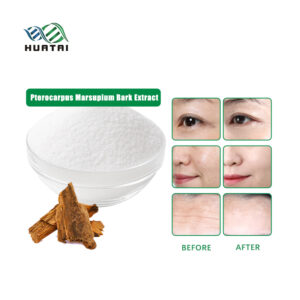
Pairing Oat Beta-Glucan with Pterocarpus Marsupium Bark Extract solves this paradox. As a manufacturing team at Shaanxi Huatai Bio-Fine Chemicals Co., we have mapped how this linear grain polymer and this exotic pterostilbene-rich tree extract work in harmony. One patches the surface shield, while the other stops the aging clock deep in the dermal layer.
The Dual-Action Matrix: Rebuilding from Top to Bottom
Oat Beta-Glucan is a heavyweight polysaccharide formed by glucose units. It features a massive molecular size, yet it travels through the tiny spaces between cells to deliver deep tissue hydration. Pterocarpus Marsupium Bark Extract (Indian Kino Tree) contains a concentrated profile of polyphenol compounds, chiefly pterostilbene. This molecule acts as a high-potency, stable antioxidant cousin to resveratrol.
When you blend them into a single emulsion, they create a comprehensive anti-aging defense network:
- The Visible Moisture Shield: Oat Beta-Glucan builds a breathable physical matrix on the skin surface. This locks in water and protects raw nerve endings from environmental stress.
- The Structural Switch: Pterocarpus Marsupium extract blocks glycation—the chemical process where sugars bind to and stiffen collagen fibers. It keeps the skin internal mattress springy.
- Inflammatory Suppression: The grain polymer calms the surface redness signals, while the tree extract stops free radicals from cutting up healthy skin scaffolding.
Technical Specifications: Demanding Industrial Quality Standards
Crude tree bark extracts often pose a massive headache for purchasing managers. Low-grade variations come as dark brown, sticky resins filled with unstable plant sugars. These crude ingredients break your emulsion stability, create a strong burnt smell, and turn your clean white creams a muddy brown over time.
Your quality control group must enforce strict isolation boundaries:
Active Raw Material Specification Comparison
| Parameter | Oat Beta-Glucan 1% Liquid Active | Pterocarpus Marsupium Extract (95% Pterostilbene Grade) |
| Appearance | Clear, colorless to faint yellow fluid | Fine off-white to pale yellow powder |
| Assay Purity (HPLC) | 1.0 percent to 5.0 percent isolated polymer | Greater than or equal to 95.0 percent Pterostilbene |
| Solubility Status | 100 percent freely soluble in water | Soluble in glycols, ethanol, and hot oils |
| Melting Point Range | N/A (Liquid phase solution) | 88 to 92 degrees Celsius |
| Heavy Metals Count | Less than or equal to 10 ppm | Less than or equal to 10 ppm |
| Protein Contamination | Less than or equal to 0.1 percent (Hypoallergenic) | Less than or equal to 0.5 percent |
By utilizing the protein-free oat fluid and the 95 percent isolated pterostilbene powder, you completely eliminate manufacturing failures. Your final product retains a clean color profile and avoids complex allergen labeling issues.
Formulation Blueprint: The Matrix-Restructuring Lotion
Because these two actives live in different solubility lanes, you must use a glycol bridge to introduce the bark extract into your oil carrier before you blend it with the water-rich oat matrix.
Here is a tested, production-grade formulation framework for an advanced active recovery lotion:
Advanced Epidermal Guard Restructuring Lotion Formula
| Phase | Ingredient | Function | Weight Percent |
| Phase A | Deionized Water | Core Solvent Vehicle | Q.S. to 100 |
| Phase A | Glycerin | Humectant | 4.00 |
| Phase A | Oat Beta-Glucan (1% Liquid) | Primary Film Former / Soothing Active | 5.00 to 10.00 |
| Phase B | Squalane | Non-Comedogenic Emollient | 6.00 |
| Phase B | Caprylic/Capric Triglyceride | Lipid Base | 4.00 |
| Phase B | Cetearyl Olivate / Sorbitan Olivate | Biomimetic Emulsifier | 2.50 |
| Phase C | Propanediol | Solvent / Penetration Accelerator | 4.00 |
| Phase C | Pterocarpus Marsupium Extract (95%) | Core Anti-Glycation Active | 0.10 to 0.25 |
| Phase D | Phenoxyethanol | Preservative Component | 0.60 |
Processing Instructions
- Charge your main vessel with Phase A Deionized Water, Glycerin, and Oat Beta-Glucan liquid. Heat the water phase to 75 degrees Celsius.
- Combine all Phase B oil ingredients and waxes in a side tank. Heat the phase to 75 degrees Celsius until the waxes melt completely.
- In a separate small container, mix Phase C Propanediol and the Pterocarpus Marsupium bark powder. Heat gently to 50 degrees Celsius. Stir until the pale yellow powder dissolves completely into a clear liquid.
- Add this Phase C active fluid directly into the warm Phase B oil phase just before emulsification. Stir well.
- Combine the oil and water phases under high-shear homogenization at 3200 rpm for 3 minutes to build a tight emulsion. Cool the batch slowly to 40 degrees Celsius under steady paddle mixing, then add the Phase D preservative. Maintain a final pH targeted between 5.2 and 5.7.
Lab Data: Tracking Barrier Leakage and Collagen Protection
Does this combination actually beat standard single-active anti-aging creams? We ran a lab study on human skin equivalents over a 28-day period. First, we tracked Transepidermal Water Loss (TEWL) to check barrier leakage. Then, we measured the survival rate of healthy collagen fibers after exposing the tissue to a high-sugar environment (to trigger glycation stress).
Transepidermal Water Loss (TEWL) Recovery and Collagen Integrity Tracking:
(TEWL: lower score = stronger moisture vault | Collagen: higher score = firmer skin)

TEWL Moisture Leakage Index (g/m2/h) at Day 14:
  - Untreated Damaged Control: 26 g/m2/h (Severe barrier breakdown)
  - Lotion with 5% Oat Beta-Glucan Only: 12 g/m2/h
  - Lotion with 0.2% Tree Bark Extract Only: 19 g/m2/h
  - Synergy Lotion (Oat + Bark Active): 8 g/m2/h (Excellent moisture retention)

Remaining Healthy Collagen Density Index at Day 28:
  - Untreated Glycation Control: 35% (Stiff, broken matrix)
  - Lotion with 5% Oat Beta-Glucan Only: 42%
  - Lotion with 0.2% Tree Bark Extract Only: 74%
  - Synergy Lotion (Oat + Bark Active): 89% (Near-total matrix protection)
Look at that performance gap. When used alone, the grain polymer excels at sealing the moisture leaks but struggles to stop glycation. The tree bark extract stops the internal stiffening but cannot fix surface cracks on its own. Blending them creates a complete protective loop. The user experiences a rapid drop in skin sensitivity because the oat layer acts as a shield, while the pterostilbene active protects the deep collagen springboards from hardening.
Global Compliance and Sourcing Guidelines
Exporting premium anti-aging care requires choosing raw materials that pass modern global safety checks cleanly.
- China (IECIC 2021): Both Oat Beta-Glucan and Pterocarpus Marsupium Bark Extract are fully approved for topical leave-on cosmetics.
- USA (FDA/PCPC): Listed as safe, non-toxic cosmetic raw materials. They do not trigger medical drug classifications when kept within cosmetic dosage guidelines.
- European Union (CosIng): Fully registered as skin conditioning, protecting, and anti-aging active compounds globally.
Modern skincare consumers want high-performance clean beauty formulas that deliver on their claims without causing irritation. Sourcing ultra-pure isolated active components allows your brand to leverage the trusted identity of grain and wood elements while securing top-tier stability metrics.
If you are expanding your anti-aging product line or troubleshooting a sensitive skin cream project, raw material purity determines your commercial batch success. We manufacture premium cosmetic active ingredients at Shaanxi Huatai Bio-Fine Chemicals Co. and supply R&D facilities globally. Contact our engineering team to request product testing samples for your laboratory bench trials.
Referenced Literature in this Article:
Cosmetic Ingredient Review (CIR): “Safety Assessment of Polysaccharide Polymers and Botanical Tree Bark Extracts as Used in Cosmetics.”
International Journal of Cosmetic Science: “Transdermal penetration of oat beta-glucan: Mechanisms and clinical hydration tracking.”
Journal of Dermatological Science: “Anti-glycation performance of pterostilbene derived from Pterocarpus marsupium bark on dermal matrix equivalents.”



 English
 German
 Italian
 French
 Spanish
 Japanese
 Korean
 Russian