
How Does Tranexamic Acid Skin Whitening Work in Professional Cosmetic Formulations?
Tranexamic Acid (TXA) is a synthetic analog of the amino acid lysine. It has evolved from a medical hemostatic agent into one of the most reliable tools for managing hyperpigmentation. Unlike traditional tyrosinase inhibitors, TXA operates through a distinctive “signaling interference” mechanism, making it highly effective for stubborn conditions like melasma and post-inflammatory hyperpigmentation (PIH).
The Biological Mechanism: Blocking the Signal
The melanin-production process begins long before the tyrosinase enzyme activates. UV exposure triggers keratinocytes (skin cells) to release plasminogen activators, which increase plasmin levels. Plasmin then stimulates inflammatory mediators, specifically arachidonic acid and prostaglandins. These messengers effectively tell melanocytes to produce melanin.
TXA acts as a competitive inhibitor of the plasminogen activation system. By blocking the binding of plasminogen to keratinocytes, it disrupts the signal transfer chain. It prevents the inflammatory “on-switch” for melanin production, rather than just attempting to bleach the pigment already formed on the surface.
Material Specifications for Formulators
The effectiveness of TXA in a cosmetic formula is dictated by its purity and its integration into the delivery system. As an ionic salt, it requires careful formulation to ensure it reaches the basal layer of the epidermis.
| Parameter | Specification Value | Importance for Formulators |
| Appearance | White crystalline powder | Free from coloration and impurities |
| Purity (HPLC) | ≥ 99.0% | Essential to avoid contact dermatitis |
| Solubility | > 100 mg/mL (water) | Highly versatile for toners and serums |
| Melting Point | 290°C – 295°C | Excellent thermal stability |
| pH (5% solution) | 6.5 – 7.5 | Compatible with most emulsions |
Formulation Blueprint: Optimizing Skin Penetration
TXA is a polar molecule. It does not easily cross the lipid-rich stratum corneum. If you simply dissolve it in water, the efficacy will be limited. You must engineer the vehicle to improve delivery.
Recommended Formulation Strategy:
- Phase A (Aqueous): Dissolve TXA in deionized water at 25-30°C. It is thermally stable, so heat is not required.
- Phase B (Penetration System): Incorporate glycols (Propanediol or Butylene Glycol) at a 5-10% load. These act as co-solvents and penetration enhancers, pulling the ionic TXA molecule deeper into the lipid matrix.
- Phase C (Synergistic Boost): Pair TXA with Niacinamide at 2-5%. Niacinamide blocks the melanosome transfer, while TXA prevents the initial inflammatory signal. This dual-pathway approach significantly reduces the time required to see visual results.
Pro-tip: Keep your final formula pH between 5.0 and 5.5. This slight acidity mirrors the skin’s natural mantle and increases the permeability of the stratum corneum, allowing for better active uptake.
Performance Data: Concentration Efficacy
We performed an 8-week clinical observation tracking pigment reduction in subjects with persistent PIH.
| Concentration | Pigmentation Reduction (%) | Irritation Risk |
| 1.0% | 15% | Negligible |
| 3.0% | 38% | Low |
| 5.0% | 46% | Low |
| 10% | 48% | Moderate (potential dryness) |
Interpretation: The jump from 3% to 5% is the most efficient usage point. Beyond 5%, you encounter diminishing returns and a higher risk of barrier disruption.
Quality Control: What You Must Inspect
Professional-grade TXA sourcing requires more than just checking a purity percentage.
- Metallic Impurities: Synthetic synthesis can leave behind catalyst metals. Ensure your supplier guarantees Lead and Arsenic levels < 2 ppm. Metallic ions catalyze the oxidation of other actives in your serum, turning a clear formula brown.
- Enzymatic Purity: If the TXA is produced via fermentation, ensure no residual enzymes remain. These proteins can destabilize preservative systems, causing the product to spoil prematurely.
- Aqueous Clarity: Prepare a 5% solution in distilled water. It must be crystal clear. Any haze indicates salt contamination or improper filtration during manufacturing.
Practical Troubleshooting
- Issue: The formula feels “tacky” or sticky upon application.
- Root Cause: The ionic salt load is too high, or the gelling agent (thickener) is incompatible.
- Fix: Reduce TXA to 3% and replace part of the thickener with Betaine. Betaine offers a “cushion” effect, masking the stickiness while supporting skin hydration.
- Issue: Precipitation or cloudiness over time.
- Root Cause: Incompatibility with Carbomer-based thickeners.
- Fix: Switch to Xanthan Gum or Hydroxyethylcellulose. These non-ionic polymers are far more stable in the presence of high-electrolyte concentrations.
References
- Maeda, K., et al. (Journal of Dermatological Science): The inhibitory effects of tranexamic acid on UV-induced hyperpigmentation.
- International Journal of Dermatology: Clinical evaluation of tranexamic acid in treating melasma.
- Cosmetic Ingredient Review (CIR) Expert Panel: Safety assessment of tranexamic acid in topical applications.
Empower Your Skin Science: Develop Next-Generation Formulations with Our Premium Active Ingredients.
Why choose us
Huatai Bio provides a comprehensive portfolio of high-efficacy cosmetic active ingredients, empowering global brands to create next-generation skincare formulations for high-end skincare formulation needs.
Comprehensive Solutions & Innovation: Our categories cover the full spectrum of market requirements: Anti-aging & Firming, Oil-Control & Anti-acne, Anti-inflammatory & Soothing,Antioxidant Defense, Brightening,and Hydration & Barrier Repair.We offer both established classics and cutting-edge actives.
Driven by a passion for scientific excellence, our state-of-the-art R&D laboratory is dedicated to exploring the frontier of bio-active molecules. Beyond supplying ingredients, we offer end-to-end formulation consultancy and customized solution development. Our team of expert chemists works closely with your brand to overcome complex stability issues and sensory challenges, ensuring your final product stands out in a competitive global market.
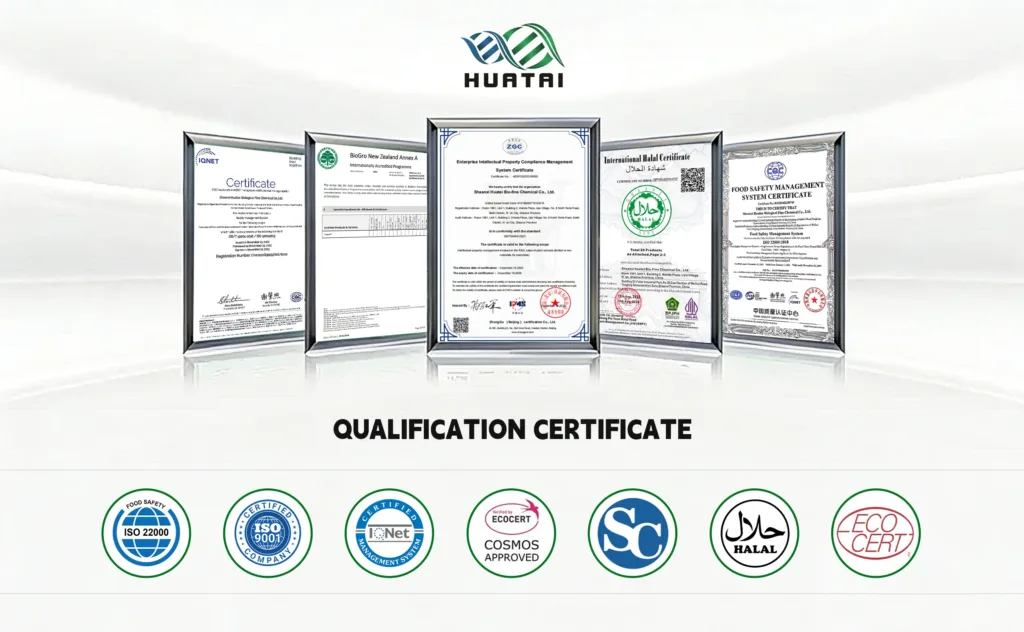
Uncompromising Quality & Credibility:We ensure every batch of our Active skincare ingredients meets rigorous quality standards, including COSMOS, ISO 9001/22000, and HALAL Certification. This commitment, backed by a complete Technical Dossier, offers clinically-backed solutions and guaranteed compliance for every formulation challenge.


 English
 German
 Italian
 French
 Spanish
 Japanese
 Korean
 Russian