
Beyond Tyrosinase: What PIH Teaches Us About Evaluating Cosmetic Brightening Ingredients
In pigmentation ingredient development, tyrosinase inhibition is often one of the first results considered during early screening. That makes sense. Tyrosinase is directly involved in melanin synthesis, and an inhibition assay provides a relatively simple way to compare different compounds under controlled conditions.
Key Takeaway: As development moves toward formulation, enzyme activity becomes only part of the evaluation. A strong tyrosinase inhibition result does not necessarily predict how an ingredient will behave in a finished cosmetic formula.
PIH Is an Inflammation-Driven Pigmentation Response
Post-inflammatory hyperpigmentation (PIH) does not begin with melanin production alone. In many cases, inflammation comes first. Following acne, irritation, dermatitis, or other forms of skin stress, inflammatory signals can change the surrounding cellular environment.
Research has associated PIH-related pigmentation with several biological factors (these do not directly “create pigment” but modify cell communication):
| Biological Factor | Primary Role in PIH |
|---|---|
| Cytokines | Alter signaling pathways received by melanocytes |
| Reactive Oxygen Species (ROS) | Modify oxidative balance and influence cellular responses |
| Prostaglandins | Mediate inflammation and stimulate melanocyte activity |
| Endothelin-related signaling | Act as communication messengers modifying pigmentation response |
Inflammation
↓
Changes in cellular signaling
↓
Melanocyte activation
↓
Changes in melanogenesis activity
↓
Pigment accumulation
Looking at Melanocytes Beyond a Single Enzyme
Tyrosinase remains an important target, but melanocyte behavior is also regulated by upstream signaling pathways. MITF (microphthalmia-associated transcription factor) is one important example. It regulates the expression of several pigmentation-related genes, including tyrosinase.
An ingredient that directly affects tyrosinase provides information about enzyme-level activity. An ingredient that influences upstream signaling provides a different type of evidence. Neither is necessarily better; they simply examine different points within the same biological process.
Why Melanosome Transfer Should Not Be Ignored
Pigmentation does not end when melanocytes produce melanin. The overall visible pigmentation process involves multiple sequential steps. Understanding where an ingredient acts can help determine how it should be evaluated.
| Step 1 | Step 2 | Step 3 | Step 4 | Step 5 |
|---|---|---|---|---|
| Melanocyte Activation | Melanin Synthesis | Melanosome Formation | Melanosome Transfer | Pigment Distribution |
Oxidative Stress & Botanical Ingredient Profiles
Inflammation and oxidative stress are closely connected. Changes in oxidative balance can influence cellular responses, which is why antioxidant mechanisms frequently appear in pigmentation research. Botanical-derived compounds act through varied pathways:
| Active Ingredient | Primary Investigated Mechanisms |
|---|---|
| Glabridin (Licorice-derived) | Tyrosinase activity, melanogenesis regulation, and inflammatory responses. |
| Licochalcone A (Licorice-derived) | Inflammatory signaling and oxidative stress pathways. |
From Biological Activity to Formula Performance
A promising laboratory result still needs to perform within a real formulation. A compound may show interesting activity in a controlled test system, while a cosmetic formula presents a much more complex environment.
| Key Formulation Performance Factors | |
|---|---|
| Ingredient Stability | Resistance to oxidation, light degradation, and structural breakdown over time. |
| Solubility | Ability to fully integrate into the product’s delivery system (water/oil phase). |
| pH Conditions | Maintaining the optimal acid/base environment for active efficacy. |
| Processing Temperature | Heat tolerance during compounding and manufacturing. |
| Compatibility | Interactions with other active ingredients, emulsifiers, or preservatives. |
FAQ: PIH and Cosmetic Ingredient Evaluation
Q: Why is tyrosinase inhibition commonly tested for pigmentation ingredients?
A: Because tyrosinase is directly involved in melanin synthesis, its inhibition provides useful information during early ingredient screening.
Q: Why does tyrosinase inhibition not fully explain PIH?
A: Because PIH involves more than melanin production. Inflammation, melanocyte regulation, oxidative stress, and melanosome transfer can also contribute to the pigmentation response.
Q: How does inflammation affect pigmentation?
A: Inflammatory signals can modify melanocyte activity and influence pigmentation-related pathways.
Q: Why is formulation performance important for cosmetic actives?
A: Because biological activity observed in a controlled test does not always translate directly into finished product performance.
Q: What should be considered when evaluating PIH-related ingredients?
A: Mechanism, stability, formulation compatibility, and application conditions should be considered together.
References
- Callender VD, St Surin-Lord S, Davis EC, Maclin M. Postinflammatory Hyperpigmentation: Etiologic and Therapeutic Considerations. American Journal of Clinical Dermatology. 2011.
- Davis EC, Callender VD. Postinflammatory Hyperpigmentation: A Review of the Epidemiology, Clinical Features, and Treatment Options in Skin of Color. Journal of Clinical and Aesthetic Dermatology. 2010.
- D’Mello SAN, Finlay GJ, Baguley BC, Askarian-Amiri ME. Signaling Pathways in Melanogenesis. International Journal of Molecular Sciences. 2016.
- Lin JY, Fisher DE. Melanocyte Biology and Skin Pigmentation. Nature. 2007.
- Slominski A, Tobin DJ, Shibahara S, Wortsman J. Melanin Pigmentation in Mammalian Skin and Its Hormonal Regulation. Physiological Reviews. 2004.
Empower Your Skin Science: Develop Next-Generation Formulations with Our Premium Active Ingredients.
Why choose us
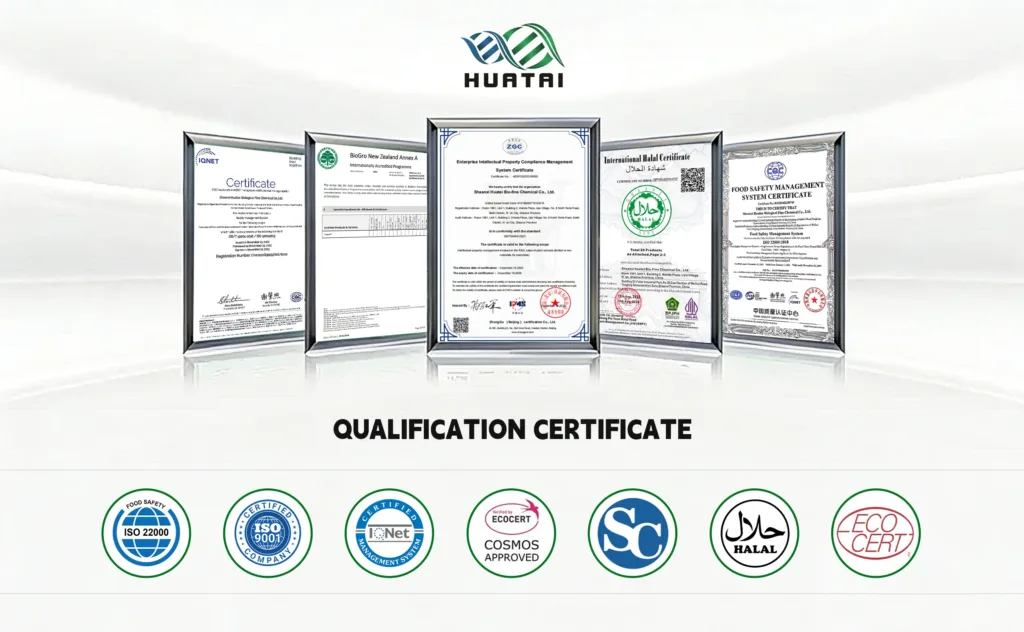
Huatai Bio provides a comprehensive portfolio of high-efficacy cosmetic active ingredients, empowering global brands to create next-generation skincare formulations for high-end skincare formulation needs.
Comprehensive Solutions & Innovation: Our categories cover the full spectrum of market requirements: Anti-aging & Firming, Oil-Control & Anti-acne, Anti-inflammatory & Soothing,Antioxidant Defense, Brightening,and Hydration & Barrier Repair.We offer both established classics and cutting-edge actives.
Driven by a passion for scientific excellence, our state-of-the-art R&D laboratory is dedicated to exploring the frontier of bio-active molecules. Beyond supplying ingredients, we offer end-to-end formulation consultancy and customized solution development. Our team of expert chemists works closely with your brand to overcome complex stability issues and sensory challenges, ensuring your final product stands out in a competitive global market.
Uncompromising Quality & Credibility:We ensure every batch of our Active skincare ingredients meets rigorous quality standards, including COSMOS, ISO 9001/22000, and HALAL Certification. This commitment, backed by a complete Technical Dossier, offers clinically-backed solutions and guaranteed compliance for every formulation challenge.


 English
 German
 Italian
 French
 Spanish
 Japanese
 Korean
 Russian