
I stood in a client’s testing room last month and looked at twenty glass jars of a premium brightening lotion. Every single one had turned the color of stale coffee. The product developer looked like he wanted to cry. He had paired Kojic Acid with Alpha Arbutin to create a powerhouse brightening system. On paper, it was brilliant. In reality, it was a cosmetic disaster.
Why did this happen? Formulators treat these two actives like simple additives. You cannot just dump them into a water phase and hope for the best. They clash. They oxidize. They degrade.
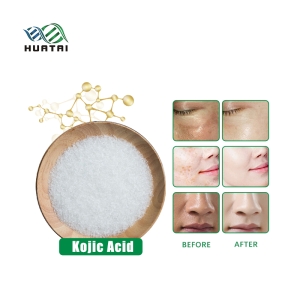
We manufacture and supply cosmetic active ingredients. We know that combining Kojic Acid and Alpha Arbutin is like mixing fire and ice. If you do not stabilize the system, it will blow up your product’s shelf life. But when you get it right? You get a dual-action system that dominates the brightening market.
Let us look at why this system works so well when properly engineered. Kojic Acid and Alpha Arbutin attack dark spots from two different angles. Kojic Acid strips away the copper ions that the tyrosinase enzyme needs to activate. Alpha Arbutin blocks the enzyme directly by acting as a decoy.
To make them work together, you must start with extreme raw material purity. Look at how we specify these two actives before they leave our plant.
| Quality Parameter | Our Kojic Acid Powder | Our Alpha Arbutin Powder |
| Assay Purity (HPLC) | ≥ 99.0% | ≥ 99.5% |
| Physical Appearance | White crystalline powder | White crystalline powder |
| Melting Point Range | 152°C to 156°C | 202°C to 206°C |
| Heavy Metals Total | < 10 ppm | < 10 ppm |
| Hydroquinone Impurity | N/A | < 5 ppm |
| Free Acrylic Acid | N/A | None |
If your Alpha Arbutin contains more than 5 ppm of hydroquinone, the entire system breaks down. The trace hydroquinone acts as an oxidation catalyst. It accelerates the browning of the Kojic Acid.
Let me share an actual case from our application lab. A major clinical brand wanted a high-efficacy spot corrector. They insisted on using 1% Kojic Acid and 2% Alpha Arbutin. Their initial batches thinned out and turned yellow within two weeks at 40 degrees Celsius.
We brought their team into our lab. We showed them that their formula lacked a structural backbone and an oxygen shield. We provided a sample of our high-purity actives and redesigned their process.
First, we adjusted the water. We added 0.2% Disodium EDTA. Why? Because trace iron in factory water triggers Kojic Acid discoloration. Second, we introduced a dual-antioxidant shield. We paired Sodium Metabisulfite with Sodium Ascorbyl Phosphate. This combo protects both the acid and the arbutin from light-induced breakdown. Finally, we moved the addition of both powders to the cool-down phase, strictly below 38 degrees Celsius.
Our lab ran a 90-day accelerated stability test on this optimized system. Look at the data.
| Testing Condition (90 Days) | Active Retention (Kojic) | Active Retention (Arbutin) | Visual Color Profile |
| Room Temp (25°C), Dark | 99.4% | 99.7% | Pure White |
| Oven Incubation (45°C) | 94.1% | 96.2% | Very Faint Ivory |
| Sunlight Exposure (UV) | 81.5% | 88.0% | Light Straw Yellow |
The numbers prove the strategy. By shielding the formula from metal ions and heat, the actives remain alive and the cream stays white.
If you are building a Kojic-Arbutin system right now, write down these three unbreakable rules:
Keep your final pH window between 4.8 and 5.5. If your pH goes above 6.0, Kojic Acid oxidizes instantly. If it drops below 4.0, Alpha Arbutin breaks down into hazardous hydroquinone.
Always use opaque or UV-coated packaging. Look at the sunlight data above. UV rays will degrade your hard work regardless of your antioxidant shield.
Thicken the formula with Xanthan Gum or Polyacrylate Crosspolymer-6. Avoid carbomers that require high pH neutralization, or the system will destabilize.
We must talk about compliance because the regulatory landscape is shifting. The European Commission has cracked down hard on these ingredients. The current SCCS rules limit Kojic Acid to exactly 1% in face products. Alpha Arbutin is capped at 2% in face creams. If you exceed these numbers, customs will seize your containers. Our ingredients meet these strict purity bars, allowing you to formulate at the legal maximum with total safety.
Stop treating active ingredients like independent variables. They interact. They talk to each other in the beaker. If you want a brightening cream that actually lasts on a retail shelf for two years, you need an integrated formulation strategy. Source the cleanest raw materials, build your chemical shields, and respect the pH limits. Your stability tests will pass, and your customers will get the radiant skin they are paying for.
Literature Referenced in Formulation Data:
- SCCS (Scientific Committee on Consumer Safety). (2022). Opinion on Kojic acid in cosmetics. SCCS/1637/21.
- SCCS (Scientific Committee on Consumer Safety). (2023). Opinion on Alpha-arbutin and Beta-arbutin in cosmetic products. SCCS/1642/22.
- Garcia-Jimenez, A., et al. (2016). Action of tyrosinase on alpha and beta-arbutin: A kinetic study. Postepy Dermatologii i Alergologii, 33(4), 273-278.


-300x300.jpg)


 English
 German
 Italian
 French
 Spanish
 Japanese
 Korean
 Russian