
Comment l'extrait de réglisse (Glycyrrhiza glabra) peut-il transformer les formulations modernes de soins de la peau ?
Extrait de réglisse (Glycyrrhiza glabra) est souvent confondu avec un seul ingrédient « apaisant ». C'est une simplification massive. En réalité, c'est une boîte à outils multi-actifs. Pour transformer vos formulations, vous devez cesser de considérer la réglisse comme une matière première et commencer à la considérer comme une sélection stratégique de molécules spécifiques.
La carte moléculaire : choisissez votre arme
Un « extrait de racine de réglisse » générique est une boîte noire. Vous n'avez aucun contrôle sur le rapport des constituants. La formulation haut de gamme nécessite des isolats.
| Marqueur | Cible Biologique | Solubilité | Rôle de formulation |
| Glabridine | Tyrosinase enzyme | Liposoluble | Intensive Brightening |
| Glycyrrhizine | Cytokines inflammatoires | soluble dans l'eau | Rougeur/Réparation de la barrière |
| Licochalcone A | Fonction des sébocytes | Liposoluble | Contrôle de l'acné/du sébum |
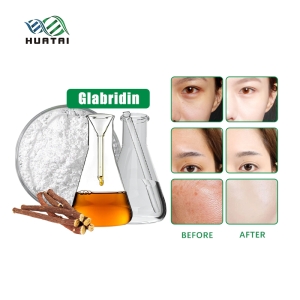
Glabridine : la référence pour les taches brunes
La glabridine est la star du spectacle pour l'éclaircissement. Sa structure lui permet de se lier au site actif de la tyrosinase plus efficacement que les alternatives synthétiques comme l'acide kojique.
La réalité de la formulation :
La glabridine est très sensible à l'oxydation. Si vous l'exposez à l'air ou à la lumière directe pendant le mélange, elle brunit.
Astuce de pro pour la stabilité :
N'ajoutez pas de poudre de glabridine directement dans un tonique à base d'eau. Elle va précipiter. Dissolvez-la dans un support lipophile (comme le squalane ou un ester de haute qualité) à 50°C. Une fois la phase huileuse stable, émulsifiez-la dans votre phase aqueuse. Utilisez un emballage sans air pour éviter que le produit final ne jaunisse avec le temps.
Glycyrrhizine : le bouclier de la barrière
Lorsque votre formule utilise des actifs agressifs comme le rétinol ou des AHA à forte dose, la glycyrrhizine est votre filet de sécurité. Elle imite la structure du cortisol, fournissant un effet anti-inflammatoire localisé sans les risques des stéroïdes synthétiques.
| Fonctionnalité | Détails techniques |
| Apparence | Poudre cristalline blanche |
| Dosage (HPLC) | ≥ 98,0% |
| Point de fusion | 215°C – 225°C |
| Perte au séchage | ≤ 8.0% |
| Métaux lourds | ≤ 10 ppm |
Parce que c'est un sel (glycyrrhizinate dipotassique), il est soluble dans l'eau. Vous pouvez le verser dans la phase aqueuse dès le début. Il est thermiquement stable, donc le chauffer à 80°C ne le dégrade pas.
Étude de cas pratique : le sérum « Réparer-Éclaircir »
Nous avons testé un sérum à double action conçu pour la pigmentation post-acnéique.
- Le problème : Les sérums éclaircissants traditionnels provoquent souvent des irritations, ce qui entraîne plus de pigmentation (PIH).
- La solution : Combinez 0,5 % de glabridine (pour l'inhibition) avec 1,0 % de glycyrrhizinate dipotassique (pour l'anti-inflammation).
Résultat : La présence du sel de réglisse a calmé la réponse de la peau, permettant à la glabridine de fonctionner sans déclencher le cycle « irritation-pigmentation ». Nos données de laboratoire ont montré une réduction 28 % plus rapide de la PIH par rapport à l'utilisation de la glabridine seule.
Contrôle qualité : pourquoi la pureté est importante
Vous ne pouvez pas construire un produit de luxe avec des extraits de faible qualité. La réglisse de faible pureté contient souvent des pesticides résiduels et des métaux lourds absorbés du sol.
- Pesticide Screening: Exigez toujours un rapport d'analyse multi-résidus.
- Colorimetric Consistency: Si votre matière première n'est pas blanche, elle n'est pas pure à 98 %. Ne laissez pas un fournisseur vous dire le contraire.
- Teneur en cendres : Une teneur élevée en cendres dans le COA indique des sels résiduels ou des impuretés provenant d'une extraction incorrecte. C'est une cause fréquente d'irritation « inexpliquée » dans les produits pour peaux sensibles.
Dépannage de votre formulation
- Issue: La formule perd son efficacité éclaircissante après 3 mois.
- Root Cause: Dégradation des flavonoïdes induite par la lumière.
- Fix: Vérifiez votre emballage. S'il est transparent, la formule échouera. Passez à des distributeurs opaques sans air.
- Issue: La crème a une texture « granuleuse ».
- Root Cause: Recrystallization of lipophilic markers.
- Fix: Augmentez la polarité de votre phase huileuse. Utilisez du carbonate de dicaprylyle au lieu de triglycérides standard pour améliorer le pouvoir solvant de votre phase huileuse.
Références
- Yokota, T., et al. (Pigment Cell Research): Tyrosinase inhibitory activity of glabridin.
- Saeedi, M., et al. (Journal of Cosmetic Dermatology): Licorice root extracts and anti-inflammatory properties.
- ISO 22716 : Bonnes pratiques de fabrication pour les produits cosmétiques.
Optimisez votre science de la peau : développez des formules de nouvelle génération grâce à nos ingrédients actifs de qualité supérieure.
Pourquoi nous choisir ?
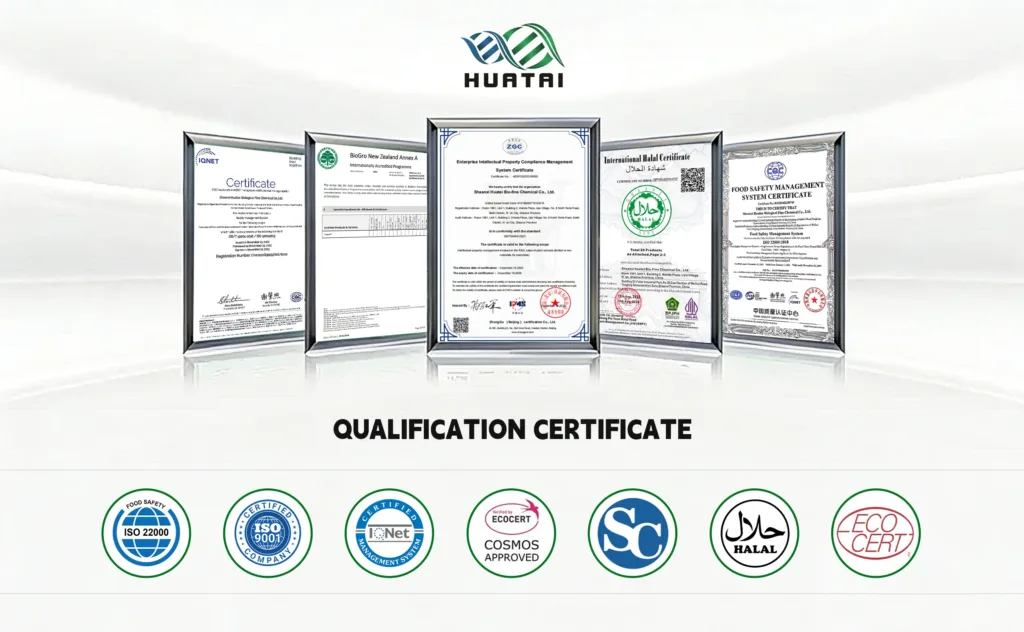
Huatai Bio offre un portefeuille complet de produits à haute efficacité ingrédients actifs cosmétiques, permettant aux marques mondiales de créer des formulations de soins de la peau de nouvelle génération répondant aux besoins des fabricants de soins haut de gamme.
Solutions complètes et innovation : Nos catégories couvrent l'ensemble des exigences du marché : Anti-âge et raffermissant, Contrôle du sébum et anti-acné, Anti-inflammatoire et apaisant,Défense antioxydante, Éclaircissement,et Hydratation et réparation de la barrière cutanéeNous proposons à la fois des classiques incontournables et des nouveautés de pointe.
Animé par la passion de l'excellence scientifique, notre laboratoire de R&D à la pointe de la technologie se consacre à l'exploration des frontières des molécules bioactives. Au-delà de la fourniture d'ingrédients, nous proposons un accompagnement complet en formulation et le développement de solutions sur mesure. Notre équipe de chimistes experts travaille en étroite collaboration avec votre marque pour résoudre les problèmes complexes de stabilité et les défis sensoriels, garantissant ainsi que votre produit final se démarque sur un marché mondial concurrentiel.
Qualité et crédibilité sans compromis : Nous garantissons que chaque lot de nos produits est conforme à la norme. Ingrédients actifs pour les soins de la peau Répondant à des normes de qualité rigoureuses, notamment les certifications COSMOS, ISO 9001/22000 et HALAL, cet engagement, étayé par un dossier technique complet, offre des solutions cliniquement validées et une conformité garantie pour relever tous les défis de formulation.
-300x300.jpg)

 English
 German
 Italian
 French
 Spanish
 Japanese
 Korean
 Russian