Dipotassium Glycyrrhizate in Skincare: Physical Limits, Formula Stability, and Efficacy Metrics
Formulators often wonder why a clear soothing toner suddenly grows white, needle-like crystals. Or why a fresh white emulsion slowly turns yellow on the shelf.
Many blame the production environment. The real reason is a failure to respect the active ingredient’s physical limits.
グリチルリチン酸ジカリウム (DPG) is a fundamental soothing agent. Extracted from licorice roots, it offers excellent water solubility and proven skin-calming effects. But it demands precise chemical handling. As an active ingredient manufacturer, we rely on data, not empty marketing. Let us look at the actual physical constraints and formulation behavior of DPG.
1. The Core Analytical Data (COA Profile)
You cannot build a stable formula without knowing your raw material. The table below outlines the precise specification limits for high-purity cosmetic-grade DPG.
| パラメータ | 仕様制限 | Analytical Method / Note |
|---|---|---|
| 外観 | 白色~淡黄色の微粉末 | 外観 |
| 分析法(HPLC) | ≥ 98.0% | Ensures minimal plant impurities |
| 溶解度 | > 50 g / 100 mL in Water | Room temperature |
| pH (1% Aqueous) | 5.0~6.0 | Potentiometric |
| 乾燥減量 | 8.0%以下 | 105°C for 2 hours |
| ベンチケミストのヒント:乳化を成功させる | ≤ 10 ppm | 色度測定 |
Notice the purity level. DPG is a highly mature extract. You do not need expensive, exaggerated liposomal encapsulation for it. Its natural molecular structure penetrates compromised skin barriers efficiently. Elaborate modification technologies often just mask unnecessary costs.
2. Confronting Color Shifts and Crystallization
We must address the instability issues that many suppliers ignore.
The Crystallization Problem
DPG dissolves easily in water. But this solubility requires a strict pH environment. The pKa of glycyrrhizic acid is approximately 4.6. When your formula pH drops below 4.5, the potassium salt converts back to free glycyrrhizic acid. The solubility plummets. The acid precipitates out. This chemical reaction creates those white needles at the bottom of your BHA or AHA toners.
Formulation Rule: Buffer your DPG solutions to a pH of 5.0 to 6.5. Do not force DPG into highly acidic exfoliating formulas.
The Yellowing Reality
高純度 2K粉末 is white. However, a dissolved aqueous solution left under sunlight will slowly turn yellow. This happens because the molecular structure of licorice derivatives responds to photo-oxidation. Heat speeds this up. Emulsifying a cream above 85°C for prolonged periods causes a slight color shift in the final batch.
Formulation Rule: Add a chelating agent like 0.05% Sodium Phytate. Use opaque bottles. Keep high-heat processing times strictly under 15 minutes.
3. Objective Efficacy Data (IC50)
How does DPG actually reduce redness? It inhibits hyaluronidase. This enzyme breaks down hyaluronic acid in the skin and triggers inflammatory pathways.
In standard in vitro colorimetric assays, DPG demonstrates an IC50 for hyaluronidase of approximately 0.9 to 1.1 mg/mL. This means it cuts the enzyme’s destructive activity by 50% at this specific concentration.
We must remain scientifically rigorous. Do not compare DPG to pharmaceutical steroids like hydrocortisone. DPG does not bind directly to glucocorticoid receptors. It operates upstream to gently downregulate the release of inflammatory mediators like PGE2. It acts slower than a steroid. However, it entirely avoids the risk of epidermal atrophy (skin thinning).
4. Real-World Efficacy: Erythema Reduction Test
- Test Matrix: A simple hydrogel (Water, Glycerin, Carbomer, pH 5.5).
- Test Group: Gel + 0.2% DPG.
- コントロール群: Gel only.
- 方法: 15 human subjects received a controlled UV dose on their inner forearms to induce mild erythema (redness). We measured the a* value (red/green axis) using a chromameter before application and 24 hours post-application.
Data Results: After 24 hours, the vehicle control group showed an 8% natural recovery in the a* value. The 0.2% DPG group showed a 24% reduction in the a* value. This data proves that even a low dose of 0.2% provides a statistically significant drop in visible skin redness compared to the body’s baseline healing rate.
5. High-Frequency FAQ for DPG Sourcing
Here are the top 8 questions formulators ask when vetting a DPG manufacturer:
Standard cosmetic grade must hit ≥98.0% via HPLC. Lower purities contain excessive plant resins that cause severe browning and poor odor in your final product.
Add it directly to the water phase at room temperature. It dissolves rapidly. You do not need glycols or strong solvents.
Do not drop the final formula pH below 4.5. The active will precipitate into insoluble crystals. Keep your formula between pH 5.0 and 6.5.
It will not stain human skin. The bulk liquid formulation can turn yellow if exposed to continuous UV light. Always use opaque packaging.
Pure L-Ascorbic Acid requires a pH of around 3.0 to 3.5. This low pH will crash the DPG out of your solution. Pair DPG with stable derivatives like Ascorbyl Glucoside or Ethyl Ascorbic Acid, which tolerate a pH of 5.5.
Because it is a root extract, soil quality dictates safety. Rigorous COAs must show Total Heavy Metals ≤ 10 ppm, with Lead (Pb) and Arsenic (As) each strictly testing at ≤ 2 ppm.
For daily maintenance formulations, use 0.1% to 0.2%. For acute post-sun or post-procedure calming gels, formulators push the dosage to 0.5% or 1.0%.
Store in sealed, light-proof containers in a cool, dry environment. DPG is slightly hygroscopic. High ambient humidity will cause the powder to clump hard.
Reference Literature
- 皮膚科学雑誌 – Mechanisms of hyaluronidase inhibition by glycyrrhizic acid salts and their topical efficacy.
- 国際化粧品科学ジャーナル – Physical stability and pH constraints of botanical salts in varied emulsion systems.
- Cosmetics & Toiletries – Evaluating the anti-inflammatory activity of licorice extract derivatives via chromameter a* value analysis.
スキンケア科学をさらに進化させましょう:当社のプレミアム有効成分で、次世代の処方を開発してください。
当社を選ぶ理由
華泰バイオ 高効能の包括的なポートフォリオを提供します 化粧品有効成分グローバルブランドが、ハイエンドスキンケア製品のニーズに応える次世代スキンケア処方を開発できるよう支援します。
包括的なソリューションとイノベーション:当社の製品categoryは、市場のニーズを幅広く網羅しています。 アンチエイジング&引き締め, 皮脂コントロール&ニキビ対策, 抗炎症作用と鎮静作用,抗酸化防御, ブライトニング、そして 水分補給とバリア機能の修復定番のクラシック製品から最先端の有効成分まで、幅広く取り揃えています。
科学的卓越性への情熱に突き動かされ、最先端の研究開発ラボは、生物活性分子の最先端を探求することに専念しています。原料供給にとどまらず、包括的な処方コンサルティングとカスタマイズされたソリューション開発を提供しています。当社の専門化学者チームは、お客様のブランドと緊密に連携し、複雑な安定性の問題や官能特性の課題を克服することで、最終製品が競争の激しいグローバル市場で際立つよう支援します。
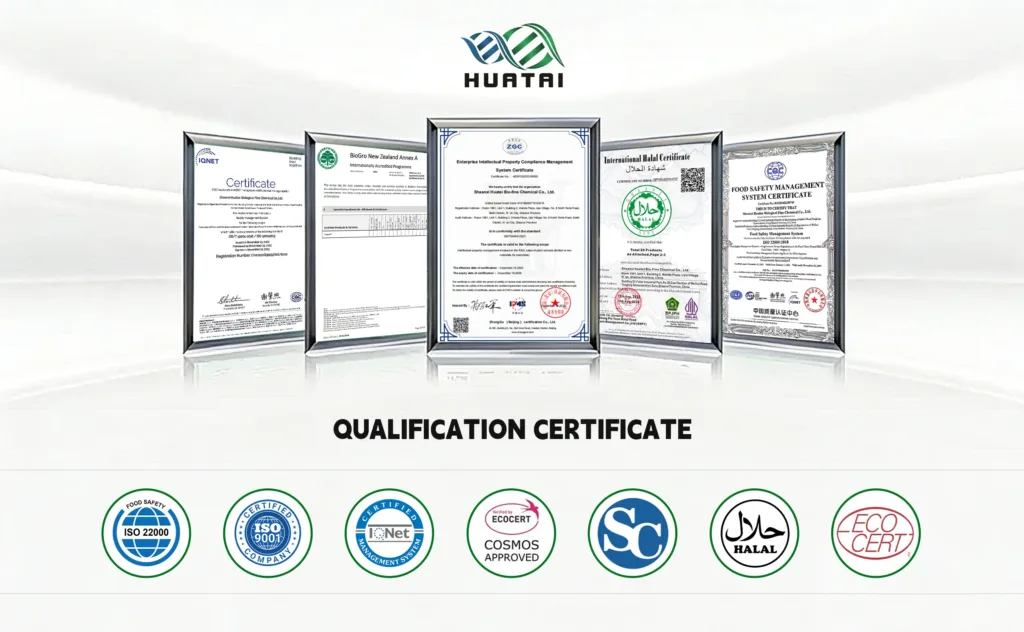
妥協のない品質と信頼性:当社はすべてのバッチにおいて スキンケアの有効成分 COSMOS、ISO 9001/22000、ハラール認証など、厳格な品質基準を満たしています。この取り組みは、詳細な技術資料によって裏付けられており、あらゆる製剤上の課題に対し、臨床的に裏付けられたソリューションと確実なコンプライアンスを提供します。

 English
 German
 Italian
 French
 Spanish
 Japanese
 Korean
 Russian