Dipotassium Glycyrrhizate in Skincare: Physical Limits, Formula Stability, and Efficacy Metrics
Formulators often wonder why a clear soothing toner suddenly grows white, needle-like crystals. Or why a fresh white emulsion slowly turns yellow on the shelf.
Many blame the production environment. The real reason is a failure to respect the active ingredient’s physical limits.
glicirrizato dipotásico (DPG) is a fundamental soothing agent. Extracted from licorice roots, it offers excellent water solubility and proven skin-calming effects. But it demands precise chemical handling. As an active ingredient manufacturer, we rely on data, not empty marketing. Let us look at the actual physical constraints and formulation behavior of DPG.
1. The Core Analytical Data (COA Profile)
You cannot build a stable formula without knowing your raw material. The table below outlines the precise specification limits for high-purity cosmetic-grade DPG.
| Parámetro | Límite de especificación | Analytical Method / Note |
|---|---|---|
| Apariencia | Polvo fino de blanco a amarillo pálido | Visual |
| Ensayo (HPLC) | ≥ 98,0% | Ensures minimal plant impurities |
| Solubilidad | > 50 g / 100 mL in Water | Room temperature |
| pH (1% Aqueous) | 5.0 – 6.0 | Potentiometric |
| Pérdida por secado | ≤ 8.0% | 105°C for 2 hours |
| Metales Pesados Totales | ≤ 10 ppm | Colorimetría |
Notice the purity level. DPG is a highly mature extract. You do not need expensive, exaggerated liposomal encapsulation for it. Its natural molecular structure penetrates compromised skin barriers efficiently. Elaborate modification technologies often just mask unnecessary costs.
2. Confronting Color Shifts and Crystallization
We must address the instability issues that many suppliers ignore.
The Crystallization Problem
DPG dissolves easily in water. But this solubility requires a strict pH environment. The pKa of glycyrrhizic acid is approximately 4.6. When your formula pH drops below 4.5, the potassium salt converts back to free glycyrrhizic acid. The solubility plummets. The acid precipitates out. This chemical reaction creates those white needles at the bottom of your BHA or AHA toners.
Formulation Rule: Buffer your DPG solutions to a pH of 5.0 to 6.5. Do not force DPG into highly acidic exfoliating formulas.
The Yellowing Reality
Alta pureza Polvo de DPG is white. However, a dissolved aqueous solution left under sunlight will slowly turn yellow. This happens because the molecular structure of licorice derivatives responds to photo-oxidation. Heat speeds this up. Emulsifying a cream above 85°C for prolonged periods causes a slight color shift in the final batch.
Formulation Rule: Add a chelating agent like 0.05% Sodium Phytate. Use opaque bottles. Keep high-heat processing times strictly under 15 minutes.
3. Objective Efficacy Data (IC50)
How does DPG actually reduce redness? It inhibits hyaluronidase. This enzyme breaks down hyaluronic acid in the skin and triggers inflammatory pathways.
In standard in vitro colorimetric assays, DPG demonstrates an IC50 for hyaluronidase of approximately 0.9 to 1.1 mg/mL. This means it cuts the enzyme’s destructive activity by 50% at this specific concentration.
We must remain scientifically rigorous. Do not compare DPG to pharmaceutical steroids like hydrocortisone. DPG does not bind directly to glucocorticoid receptors. It operates upstream to gently downregulate the release of inflammatory mediators like PGE2. It acts slower than a steroid. However, it entirely avoids the risk of epidermal atrophy (skin thinning).
4. Real-World Efficacy: Erythema Reduction Test
- Test Matrix: A simple hydrogel (Water, Glycerin, Carbomer, pH 5.5).
- Test Group: Gel + 0.2% DPG.
- Control Group: Gel only.
- Método: 15 human subjects received a controlled UV dose on their inner forearms to induce mild erythema (redness). We measured the a* value (red/green axis) using a chromameter before application and 24 hours post-application.
Data Results: After 24 hours, the vehicle control group showed an 8% natural recovery in the a* value. The 0.2% DPG group showed a 24% reduction in the a* value. This data proves that even a low dose of 0.2% provides a statistically significant drop in visible skin redness compared to the body’s baseline healing rate.
5. High-Frequency FAQ for DPG Sourcing
Here are the top 8 questions formulators ask when vetting a DPG manufacturer:
Standard cosmetic grade must hit ≥98.0% via HPLC. Lower purities contain excessive plant resins that cause severe browning and poor odor in your final product.
Add it directly to the water phase at room temperature. It dissolves rapidly. You do not need glycols or strong solvents.
Do not drop the final formula pH below 4.5. The active will precipitate into insoluble crystals. Keep your formula between pH 5.0 and 6.5.
It will not stain human skin. The bulk liquid formulation can turn yellow if exposed to continuous UV light. Always use opaque packaging.
Pure L-Ascorbic Acid requires a pH of around 3.0 to 3.5. This low pH will crash the DPG out of your solution. Pair DPG with stable derivatives like Ascorbyl Glucoside or Ethyl Ascorbic Acid, which tolerate a pH of 5.5.
Because it is a root extract, soil quality dictates safety. Rigorous COAs must show Total Heavy Metals ≤ 10 ppm, with Lead (Pb) and Arsenic (As) each strictly testing at ≤ 2 ppm.
For daily maintenance formulations, use 0.1% to 0.2%. For acute post-sun or post-procedure calming gels, formulators push the dosage to 0.5% or 1.0%.
Store in sealed, light-proof containers in a cool, dry environment. DPG is slightly hygroscopic. High ambient humidity will cause the powder to clump hard.
Reference Literature
- Journal of Dermatological Science – Mechanisms of hyaluronidase inhibition by glycyrrhizic acid salts and their topical efficacy.
- International Journal of Cosmetic Science – Physical stability and pH constraints of botanical salts in varied emulsion systems.
- Cosmetics & Toiletries – Evaluating the anti-inflammatory activity of licorice extract derivatives via chromameter a* value analysis.
Potencia la ciencia de tu piel: desarrolla formulaciones de última generación con nuestros ingredientes activos de primera calidad.
¿Por qué elegirnos?
Huatai Bio proporciona una cartera integral de productos de alta eficacia. ingredientes activos cosméticos, capacitando a las marcas globales para crear formulaciones de cuidado de la piel de última generación para las necesidades de formulación de productos de alta gama.
Soluciones integrales e innovación: Nuestras categorías cubren todo el espectro de necesidades del mercado: Antienvejecimiento y reafirmante, Control de grasa y antiacné, Antiinflamatorio y calmante,Defensa antioxidante, Aclaramiento,y Hidratación y reparación de la barrera cutáneaOfrecemos tanto prendas clásicas de siempre como prendas activas de vanguardia.
Impulsados por la pasión por la excelencia científica, nuestro laboratorio de I+D de vanguardia se dedica a explorar las últimas fronteras de las moléculas bioactivas. Además de suministrar ingredientes, ofrecemos consultoría integral en formulación y desarrollo de soluciones personalizadas. Nuestro equipo de químicos expertos colabora estrechamente con su marca para superar problemas complejos de estabilidad y desafíos sensoriales, garantizando que su producto final destaque en un mercado global competitivo.
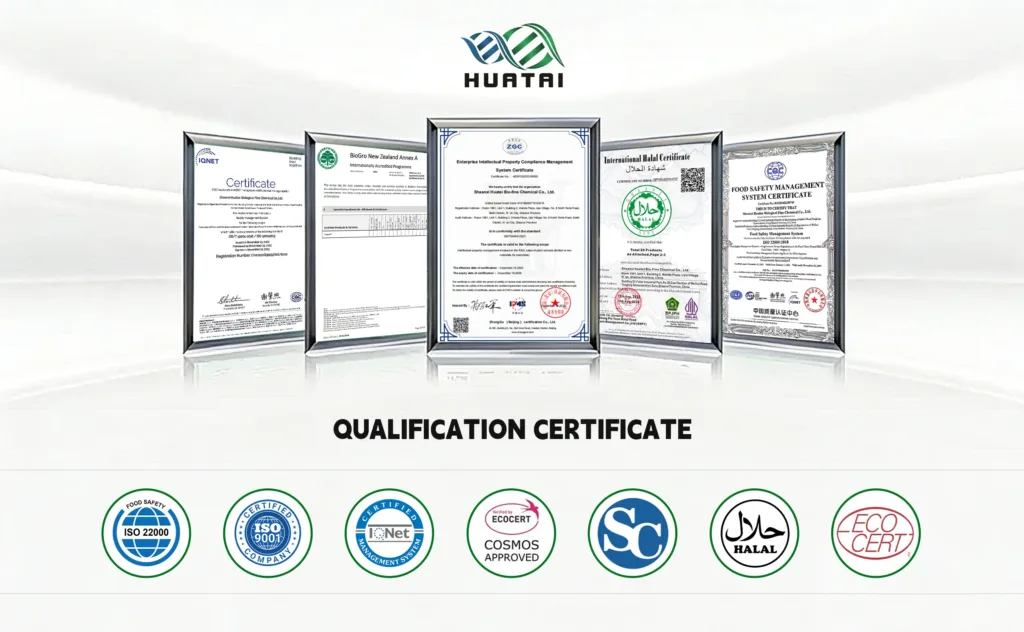
Calidad y credibilidad inquebrantables: Garantizamos que cada lote de nuestros productos cumple con nuestros estándares. Ingredientes activos para el cuidado de la piel Cumple con rigurosos estándares de calidad, incluyendo las certificaciones COSMOS, ISO 9001/22000 y HALAL. Este compromiso, respaldado por un expediente técnico completo, ofrece soluciones con respaldo clínico y garantiza el cumplimiento para cualquier desafío de formulación.


 English
 German
 Italian
 French
 Spanish
 Japanese
 Korean
 Russian