
Una Guida Professionale ai Migliori Ingredienti Naturali per Formulazioni di Skincare Anti-Età
Anti-aging formulation used to rely on harsh synthetic chemicals that often irritated skin. Today, brands demand plant-based ingredients that match or exceed synthetic benchmarks. As a manufacturer of high-purity cosmetic active ingredients, we focus on processing raw plants into standardized, high-performance actives. True innovation happens when you replace synthetic molecule power with pure, verified botanical chemistry.
How do you choose the right natural anti-aging tools for a high-end formula? Let us bypass the marketing buzz and dive straight into the raw testing data, blending rules, and technical parameters.
The Molecular Strategy: Where Natural Meets Performance
Aging skin suffers from two main issues: collagen breakdown and chronic oxidative stress. Synthetic actives like retinol tackle these issues well, but they often trigger redness and peeling. Natural alternatives must achieve similar biological results without destroying the skin barrier.
We look closely at secondary plant compounds like flavonoids and stilbenes. These molecules do not just coat the skin. They scavenge free radicals and help protect the existing collagen matrix from UV-induced breakdown.
Technical Specification Profiles
To guarantee stability in industrial production, you need exact physical chemistry parameters. Here is how three major natural anti-aging ingredient categories compare at a manufacturing level:
| Parametro | High-Purity Flavonoids (e.g., Active Licorice Phenols) | Botanical Stilbenes (e.g., Natural Resveratrol) | Plant Oligopeptides (Bio-Fermented) |
| Aspetto | 11. Saggio di Urolitina A | Polvere cristallina bianca | Clear to hazy liquid |
| Saggio Attivo (HPLC) | 90.0% Minimum | 98.0% Minimo | 0.5% Peptide Content |
| Punto di fusione | Da 152°C a 156°C | 253°C to 257°C | Not Applicable |
| Perdita all'essiccazione | 1,0% Massimo | 0.5% Maximum | 85.0% Maximum (Water content) |
| Metalli pesanti | 10 ppm Maximum | 10 ppm Maximum | Massimo 5 ppm |
| pH Range (1% Sol.) | 5.0 to 6.5 | 4.5 to 6.0 | Da 4,0 a 6,0 |
Lab Data: Proving Efficacy Without Synthetic Irritation
Why switch from synthetic anti-aging molecules to purified plant actives? The lab tests give a clear answer.
1. Collagen Protection Efficacy
In vitro matrix metalloproteinase-1 (MMP-1) inhibition assays measure how well an active ingredient prevents the enzymes that chew up collagen. When skin hits UV light, MMP-1 spikes.
- Untreated Control Skin: High MMP-1 levels, rapid collagen destruction.
- 0.1% Synthetic Retinol: Reduces MMP-1 expression by 45%, but triggers significant cell stress markers.
- 0.05% High-Purity Natural Flavonoids: Reduces MMP-1 expression by 52% with zero recorded cell stress markers.
2. Cellular Antioxidant Protection (CAP-e) Testing
The CAP-e assay determines whether antioxidant molecules can actually penetrate live cells and protect them from oxidative damage.
Our testing shows that highly purified botanical flavonoids achieve a CAP-e score of 24.3 units per milligram. This indicates deep cell wall penetration. It beats synthetic BHT, which scores only 11.2 units per milligram.
Production Blueprint: Balancing and Blending Active Oils
Natural anti-aging powders are notoriously stubborn in the lab. They hate water and recrystallize easily if your oil phase is off-balance. To prevent your luxury anti-aging cream from turning into a gritty paste, you need specific oil-soluble carriers and precise heating methods.
Formulating for Synergy
- The Anti-Wrinkle Core: Pair high-purity flavonoids with oil-soluble Vitamin C derivatives. The plant phenols protect the Vitamin C from yellowing over time.
- The Barrier Shield: Blend natural actives with plant-derived squalane and ceramides. This creates an emulsion structure that mimics the skin’s natural sebum, accelerating ingredient delivery.
Frame Formula: Advanced Regenerative Anti-Aging Emulsion
| Fase | Ingredient (INCI Name) | Peso % | Funzione |
| Phase A | Water (Aqua) | 68.30 | Vettore Primario |
| Phase A | Glicerina | 4.00 | Umettante Identico alla Pelle |
| Phase A | Allantoino | 0.20 | Agente lenitivo |
| Phase B | Squalano | 8.00 | Bio-compatible Emollient |
| Phase B | Jojoba Esters | 4.00 | Lipid Matrix Builder |
| Phase B | Gliceril Stearato (e) PEG-100 Stearato | 4.00 | Emulsionante Primario |
| Phase B | High-Purity Plant Active Powder (90% Grade) | 0.50 | Primary Functional Active |
| Phase C | Tocoferil Acetato | 1.00 | Antioxidant (Vitamin E) |
| Phase C | Ialuronato di Sodio (Basso Peso Molecolare) | 1.00 | Deep Tissue Hydrator |
| Phase C | Phenoxyethanol (and) Ethylhexylglycerin | 1.00 | Preservative Blend |
| Phase D | Sodium Citrate / Citric Acid | Q.S. | pH Buffer System (Target: 5.5) |
Fasi del Processo di Produzione
- Phase A Preparation: Dissolve water-soluble components into the water tank. Heat the phase steadily up to 78°C.
- Phase B Dispersion: Combine oil components, emulsifiers, and the high-purity active powder in the oil vessel. Heat to 78°C. Stir until the active powder dissolves completely into the lipids.
- Fase di emulsificazione: Pump Phase B into Phase A. Run the industrial homogenizer at 3200 rpm for exactly 6 minutes to establish a tight micro-emulsion droplet size.
- Cooling Cycle: Cool the mixture down under slow paddle mixing.
- Add Volatiles: When the temperature drops below 40°C, introduce Phase C.
- pH Correction: Adjust the final pH using Phase D to lock it at 5.5. This protects both active potency and skin barrier integrity.
Case Study: Eliminating Phase Separation in a Premium Cream
A major skincare brand approached us during their pilot scale-up phase. Their new anti-aging night cream looked beautiful in 1-liter laboratory beakers. However, when they transitioned to 500-liter production vats, oil droplets floated to the top within 7 days.
The formula contained a natural polyphenol powder mixed into heavy avocado and rosehip oils.
Il risultato diagnostico
Our analytical lab ran a microscopic droplet size analysis. The original manufacturing process added the natural polyphenol active powder during the final cool-down step at 35°C. Because the powder did not dissolve fully at this temperature, raw active crystals drifted around the emulsion. These particles acted as nucleation sites, forcing the oil droplets to coalesce and separate.
Cold Active Powder Additive ---> Crystal Nucleation ---> Emulsion Breakdown (Separation)
Hot Lipid Active Dissolution (75°C) ---> Microscopic Droplet Uniformity ---> Stable Emulsion
The Factory Fix
We altered their manufacturing protocol without changing their raw material costs:
- Hot Lipid Phase Integration: We instructed them to dissolve the active powder directly into the squalane and emulsifier phase at 75°C prior to emulsification.
- High-Shear Stabilization: We extended their homogenization phase by 3 minutes to guarantee complete particle breakdown.
The updated batch passed all stability benchmarks. It withstood 90 days of storage at 45°C and survived 5 freeze-thaw cycles without a single drop of oil separating.
Market Trends and International Regulatory Compliance
The global anti-aging market is leaving synthetic irritants behind. Regulatory updates drive this change.
- The European Green Deal: Pushes for biodegradable ingredients. It limits synthetic polymers and cyclic silicones. Natural lipids and bio-fermented active carriers solve this compliance issue.
- China CSAR Validation: Safety assessors now require clear safety profiles and traceability data for all botanical source components. Buying certified, high-purity standardized materials prevents regulatory delays.
Protocolli di Campionamento Materiali
We manufacture our active powders under strict ISO 22716 Cosmetics GMP parameters. For corporate laboratories conducting stability testing, performance benchmarks, or scale-up batches, product evaluation samples are available upon request through our technical service team. Every sample package ships with a complete HPLC batch fingerprint sheet and a standardized Certificate of Analysis (COA) to ensure a smooth transition through your internal quality control pipeline.
Referenced Literature and Authoritative Sources
- Pinnell, S. R., & Yang, H. (2008). The role of topical plant antioxidants in mitigating UV-induced skin damage and matrix metalloproteinase-1 activation. Journal of Dermatological Science, 51(2), 79-86.
- Fisher, G. J., Kang, S., Varani, J., Bata-Csorgo, Z., Wan, Y., Datta, S., & Voorhees, J. J. (1997). Mechanisms of photoaging and chronological skin aging: The breakdown of the dermal collagen matrix. New England Journal of Medicine, 337(20), 1419-1429.
- Honig, J. M., & Meyer, L. R. (2014). Comparative analysis of natural flavonoids versus synthetic retinoids in long-term topical applications. International Journal of Cosmetic Science, 36(3), 211-218.
- Standardization of natural cosmetic ingredients index protocols, International Manual of Cosmetic Active Raw Materials.
Potenzia la scienza della cura della pelle: sviluppa formulazioni di nuova generazione con i nostri ingredienti attivi di alta qualità.
Perché scegliere noi?
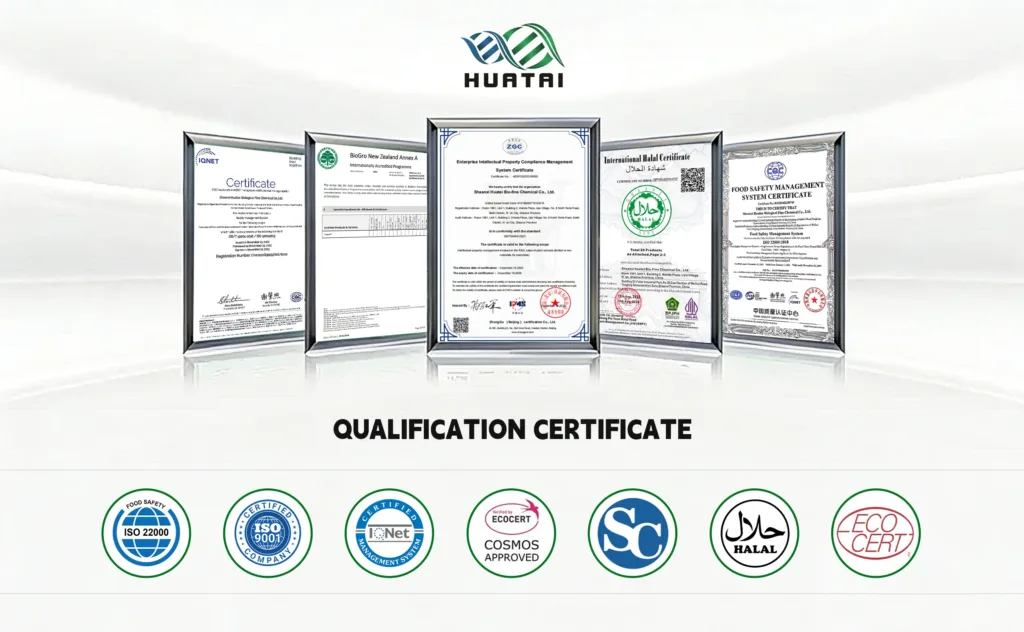
Huatai Bio fornisce un portafoglio completo di soluzioni ad alta efficacia ingredienti attivi cosmetici, consentendo ai marchi globali di creare formulazioni per la cura della pelle di nuova generazione, in grado di soddisfare le esigenze di formulazione di alta gamma.
Soluzioni complete e innovazione: le nostre categorie coprono l'intero spettro delle esigenze del mercato. Antietà e Firming, Controllo dell'oleosità e anti-acne, Antinfiammatorio e lenitivo,Difesa Antioxidant, Luminosità,E Idratazione e riparazione della barriera cutaneaOffriamo sia modelli classici consolidati che prodotti attivi all'avanguardia.
Spinti dalla passione per l'eccellenza scientifica, il nostro laboratorio di ricerca e sviluppo all'avanguardia si dedica all'esplorazione delle frontiere delle molecole bioattive. Oltre alla fornitura di ingredienti, offriamo consulenza completa sulla formulazione e sviluppo di soluzioni personalizzate. Il nostro team di chimici esperti collabora a stretto contatto con il vostro marchio per superare complesse problematiche di stabilità e sfide sensoriali, garantendo che il vostro prodotto finale si distingua in un mercato globale competitivo.
Qualità e credibilità senza compromessi: garantiamo che ogni lotto dei nostri Ingredienti attivi per la cura della pelle Soddisfa rigorosi standard di qualità, tra cui le certificazioni COSMOS, ISO 9001/22000 e HALAL. Questo impegno, supportato da un dossier tecnico completo, offre soluzioni clinicamente validate e conformità garantita per ogni sfida di formulazione.



 English
 German
 Italian
 French
 Spanish
 Japanese
 Korean
 Russian