
노화 방지 스킨케어 제품에 가장 적합한 천연 성분에 대한 전문가 가이드
Anti-aging formulation used to rely on harsh synthetic chemicals that often irritated skin. Today, brands demand plant-based ingredients that match or exceed synthetic benchmarks. As a manufacturer of high-purity cosmetic active ingredients, we focus on processing raw plants into standardized, high-performance actives. True innovation happens when you replace synthetic molecule power with pure, verified botanical chemistry.
How do you choose the right natural anti-aging tools for a high-end formula? Let us bypass the marketing buzz and dive straight into the raw testing data, blending rules, and technical parameters.
The Molecular Strategy: Where Natural Meets Performance
Aging skin suffers from two main issues: collagen breakdown and chronic oxidative stress. Synthetic actives like retinol tackle these issues well, but they often trigger redness and peeling. Natural alternatives must achieve similar biological results without destroying the skin barrier.
We look closely at secondary plant compounds like flavonoids and stilbenes. These molecules do not just coat the skin. They scavenge free radicals and help protect the existing collagen matrix from UV-induced breakdown.
Technical Specification Profiles
To guarantee stability in industrial production, you need exact physical chemistry parameters. Here is how three major natural anti-aging ingredient categories compare at a manufacturing level:
| 매개변수 | High-Purity Flavonoids (e.g., Active Licorice Phenols) | Botanical Stilbenes (e.g., Natural Resveratrol) | Plant Oligopeptides (Bio-Fermented) |
| 모습 | 연한 노란색에서 미색의 파우더 | 흰색 결정 분말 | Clear to hazy liquid |
| Active Assay (HPLC) | 90.0% Minimum | 최소 98.0% | 0.5% Peptide Content |
| 녹는점 | 152°C ~ 156°C | 253°C to 257°C | Not Applicable |
| 건조 감량 | 0% 최대 | 0.5% Maximum | 85.0% Maximum (Water content) |
| 중금속 | 10 ppm Maximum | 10 ppm Maximum | 5 ppm Maximum |
| pH Range (1% Sol.) | 5.0 to 6.5 | 4.5 to 6.0 | 4.0~6.0 |
Lab Data: Proving Efficacy Without Synthetic Irritation
Why switch from synthetic anti-aging molecules to purified plant actives? The lab tests give a clear answer.
1. Collagen Protection Efficacy
In vitro matrix metalloproteinase-1 (MMP-1) inhibition assays measure how well an active ingredient prevents the enzymes that chew up collagen. When skin hits UV light, MMP-1 spikes.
- Untreated Control Skin: High MMP-1 levels, rapid collagen destruction.
- 0.1% Synthetic Retinol: Reduces MMP-1 expression by 45%, but triggers significant cell stress markers.
- 0.05% High-Purity Natural Flavonoids: Reduces MMP-1 expression by 52% with zero recorded cell stress markers.
2. Cellular Antioxidant Protection (CAP-e) Testing
The CAP-e assay determines whether antioxidant molecules can actually penetrate live cells and protect them from oxidative damage.
Our testing shows that highly purified botanical flavonoids achieve a CAP-e score of 24.3 units per milligram. This indicates deep cell wall penetration. It beats synthetic BHT, which scores only 11.2 units per milligram.
Production Blueprint: Balancing and Blending Active Oils
Natural anti-aging powders are notoriously stubborn in the lab. They hate water and recrystallize easily if your oil phase is off-balance. To prevent your luxury anti-aging cream from turning into a gritty paste, you need specific oil-soluble carriers and precise heating methods.
Formulating for Synergy
- The Anti-Wrinkle Core: Pair high-purity flavonoids with oil-soluble Vitamin C derivatives. The plant phenols protect the Vitamin C from yellowing over time.
- The Barrier Shield: Blend natural actives with plant-derived squalane and ceramides. This creates an emulsion structure that mimics the skin’s natural sebum, accelerating ingredient delivery.
Frame Formula: Advanced Regenerative Anti-Aging Emulsion
| 상 | Ingredient (INCI Name) | 무게 % | 기능 |
| Phase A | Water (Aqua) | 68.30 | Primary Carrier |
| Phase A | 글리세린 | 4.00 | Skin-Identical Humectant |
| Phase A | 알란토인 | 0.20 | 진정제 |
| Phase B | 스쿠알란 | 8.00 | 생체 적합성 연화제 |
| Phase B | Jojoba Esters | 4.00 | Lipid Matrix Builder |
| Phase B | Glyceryl Stearate (and) PEG-100 Stearate | 4.00 | 주요 유화제 |
| Phase B | High-Purity Plant Active Powder (90% Grade) | 0.50 | Primary Functional Active |
| Phase C | 토코페릴 아세테이트 | 1.00 | Antioxidant (Vitamin E) |
| Phase C | Sodium Hyaluronate (Low Molecular Weight) | 1.00 | Deep Tissue Hydrator |
| Phase C | Phenoxyethanol (and) Ethylhexylglycerin | 1.00 | Preservative Blend |
| Phase D | Sodium Citrate / Citric Acid | Q.S. | pH Buffer System (Target: 5.5) |
Manufacturing Process Steps
- Phase A Preparation: Dissolve water-soluble components into the water tank. Heat the phase steadily up to 78°C.
- Phase B Dispersion: Combine oil components, emulsifiers, and the high-purity active powder in the oil vessel. Heat to 78°C. Stir until the active powder dissolves completely into the lipids.
- Emulsification Phase: Pump Phase B into Phase A. Run the industrial homogenizer at 3200 rpm for exactly 6 minutes to establish a tight micro-emulsion droplet size.
- Cooling Cycle: Cool the mixture down under slow paddle mixing.
- Add Volatiles: When the temperature drops below 40°C, introduce Phase C.
- pH Correction: Adjust the final pH using Phase D to lock it at 5.5. This protects both active potency and skin barrier integrity.
Case Study: Eliminating Phase Separation in a Premium Cream
A major skincare brand approached us during their pilot scale-up phase. Their new anti-aging night cream looked beautiful in 1-liter laboratory beakers. However, when they transitioned to 500-liter production vats, oil droplets floated to the top within 7 days.
The formula contained a natural polyphenol powder mixed into heavy avocado and rosehip oils.
The Diagnostic Finding
Our analytical lab ran a microscopic droplet size analysis. The original manufacturing process added the natural polyphenol active powder during the final cool-down step at 35°C. Because the powder did not dissolve fully at this temperature, raw active crystals drifted around the emulsion. These particles acted as nucleation sites, forcing the oil droplets to coalesce and separate.
Cold Active Powder Additive ---> Crystal Nucleation ---> Emulsion Breakdown (Separation)
Hot Lipid Active Dissolution (75°C) ---> Microscopic Droplet Uniformity ---> Stable Emulsion
공장 수정
We altered their manufacturing protocol without changing their raw material costs:
- Hot Lipid Phase Integration: We instructed them to dissolve the active powder directly into the squalane and emulsifier phase at 75°C prior to emulsification.
- High-Shear Stabilization: We extended their homogenization phase by 3 minutes to guarantee complete particle breakdown.
The updated batch passed all stability benchmarks. It withstood 90 days of storage at 45°C and survived 5 freeze-thaw cycles without a single drop of oil separating.
Market Trends and International Regulatory Compliance
The global anti-aging market is leaving synthetic irritants behind. Regulatory updates drive this change.
- The European Green Deal: Pushes for biodegradable ingredients. It limits synthetic polymers and cyclic silicones. Natural lipids and bio-fermented active carriers solve this compliance issue.
- China CSAR Validation: Safety assessors now require clear safety profiles and traceability data for all botanical source components. Buying certified, high-purity standardized materials prevents regulatory delays.
Material Sampling Protocols
We manufacture our active powders under strict ISO 22716 Cosmetics GMP parameters. For corporate laboratories conducting stability testing, performance benchmarks, or scale-up batches, product evaluation samples are available upon request through our technical service team. Every sample package ships with a complete HPLC batch fingerprint sheet and a standardized Certificate of Analysis (COA) to ensure a smooth transition through your internal quality control pipeline.
Referenced Literature and Authoritative Sources
- Pinnell, S. R., & Yang, H. (2008). The role of topical plant antioxidants in mitigating UV-induced skin damage and matrix metalloproteinase-1 activation. Journal of Dermatological Science, 51(2), 79-86.
- Fisher, G. J., Kang, S., Varani, J., Bata-Csorgo, Z., Wan, Y., Datta, S., & Voorhees, J. J. (1997). Mechanisms of photoaging and chronological skin aging: The breakdown of the dermal collagen matrix. New England Journal of Medicine, 337(20), 1419-1429.
- Honig, J. M., & Meyer, L. R. (2014). Comparative analysis of natural flavonoids versus synthetic retinoids in long-term topical applications. International Journal of Cosmetic Science, 36(3), 211-218.
- Standardization of natural cosmetic ingredients index protocols, International Manual of Cosmetic Active Raw Materials.
피부 과학을 한 단계 끌어올리세요: 당사의 프리미엄 활성 성분으로 차세대 포뮬러를 개발하십시오.
왜 저희를 선택해야 할까요?
후아타이 바이오 효능이 뛰어난 포괄적인 포트폴리오를 제공합니다. 화장품 활성 성분글로벌 브랜드가 고급 스킨케어 제품의 요구 사항을 충족하는 차세대 스킨케어 포뮬러를 개발할 수 있도록 지원합니다.
종합적인 솔루션 및 혁신: 당사의 제품군은 시장의 모든 요구 사항을 충족합니다. 노화 방지 및 탄력 개선, 피지 조절 및 여드름 방지, 항염 및 진정 효과,항산화 방어, 밝게 빛나게,그리고 수분 공급 및 피부 장벽 복구저희는 오랜 전통을 자랑하는 클래식 제품과 최첨단 액티브웨어를 모두 제공합니다.
과학적 우수성에 대한 열정을 바탕으로, 당사의 최첨단 연구 개발 연구소는 생체 활성 분자의 최첨단을 탐구하는 데 전념하고 있습니다. 원료 공급을 넘어, 당사는 종합적인 제형 컨설팅과 맞춤형 솔루션 개발을 제공합니다. 당사의 전문 화학자 팀은 귀사의 브랜드와 긴밀히 협력하여 복잡한 안정성 문제와 감각적 과제를 해결하고, 경쟁이 치열한 글로벌 시장에서 귀사의 최종 제품이 돋보이도록 지원합니다.
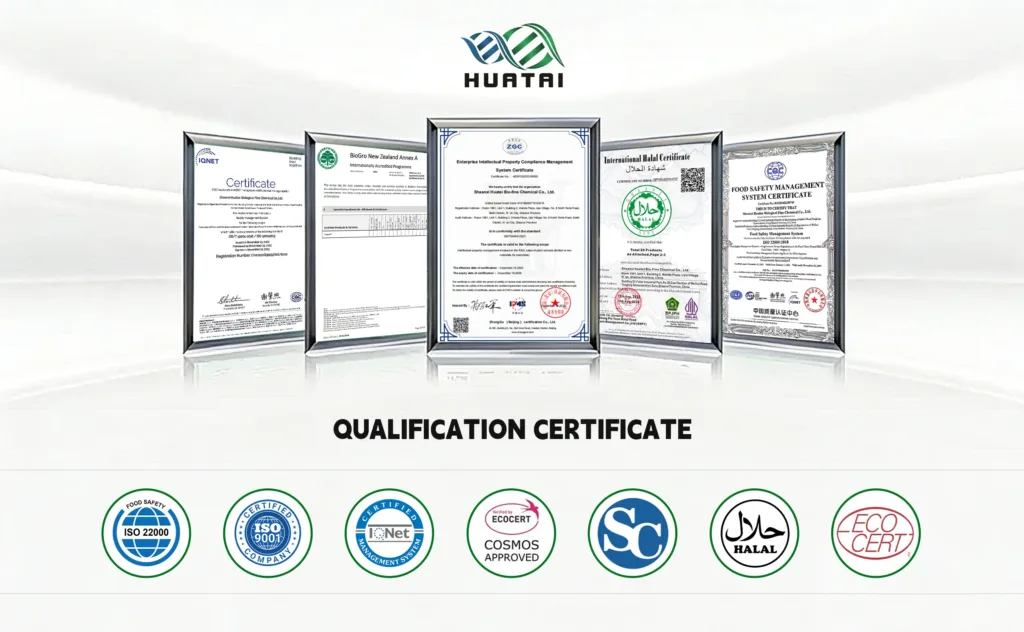
타협 없는 품질과 신뢰성: 당사는 모든 제품 배치에 대해 품질과 신뢰성을 보장합니다. 활성 스킨케어 성분 COSMOS, ISO 9001/22000 및 HALAL 인증을 포함한 엄격한 품질 기준을 충족합니다. 완벽한 기술 자료집을 바탕으로 임상적으로 검증된 솔루션과 모든 제형 관련 문제에 대한 확실한 규정 준수를 보장합니다.


 English
 German
 Italian
 French
 Spanish
 Japanese
 Korean
 Russian