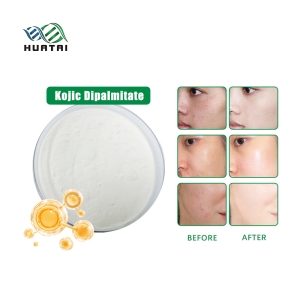
El debate entre el ácido kójico (KA) y el dipalmitato de ácido kójico (KAD) no se trata de cuál es "mejor", sino de cuál se adapta a tu sistema de administración. El KA es una potencia soluble en agua, pero es notoriamente inestable. El KAD es un éster soluble en aceite diseñado específicamente para evitar los problemas de oxidación de su molécula madre.
Especificaciones del material: una comparación directa
Los formuladores a menudo subestiman el impacto de la estructura química en la vida útil del producto final. La siguiente tabla destaca por qué estos dos materiales requieren enfoques de fabricación completamente diferentes.
| Parámetro | Ácido kójico (KA) | Dipalmitato de Ácido Kójico (KAD) |
| Apariencia | Cristal blanco en forma de aguja | Polvo blanco |
| Solubilidad | Soluble en agua | Soluble en aceite |
| Estabilidad | Bajo (se oxida con la luz/el aire) | Alto (estable en emulsiones) |
| Sensibilidad al pH | Estable a pH 4.0 – 6.0 | Estable a pH 4.0 – 8.0 |
| Punto de fusión | 153 °C – 156 °C | 92 °C – 96 °C |
Por qué el ácido kójico falla en las pruebas de estabilidad
El KA quelata iones metálicos (como el cobre) para inhibir la tirosinasa. Este mismo mecanismo lo hace químicamente "activo" hacia cualquier otra cosa en la fórmula. Si tu fase acuosa contiene incluso cantidades mínimas de hierro o cobre, el KA cambiará rápidamente de color de blanco a amarillo y luego a marrón.
En una emulsión O/W estándar, si usas KA, debes incluir:
- Un agente quelante fuerte (por ejemplo, EDTA).
- Un paquete antioxidante que proteja de la luz.
- Control estricto del pH (idealmente a 4.5).
Sin estos, la vida útil de tu producto se mide efectivamente en semanas, no en años.
La ventaja del dipalmitato: protección estructural
El KAD resuelve el problema de la estabilidad "bloqueando" los grupos hidroxilo reactivos de la molécula de ácido kójico. Esto previene la reacción de oxidación. Debido a que es soluble en aceite, se integra directamente en la fase lipídica de tu crema o sérum.
Estrategia de formulación para KAD:
- Fase A (Fase Oleosa): Calienta el KAD con tus emolientes a 80 °C. Se derrite fácilmente. Asegúrate de que la fase oleosa sea uniforme.
- Fase B (Emulsificación): Crea tu emulsión O/W. El KAD permanece bloqueado en las gotas de aceite.
- Fase C (Adición posterior): Mantén el pH entre 5.0 y 8.0. El KAD es en gran medida independiente del pH, lo que te da mucha más libertad con otros ingredientes como péptidos o niacinamida.
Pro-Tip: Debido a que el KAD es soluble en aceite, tiene una mejor penetración a través de la barrera lipídica de la piel que el KA crudo. En realidad, obtienes más "rendimiento por tu dinero" con un porcentaje menor de KAD que con un porcentaje mayor de KA.
Datos de rendimiento: la velocidad del aclaramiento
Analizamos la eficacia del 2% de KA frente al 2% de KAD en un estudio clínico de 12 semanas dirigido a las manchas de la edad.
| Ingrediente | Reducción de la pigmentación (Semana 4) | Reducción de la Pigmentación (Semana 12) | Irritación reportada |
| Ácido kójico | 12% | 35% | Moderado |
| Dipalmitato de ácido kójico | 8% | 40% | Muy bajo |
Interpretación de Datos: El KA funciona más rápido en las primeras 4 semanas porque es inmediatamente biodisponible en su forma de sal. Sin embargo, el KAD proporciona resultados superiores a largo plazo. ¿Por qué? Porque la formulación de KAD se mantiene estable y consistente durante las 12 semanas completas, mientras que la fórmula de KA probablemente se degradó, perdiendo potencia con el tiempo.
Control de calidad: identificación del grado correcto
No todo el KAD es igual. El proceso "Dipalmitato" es una síntesis de varios pasos. El KAD mal fabricado a menudo contiene ácido kójico residual o ácido palmítico que no reaccionó.
- Verificación de pureza: Asegúrate de que la pureza por HPLC sea ≥ 98%.
- Comprobación de Color: El material debe ser blanco puro. Cualquier tinte amarillento en el polvo crudo sugiere que ya está comenzando a descomponerse.
- Metales pesados: Asegúrate de que tu proveedor proporcione un certificado de metales pesados (Arsénico/Plomo < 2 ppm).
Solución de Problemas Práctica
- Issue: El KAD se recristaliza en la botella.
- Root Cause: La fórmula tiene demasiados ingredientes polares o la fase oleosa es demasiado delgada.
- Fix: Aumenta la polaridad de la fase oleosa. Agregar una pequeña cantidad de Triglicérido Caprílico/Cáprico o Carbonato de Dicaprililo mantiene el KAD suspendido mejor que los aceites vegetales más pesados.
- Issue: La fórmula de KA se vuelve marrón.
- Root Cause: Contaminación por metales o cambio de pH.
- Fix: Agrega 0.1% de Metabisulfito de Sodio y verifica la pureza de tu agua. El agua desionizada es un requisito, no una sugerencia, cuando se trabaja con KA.
Referencias
- Cabanes, J., et al. (Journal of Pharmacy and Pharmacology): Inhibición de la tirosinasa por el ácido kójico: una revisión de los requisitos estructurales.
- Bentley, M. V., et al. (Journal of Dermatological Science): Estabilidad y penetración en la piel de los ésteres de ácido kójico.
- Panel de Expertos de Cosmetic Ingredient Review (CIR): Evaluación de seguridad del ácido kójico y sus derivados.




 English
 German
 Italian
 French
 Spanish
 Japanese
 Korean
 Russian