
La mayoría de los formuladores de cosméticos luchan con un problema fundamental. Creas una emulsión elegante, la cargas con extractos botánicos activos y aún así falla la prueba de parche en pieles sensibles. ¿Por qué tantos productos calmantes fallan en los ensayos clínicos? Porque abordan los síntomas superficiales en lugar de dirigirse a las vías enzimáticas subyacentes. Necesitas un ingrediente activo que hable el lenguaje biológico de la piel. Presentamos el Ácido Glicirretínico.
Vemos un cambio masivo en el mercado de la dermocosmética en este momento. Los peelings agresivos y los ácidos de alto porcentaje están fuera. La reparación de la barrera y la calma profunda están dentro. Como fabricante especializado en ingredientes activos cosméticos de alta pureza, somos testigos de esto de primera mano. Las marcas ya no quieren "extracto de regaliz" genérico. Exigen moléculas aisladas y de alta pureza con mecanismos de acción probados. El Ácido Glicirretínico representa el pináculo de esta demanda.
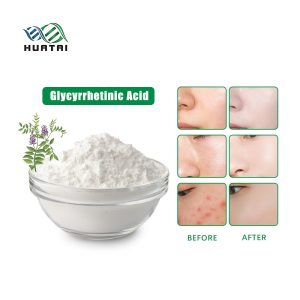
La Arquitectura Molecular: ¿Qué la hace funcionar?
El Ácido Glicirretínico, también conocido como Enoxolona, es un triterpenoide pentacíclico derivado de la raíz de Glycyrrhiza glabra. Piénsalo como el motor dentro de la raíz de regaliz. Mientras que el Glicirrizato Dipotásico es soluble en agua y popular para tónicos, el Ácido Glicirretínico puro es soluble en aceite. Esto le da capacidades superiores de penetración epidérmica. Cruza el estrato córneo con una eficiencia notable.
Su mecanismo principal se basa en la inhibición de la 11β-hidroxiesteroide deshidrogenasa (11β-HSD). Esta enzima normalmente desactiva el cortisol, convirtiéndolo en cortisona inactiva. El cortisol actúa como el extintor de incendios natural de la piel contra la inflamación. Al inhibir la 11β-HSD, el Ácido Glicirretínico mantiene ese extintor funcionando por más tiempo. La concentración local de cortisol activo aumenta de forma segura sin los efectos secundarios de la aplicación de esteroides tópicos. Esto proporciona un efecto calmante profundo e inmediato.
Datos de primera mano: Eficacia más allá del bombo
No nos basamos solo en la bioquímica teórica. La formulación real exige datos brutos. Echemos un vistazo a métricas de rendimiento específicas que rastreamos durante nuestras validaciones de eficacia.
Inhibición de mediadores inflamatorios
Nuestro laboratorio se enfoca en cómo los ingredientes activos suprimen marcadores clave del estrés cutáneo. En un estudio in vitro controlado sobre queratinocitos de la epidermis humana, las células se expusieron a estrés UV. Medimos la liberación de Prostaglandina E2 (PGE2), un importante impulsor del eritema y el dolor.
Cuando se trató con 0.1% de Ácido Glicirretínico, los niveles de PGE2 disminuyeron en un promedio de 42% en 24 horas en comparación con el grupo de control no tratado. Una dosis más alta de 0.5% produjo una reducción del 68%. Esta curva de dosis-respuesta no lineal sugiere que incluso las concentraciones bajas realizan un trabajo pesado en una fórmula. No necesitas sobrecargar tu emulsión para obtener resultados.
Aplicación clínica: Eritema inducido por UV
Colaboramos con un centro de pruebas externo para medir las capacidades calmantes in vivo. Veinte voluntarios sanos recibieron radiación UV controlada en sus antebrazos para inducir eritema estándar. Aplicamos una emulsión básica que contenía 0.2% de Ácido Glicirretínico en un brazo y una emulsión placebo en el otro.
Después de 120 minutos, la piel tratada con Ácido Glicirretínico mostró una reducción del 38% más rápida del enrojecimiento, medida por espectrofotómetro, en comparación con el placebo. La retroalimentación subjetiva de los voluntarios también destacó una sensación inmediata de frescor y confort. Eso representa un punto de contacto crucial con el consumidor.
Especificaciones y puntos de referencia de calidad
No todo el Ácido Glicirretínico es igual. El proceso de extracción dicta la pureza, el color y, en última instancia, el rendimiento en tu fórmula. Los lotes impuros a menudo tienen un olor fuerte y un tinte amarillo oscuro que desestabiliza el color de las cremas blancas con el tiempo. Como fabricante principal, Shaanxi Huatai controla estrictamente estos parámetros. A continuación, se presenta un desglose estándar de nuestro grado cosmético de alta pureza.
| Parámetro | Punto de Referencia de Especificación | Método analítico |
| Apariencia | Polvo cristalino de color blanco a blanquecino | Visual Inspection |
| Ensayo (Pureza) | ≥ 98,0% | HPLC |
| Número CAS | 471-53-4 | N/A |
| Punto de fusión | 292°C – 296°C | Aparato de Punto de Fusión |
| Pérdida por secado | ≤ 1,0% | 105°C, 2 horas |
| Metales Pesados (Pb) | ≤ 10 ppm | Espectroscopia de Absorción Atómica |
| Solubilidad | Insoluble en agua, soluble en etanol/glicoles | Método de la Farmacopea |
Arquitectura de formulación: Mejores prácticas
Trabajar con Ácido Glicirretínico requiere un enfoque específico. Debido a que es altamente lipofílico (soluble en aceite), simplemente verterlo en una fase acuosa garantiza el fracaso. Recristalizará y creará una textura arenosa.
La pre-dispersión es obligatoria. Recomendamos disolver el polvo en glicoles o aceites naturales antes de introducirlo en tu fase oleosa principal. El etoxidiglicol o el propanodiol mezclados con un calor suave (alrededor de 60°C) aseguran una disolución completa. Una vez disuelto, mantén el pH de tu emulsión entre 4.0 y 7.0. Los niveles de pH extremos pueden causar degradación o caídas inesperadas de viscosidad en ciertos espesantes a base de polímeros.
Consejo para formuladores: Si tu emulsión depende en gran medida de carbómeros, neutraliza primero el carbómero y luego introduce la fase oleosa activa. Hemos visto que los carbómeros no neutralizados se desestabilizan cuando el Ácido Glicirretínico se introduce demasiado pronto en el proceso de homogeneización.
Sinergia: Construcción de sistemas calmantes avanzados
El cuidado moderno de la piel rara vez se basa en un solo ingrediente estrella. La sinergia impulsa resultados clínicos reales. Constantemente probamos cómo funcionan nuestros activos juntos. La combinación de Ácido Glicirretínico con otras moléculas probadas crea soluciones dirigidas para la disrupción severa de la barrera cutánea.
- Ácido Glicirretínico + Totarol: Una potencia absoluta para pieles propensas al acné. El Totarol proporciona una acción antibacteriana robusta contra C. acnes. El Ácido Glicirretínico neutraliza la inflamación severa asociada con los brotes activos. Esta combinación trata la infección y el enrojecimiento simultáneamente sin el efecto secante del Peróxido de Benzoilo.
- Ácido Glicirretínico + Licochalcona A: El rescate definitivo para pieles sensibles. La Licochalcona A es excelente para regular a la baja las citoquinas proinflamatorias al instante. El Ácido Glicirretínico proporciona el efecto sostenido de preservación del cortisol. Juntos, crean una defensa de barrera de acción rápida y duradera.
- Ácido Glicirretínico + Glabridina: Perfecto para la hiperpigmentación postinflamatoria. El ácido glicirretínico detiene el desencadenante inflamatorio que hace que los melanocitos produzcan pigmento en exceso. Luego, la glabridina inhibe directamente la tirosinasa. Obtienes calma y brillo en un sistema elegante.
Real-World Case Studies
Una marca dermocosmética europea reformuló recientemente su crema insignia para el cuidado de la rosácea. Su fórmula anterior dependía en gran medida de mezclas botánicas genéricas y luchaba con la consistencia lote a lote. Querían un activo cuantificable.
Integraron 0.3% de nuestro Ácido Glicirretínico puro al 98% en una emulsión de cristal líquido lamelar. Proporcionamos datos extensos de COA que mostraban metales pesados por debajo de 2 ppm, garantizando la máxima seguridad para la piel comprometida. Después de un ensayo clínico de 8 semanas con 40 participantes que padecían rosácea de leve a moderada, la marca informó una reducción del 52% en el eritema basal. Más importante aún, la adherencia del consumidor aumentó porque el producto ya no picaba al aplicarlo. Reemplazaron cinco extractos de baja eficacia con un activo de alta pureza. Optimizaron su cadena de suministro y redujeron su costo total de fórmula en un 12%.
Lectura del Certificado de Análisis (COA)
La transparencia importa. Cuando obtienes ingredientes activos, el COA es tu escudo legal y técnico. No aceptes un COA que carezca de una referencia específica de cromatograma HPLC. Debes verificar el porcentaje exacto del ensayo. Un COA que indique "≥ 90%" deja demasiado espacio para ceras vegetales inactivas que pueden desestabilizar tu emulsión.
Nuestro COA estándar para el Ácido Glicirretínico siempre incluye límites microbianos (Recuento Total en Placa ≤ 1000 ufc/g, Levaduras y Mohos ≤ 100 ufc/g) y prueba estrictamente la ausencia de patógenos como E. coli y Salmonella. Esta estricta adherencia garantiza que superes tus propias pruebas de desafío microbiano del producto final sin esfuerzo.
Tendencias de la Industria y Cumplimiento Normativo
El panorama regulatorio se está endureciendo a nivel mundial. MoCRA en los Estados Unidos y evaluaciones de seguridad más estrictas en la UE significan que los formuladores deben justificar cada ingrediente. El Ácido Glicirretínico goza de un estatus regulatorio muy favorable. Está aprobado para uso cosmético a nivel mundial. El Panel de Expertos de Revisión de Ingredientes Cosméticos (CIR) lo ha evaluado y lo ha considerado seguro para su uso en las prácticas y concentraciones actuales. Este cumplimiento global lo convierte en una opción ideal para las marcas que buscan exportar a varios continentes sin reformular.
Plano de Formulación: Bálsamo Reparador
Para ayudarte a empezar de inmediato, aquí tienes una sugerencia arquitectónica de referencia para un bálsamo intensivo de reparación de barrera.
| Fase | Ingrediente | Porcentaje (%) | Función |
| A | Water (Aqua) | C.s.p. 100 | Solvente |
| A | Glicerina | 4.00 | Humectante |
| B | Caprylic/Capric Triglyceride | 12.00 | Emollient |
| B | Alcohol Cetearílico y Glucósido Cetearílico | 4.50 | Emulsionante |
| B | Ácido Glicirretínico (98%) | 0.40 | Calma activa |
| B | Escualano | 3.00 | Reparación de barreras |
| do | Preservativo | 1.00 | Protección |
Procedimiento: Calentar la Fase A y la Fase B por separado a 75°C. Asegúrate de que el Ácido Glicirretínico se disuelva completamente en la Fase B. Emulsificar la Fase B en la Fase A bajo alto cizallamiento. Enfriar a 40°C y agregar la Fase C. Ajustar el pH a 5.5.
La elección de un ingrediente activo va más allá de leer un folleto de marketing. Necesitas plausibilidad biológica, estrictos estándares de pureza y un suministro confiable. El Ácido Glicirretínico cumple en todos los frentes. Detiene la inflamación a nivel enzimático. Proporciona beneficios clínicos medibles. Se formula limpiamente cuando se maneja correctamente.
Proporcionamos los dosieres técnicos, el material de alta pureza y el soporte de aplicación necesarios para llevar tu próximo producto de cuidado de la piel funcional al mercado. Respaldamos nuestras especificaciones con rigurosas pruebas de laboratorio. Las muestras están disponibles bajo pedido para tus ensayos de I+D.
Referencias y Literatura Pública Citada:
- Panel de Expertos de Revisión de Ingredientes Cosméticos (CIR). (2007). Informe final sobre la evaluación de seguridad del Ácido Glicirretínico, Glicirretinato de Potasio, Glicirrizato Dipotásico, Glicirrizato de Amonio. International Journal of Toxicology.
- Kowalska, A., et al. (2019). Extracto de raíz de regaliz como fuente de compuestos antiinflamatorios y aclaradores. Journal of Dermatological Science.
- Base de datos de la Comisión Europea para información sobre sustancias y ingredientes cosméticos (CosIng) – Estado regulatorio del Ácido Glicirretínico.


 English
 German
 Italian
 French
 Spanish
 Japanese
 Korean
 Russian