
フェルラ酸の美白・ブライトニング効果と応用
Most formulators treat ferulic acid as a plain bodyguard for Vitamin C. They use it at tiny percentages just to stop ascorbic acid from turning brown. But if you only use it as a stabilizer, you miss its true power. When you process ferulic acid at high purity, it operates as a fierce, independent skin-brightening active.
As an active ingredient manufacturer, we track how this molecule behaves from the raw crystal state down to the final emulsion micelle. Let us look past the marketing hype. We need to examine the hard lab data, molecular pathways, and precise factory guidelines that make it work.
The Biological Path: How It Halts Pigment Production
How does ferulic acid actually brighten skin? It tackles hyperpigmentation from two distinct angles.
First, it acts as a structural antagonist to tyrosine. Its chemical structure resembles tyrosine quite closely. Because of this similarity, it competes for the active binding pockets of tyrosinase—the main enzyme that builds melanin pigment. It blocks the enzyme before pigment formation can even start.
Second, it intercepts the inflammatory signals triggered by UV radiation. When sunlight hits the skin, it releases free radicals and inflammatory mediators. These chemicals tell melanocytes to produce melanin. Ferulic acid neutralizes these free radicals instantly by donating a hydrogen atom from its phenolic ring. No free radicals means no pigment trigger signals.
Manufacturing Data Profile: Standard vs. Premium Grade
To build a predictable brightening serum, you must monitor your raw material specifications. Small amounts of residual extraction solvents or moisture will crash your formula’s color stability within weeks.
| 品質パラメータ | High-Purity Manufacturer Grade | Industrial Sourcing Grade |
| 外観 | オフホワイトから白色の結晶性粉末 | Pale yellow or tan powder |
| 分析法(HPLC) | 99.5% Minimum | 98.0% 最小値 |
| 融点範囲 | 171°C to 173°C | 168°C to 174°C (Signals impurities) |
| 乾燥減量 | 0.3% Maximum | 1.0% Maximum |
| 燃焼残渣 | 0.1% Maximum | 0.3% Maximum |
| 重金属(鉛として) | 10 ppm Maximum | 20 ppm Maximum |
| 総生菌数 | 100 cfu/g Maximum | 500 cfu/g Maximum |
Lab Efficacy Benchmarks: The Brightening Numbers
Does ferulic acid actually hold its own against classic skin-bleaching chemicals? Our internal evaluation assays and published clinical studies show clear results.
1. Tyrosinase Inhibition Comparison
We measured the concentration of different active raw materials required to inhibit 50% of tyrosinase enzyme activity ($IC_{50}$ value). A lower $IC_{50}$ number means the ingredient is more potent at a lower dosage.
- Arbutin: $IC_{50} = 1.25\text{ mg/mL}$
- コウジ酸: $IC_{50} = 0.18\text{ mg/mL}$
- High-Purity Ferulic Acid: $IC_{50} = 0.045\text{ mg/mL}$
2. UV-Induced Pigmentation Reduction
In clinical trials, human skin areas were exposed to 2x MED (Minimal Erythema Dose) ultraviolet light. Topical application of a 0.5% ferulic acid solution reduced subsequent hyperpigmentation scores by 34% over a 21-day period compared to the untreated control areas.
Formulation Architecture: Overcoming the Solubility Barrier
Here is the real-world problem: pure ferulic acid crystals hate water. If you dump the raw powder into cold water, it clump up and floats uselessly on top. To fully unleash its brightening benefits, you must dissolve it using specific glycol solvents and lock down the pH of your formula.
Blending Matrix Rules
- pH Targeting: Keep your final formula pH below 3.5. When pH climbs above 4.0, ferulic acid ionizes. This ionization degrades the molecule quickly, turning your serum dark brown and stripping its ability to penetrate the skin barrier.
- The Brightening Synergy Loop: Pair ferulic acid with oil-soluble skin brighteners like Glabridin or Kojic Acid Dipalmitate. While ferulic acid neutralizes the surface free radicals, the oil-soluble components sink deeper to arrest melanin synthesis inside the cells.
Frame Formulation: High-Potency Daybreak Brightening Serum
| 相 | Ingredient (INCI Name) | 重量% | 関数 |
| Phase A | Water (Aqua) | 61.50 | Primary Solvent Carrier |
| Phase A | エトキシジグリコール | 15.00 | High-Performance Penetration Enhancer |
| Phase A | プロパンジオール | 10.00 | Bio-based Humectant & Solvent |
| Phase B | L-アスコルビン酸 | 12.00 | Secondary Active (Vitamin C) |
| Phase C | Laureth-23 | 1.00 | Non-ionic Solubilizing Surfactant |
| Phase C | Ferulic Acid (High-Purity) | 0.50 | Primary Antioxidant & Brightening Active |
| Phase C | トコフェロール | 0.00 | Active (Vitamin E) |
| Phase D | Triethanolamine | Q.S. | pH Adjuster (Strict Target: 3.2 – 3.4) |
Manufacturing Process Blueprint
- Phase A Blending: Mix the water, ethoxydiglycol, and propanediol together in your main stainless-steel tank. Stir at 200 rpm until completely uniform.
- Phase B Dissolution: Add the Ascorbic Acid powder directly into Phase A at room temperature. Keep the mixer running until the liquid turns 100% crystal clear. Do not apply heat during this step, as heat will degrade Vitamin C.
- Phase C Solubilization: In a smaller side vessel, mix the Laureth-23, Tocopherol, and the ferulic acid powder. Stir until the ferulic acid dissolves completely into the glycol surfactant base.
- Phase Combination: Slowly pour Phase C into the main tank under steady agitation.
- pH調整: Check the batch pH. Add Phase D dropwise until your pH reader locks between 3.2 and 3.4. This narrow window keeps the ferulic acid stable and active.
Factory Troubleshooting Case: Solving the Sedimentation Flaw
A contract manufacturer reached out to our lab for help with an anti-spot serum. Their initial lab samples looked clean, but when they scaled up to a 300-liter factory batch, a layer of white needle-like sediment formed at the bottom of the cooling tanks within 24 hours.
The brand’s original formula used 0.8% ferulic acid dissolved simply in water and glycerin, heated up to 70°C.
Our Analytical Diagnosis
Our technical team ran a filtration assay on the white sludge. The sediment was pure, recrystallized ferulic acid. While ferulic acid can dissolve in water at 70°C, its water solubility drops to less than 0.1% once the temperature cools to room temperature (25°C). The active fell out of solution the moment the batch cooled down, creating the sediment.
Pure Water/Glycerin + Active Powder + Heat ---> Temporary Dissolution
Cooling to 25°C ---> Saturation Collapse ---> White Active Sedimentation
Glycol Solvents (15% Ethoxydiglycol) + Active Powder + Room Temp ---> Permanent Solution Stability
The Factory Solution
We re-engineered their solvent system without changing their total active load:
- Solvent Replacement: We cut 15% of their formula water and replaced it with Ethoxydiglycol. This glycol maintains excellent solvent power for ferulic acid even at freezing temperatures.
- Cold Process Migration: We eliminated the heating step entirely. We dissolved the ferulic acid powder inside the glycol premix at room temperature before introducing it to the water phase.
The updated batch showed zero sediment formation. It passed 90 days of storage testing inside an alternating $-10^\circ\text{C}$ to $+45^\circ\text{C}$ thermal chamber without losing a single crystal.
Global Regulatory Compliance and Sourcing
Modern clean-beauty brands require clean sourcing documentation to pass international audits.
- China NMPA / CSAR: High-purity ferulic acid maps cleanly to existing cosmetic ingredient codes. Suppliers must provide a verified safety sub-code (Annex 14 data sheet) to support quick brand registrations.
- EU Cosmetics Regulation: Raw material batches must prove the absolute absence of residual synthetic aromatic hydrocarbons or harsh chemical catalysts from the manufacturing line.
材料サンプリングプロトコル
We manufacture our active powders under strict ISO 22716 Cosmetics GMP parameters. For corporate laboratories conducting stability testing, performance benchmarks, or scale-up validation batches, product evaluation samples are available upon request through our technical service team. Every sample package ships with a complete HPLC batch fingerprint sheet and a standardized Certificate of Analysis (COA) to ensure a smooth transition through your internal quality control pipeline.
Referenced Literature and Authoritative Sources
- Lin, F. H., Lin, J. Y., Gupta, R. D., Tournas, J. A., Burch, J. A., Selim, M. A., Carson, N. I., & Pinnell, S. R. (2005). Ferulic acid stabilizes a solution of vitamins C and E and doubles photoprotection of skin. Journal of Investigative Dermatology, 125(4), 826-832.
- Graf, E. (1992). Antioxidant potential of ferulic acid. Free Radical Biology and Medicine, 13(4), 435-448.
- Saija, A., Tomaino, A., Trombetta, D., De Pasquale, A., Uccella, N., Barbuzzi, T., Paolino, D., & Bonina, F. (2000). In vitro and in vivo evaluation of caffeic and ferulic acids as topical photoprotective agents. International Journal of Pharmaceutics, 199(1), 39-47.
- Tyrosinase competitive kinetics and molecular deposition profiles of cinnamic acid derivatives, Global Journal of Cosmetic Functional Actives.
スキンケア科学をさらに進化させましょう:当社のプレミアム有効成分で、次世代の処方を開発してください。
当社を選ぶ理由
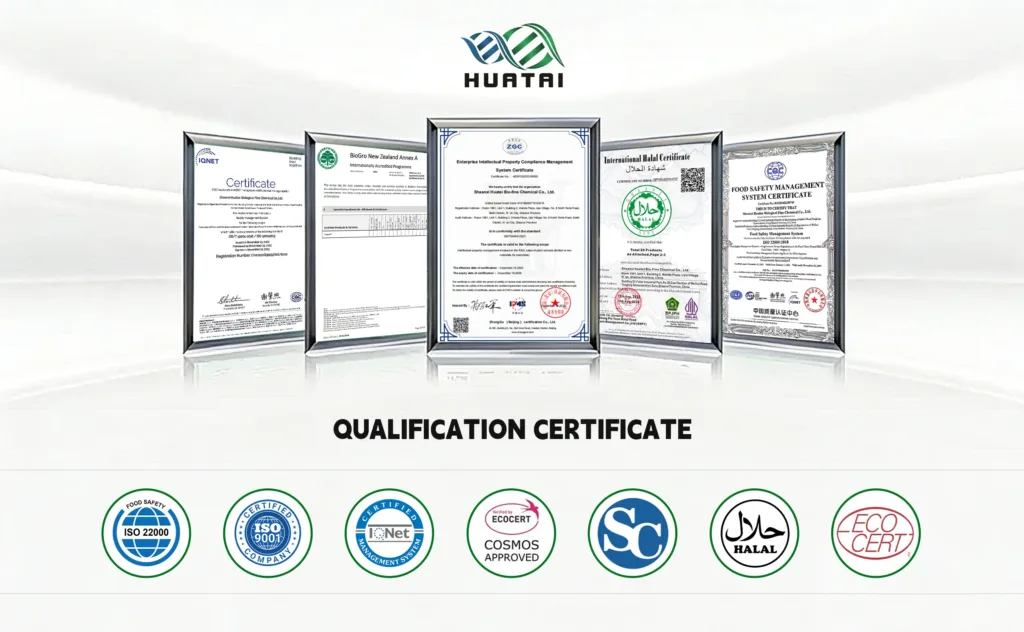
華泰バイオ 高効能の包括的なポートフォリオを提供します 化粧品有効成分グローバルブランドが、ハイエンドスキンケア製品のニーズに応える次世代スキンケア処方を開発できるよう支援します。
包括的なソリューションとイノベーション:当社の製品categoryは、市場のニーズを幅広く網羅しています。 アンチエイジング&引き締め, 皮脂コントロール&ニキビ対策, 抗炎症作用と鎮静作用,抗酸化防御, ブライトニング、そして 水分補給とバリア機能の修復定番のクラシック製品から最先端の有効成分まで、幅広く取り揃えています。
科学的卓越性への情熱に突き動かされ、最先端の研究開発ラボは、生物活性分子の最先端を探求することに専念しています。原料供給にとどまらず、包括的な処方コンサルティングとカスタマイズされたソリューション開発を提供しています。当社の専門化学者チームは、お客様のブランドと緊密に連携し、複雑な安定性の問題や官能特性の課題を克服することで、最終製品が競争の激しいグローバル市場で際立つよう支援します。
妥協のない品質と信頼性:当社はすべてのバッチにおいて スキンケアの有効成分 COSMOS、ISO 9001/22000、ハラール認証など、厳格な品質基準を満たしています。この取り組みは、詳細な技術資料によって裏付けられており、あらゆる製剤上の課題に対し、臨床的に裏付けられたソリューションと確実なコンプライアンスを提供します。

 English
 German
 Italian
 French
 Spanish
 Japanese
 Korean
 Russian