バイオサンス・バクチオール基準を超える処方:高純度バクチオールに関する技術ガイド
Biossance put Bakuchiol on the map. They proved consumers want retinol alternatives that actually work without peeling their faces off. But let us talk manufacturer to formulator. When you try to build a 1% or 2% Bakuchiol serum, what usually happens? Your beautiful white emulsion turns yellow in a month. Or worse, it smells like burnt rubber.
Why does this happen? It comes down to extraction precision.
Most suppliers sell raw “Babchi extract” and label it as Bakuchiol. That is a dangerous game. The seeds of the Psoralea corylifolia plant contain psoralens. These are natural botanical defense chemicals. If you leave them in your skincare formula, they react violently with UV light. They cause severe blistering and hyperpigmentation. Dermatologists call it phytophotodermatitis. Normal people call it a nasty chemical burn.
You need to strip those out completely. High-performance skincare demands high-purity isolation. It requires molecular precision, not just basic solvent extraction.
Look at the actual specifications. Here is the data that separates a stable, clinical-grade active from a cheap crude extract.
| パラメータ | Standard Market Extract (90%) | Our High-Purity Grade (99%) |
| バクチオールアッセイ(HPLC) | 90% | 最小99.0% |
| ソラレン含有量 | < 100 ppm | < 1 ppm (Non-detectable) |
| カラープロファイル | Dark Brown / Viscous | Pale Yellow / Clear Liquid |
| 臭気プロファイル | Strong earthy, bitter | Faint characteristic |
| 乳化安定性 | Poor (Breaks over time) | Highly stable in Lipids |
| Phototoxicity Risk | 高い | ゼロ |
Do you see the psoralen limit? That is the most critical line on your Certificate of Analysis (COA). If your current ingredient supplier does not list psoralen parts-per-million on their COA, drop them immediately. You cannot risk your brand reputation on unverified safety data.
Let me share a recent case from our lab. A European indie brand wanted to beat the standard 1% Bakuchiol squalane serum. They wanted to add Vitamin C (Ascorbyl Tetraisopalmitate) and push the Bakuchiol load to 1.5%. They initially used a 95% grade from a generic trader. Within three weeks in the 40°C oven, their prototype oxidized completely. The viscosity crashed. The smell was awful.
They brought the mess to us. We swapped their active for our 99% purified Bakuchiol. Then we tweaked their chassis. Bakuchiol hates iron and copper ions. We added 0.1% Disodium EDTA to chelate the free metal ions. We advised their contract manufacturer to incorporate the Bakuchiol entirely below 40°C during the final cool-down phase. We locked the final pH at 5.5.
The result? An ultra-stable, crystal-clear golden oil. It passed a 12-week accelerated stability test with flying colors. No odor degradation. No color shift.
You cannot ignore the published clinical science. A landmark 2018 study in the British Journal of Dermatology directly compared 0.5% Bakuchiol with 0.5% Retinol. After 12 weeks, both active groups significantly decreased wrinkle surface area. Both reduced hyperpigmentation equally. But the retinol group reported heavy facial skin scaling and stinging. The Bakuchiol group did not.
This data gives your marketing team massive claims power. But you only get these results if your active actually stays intact in the bottle. Furthermore, the European Union recently tightened regulations on retinol usage due to systemic Vitamin A overexposure. This regulatory pressure makes Bakuchiol a vital compliance strategy for global cosmetic brands, not just a passing trend.
Here are our hard-and-fast formulation rules for high-purity Bakuchiol:
- Never add it to the water phase. It is strictly oil-soluble. Pre-mix it with your non-polar lipids like Squalane or Caprylic/Capric Triglyceride.
- Add it at the very end of your manufacturing process. Keep your kettle temperatures strictly below 40°C.
- Keep your formula pH between 4.0 and 6.5. Bakuchiol degrades rapidly in highly alkaline environments.
- Always use a strong chelating agent. Free metal ions from your water source will destroy the molecule.
- Package in opaque or dark glass. Even though Bakuchiol does not make the skin photosensitive, the raw material itself degrades under direct UV exposure.
Brands often ask us for test samples to benchmark against their current supply. We gladly send them. Once you see the pale yellow clarity of a true 99% isolate next to a murky brown 90% extract, the choice makes itself.
Clean beauty requires intense scientific purification. Protect your formula, protect your consumers, and demand the analytical data to prove it.
References from Public Literature:
- Dhaliwal, S., Rybak, I., Ellis, S. R., et al. (2018). “Prospective, randomized, double-blind assessment of topical bakuchiol and retinol for facial photoageing.” British Journal of Dermatology, 180(2), 289-296.
- Chaudhuri, R. K., & Bojanowski, K. (2014). 「バクチオール:遺伝子発現プロファイリングによって明らかになったレチノール様機能性化合物であり、アンチエイジング効果が臨床的に証明されている」. International Journal of Cosmetic Science, 36(3), 221-230.
- European Commission Scientific Committee on Consumer Safety (SCCS). (2022). “Opinion on Vitamin A (Retinol, Retinyl Acetate, Retinyl Palmitate).” SCCS/1639/21.
スキンケア科学をさらに進化させましょう:当社のプレミアム有効成分で、次世代の処方を開発してください。
当社を選ぶ理由
華泰バイオ 高効能の包括的なポートフォリオを提供します 化粧品有効成分グローバルブランドが、ハイエンドスキンケア製品のニーズに応える次世代スキンケア処方を開発できるよう支援します。
包括的なソリューションとイノベーション:当社の製品categoryは、市場のニーズを幅広く網羅しています。 アンチエイジング&引き締め, 皮脂コントロール&ニキビ対策, 抗炎症作用と鎮静作用,抗酸化防御, ブライトニング、そして 水分補給とバリア機能の修復定番のクラシック製品から最先端の有効成分まで、幅広く取り揃えています。
科学的卓越性への情熱に突き動かされ、最先端の研究開発ラボは、生物活性分子の最先端を探求することに専念しています。原料供給にとどまらず、包括的な処方コンサルティングとカスタマイズされたソリューション開発を提供しています。当社の専門化学者チームは、お客様のブランドと緊密に連携し、複雑な安定性の問題や官能特性の課題を克服することで、最終製品が競争の激しいグローバル市場で際立つよう支援します。
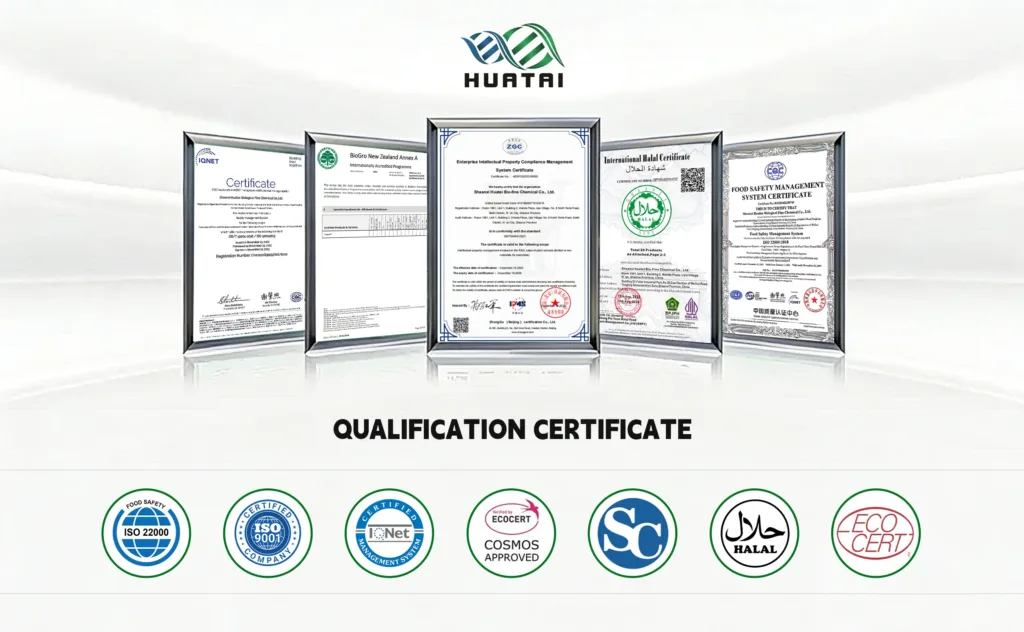
妥協のない品質と信頼性:当社はすべてのバッチにおいて スキンケアの有効成分 COSMOS、ISO 9001/22000、ハラール認証など、厳格な品質基準を満たしています。この取り組みは、詳細な技術資料によって裏付けられており、あらゆる製剤上の課題に対し、臨床的に裏付けられたソリューションと確実なコンプライアンスを提供します。

 English
 German
 Italian
 French
 Spanish
 Japanese
 Korean
 Russian