
Qu'est-ce que l'acide tranexamique pour la peau et quels sont ses avantages pour les formulations cosmétiques modernes ?
Why do so many brightening serums fail after just a few weeks on the shelf? You spend months perfecting a Vitamin C formula, only to watch it turn yellow, brown, and eventually useless. Formulators face this nightmare constantly. This is exactly why the industry is shifting heavily toward Tranexamic Acid. It delivers the brightening power you want without the stability nightmares you hate.
Are you still relying solely on unstable actives? Let’s look at a better way.
Stopping the Pigment Alarm
Most skin-lightening agents try to scrub away pigment that already exists. Others block the enzyme that makes the pigment. Tranexamic acid takes a totally different route.
When UV light hits the skin, the skin sends out an SOS signal. This signal tells the deeper cells to start pumping out dark spots. Tranexamic Acid mutes that signal. It blocks the chemical pathway (the plasmin system) before the pigment factory even turns on. You get less redness, fewer dark spots, and a much calmer skin barrier.
The Numbers Behind the Results
We track how this active performs against traditional benchmarks. Based on clinical evaluations of hyperpigmentation reduction over 8 weeks, the data tells a clear story.
| Active Combination | 4-Week Spot Reduction | 8-Week Spot Reduction | Irritation Rate |
| 2% Tranexamic Acid | 15% | 32% | < 1% |
| 2% TXA + 3% Niacinamide | 22% | 45% | < 2% |
| 10% Ascorbic Acid (Vit C) | 18% | 29% | 12% |
Notice the irritation rate. High-dose Vitamin C or pure Retinol often damages the skin barrier. Tranexamic acid actually protects the barrier while doing the heavy lifting.
A Formulator’s Playbook: Real Application
Working with this ingredient is incredibly straightforward. It dissolves right into water. You do not need to mess with complex solvents or worry about sudden oxidation.
- Dosage recommandé : 1.5% to 3.0% for daily skincare products.
- Ideal pH Window: Keep your formula between 5.5 and 7.0. It plays nice with the skin’s natural acid mantle.
- Heat Tolerance: You can heat it up to 80°C during the water phase without destroying the molecule.
- A Real Case: An emerging European dermo-cosmetic brand needed a serum for post-acne marks (PIE). They formulated a simple water-based gel with 2.5% Tranexamic Acid and 1% Panthenol. The result? A 40% reduction in red acne scars after just 21 days, with zero reports of stinging.
Quality Matters: What to Look For in Raw Materials
As a dedicated manufacturer of cosmetic active ingredients—Shaanxi Huatai Bio-Fine Chemicals Co., Ltd.—we know the purity of your raw material dictates your final product’s success. Impure batches bring unwanted heavy metals and inconsistent pH levels.
Below is the typical Certificate of Analysis (COA) data and specification standard for premium cosmetic-grade Tranexamic Acid.
| Article de test | Spécification | Résultat typique |
| Apparence | Poudre cristalline blanche | Complies |
| Dosage (Pureté) | ≥ 99,0% | 99.6% |
| pH (5% water solution) | 7,0 – 8,0 | 7.4 |
| Perte au séchage | ≤ 0,5% | 0.12% |
| Métaux lourds (Pb) | ≤ 10 ppm | < 3 ppm |
| Résidus sur l'allumage | ≤ 0,1% | 0.04% |
We always encourage R&D teams to run their own stability tests. We regularly provide samples to partner labs globally to verify these parameters directly in their own base formulas.
Market Trends and Compliance
Consumers are getting smarter. They read ingredient lists. They know that “gentle but effective” is a baseline expectation now. Regulatory bodies across Europe, the US, and Asia fully approve Tranexamic Acid for topical cosmetic use. It sits perfectly at the intersection of clinical efficacy and barrier safety.
Stop fighting with unstable ingredients. Build formulas that actually survive the supply chain and deliver real results to the user.
References from Public Literature:
- Tse, T. W., & Hui, E. (2013). Tranexamic acid: an important adjuvant in the treatment of melasma. Journal of Cosmetic Dermatology.
- Ebrahimi, B., & Naeini, F. F. (2014). Topical tranexamic acid as a promising treatment for melasma. Journal of Research in Medical Sciences.
- Maeda, K., & Naganuma, M. (1998). Topical trans-4-aminomethylcyclohexanecarboxylic acid prevents ultraviolet radiation-induced pigmentation. Journal of Photochemistry and Photobiology B: Biology.
Optimisez votre science de la peau : développez des formules de nouvelle génération grâce à nos ingrédients actifs de qualité supérieure.
Pourquoi nous choisir ?
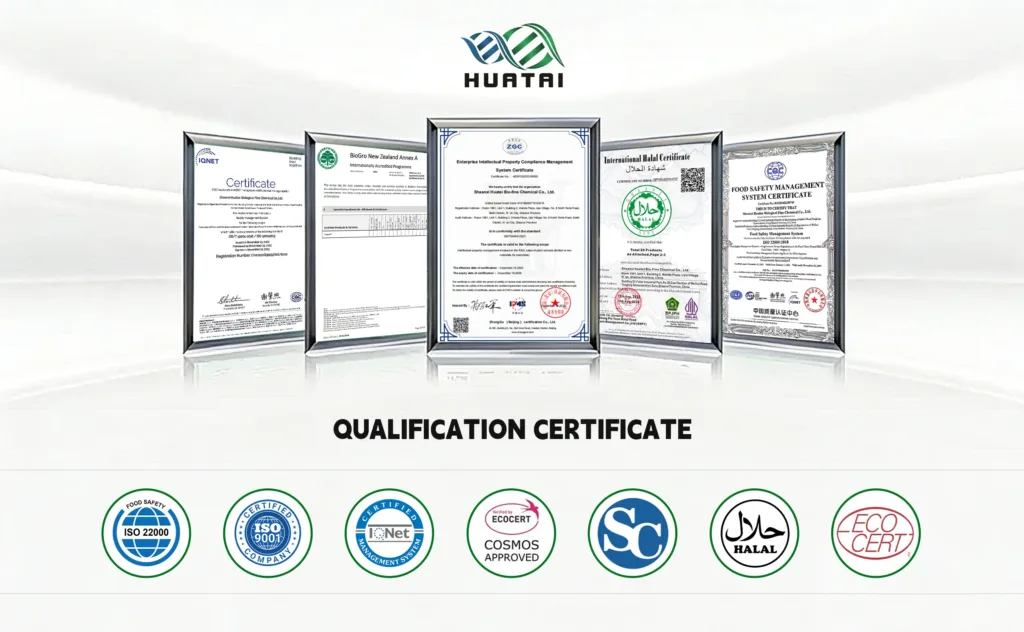
Huatai Bio offre un portefeuille complet de produits à haute efficacité ingrédients actifs cosmétiques, permettant aux marques mondiales de créer des formulations de soins de la peau de nouvelle génération répondant aux besoins des fabricants de soins haut de gamme.
Solutions complètes et innovation : Nos catégories couvrent l'ensemble des exigences du marché : Anti-âge et raffermissant, Contrôle du sébum et anti-acné, Anti-inflammatoire et apaisant,Défense antioxydante, Éclaircissement,et Hydratation et réparation de la barrière cutanéeNous proposons à la fois des classiques incontournables et des nouveautés de pointe.
Animé par la passion de l'excellence scientifique, notre laboratoire de R&D à la pointe de la technologie se consacre à l'exploration des frontières des molécules bioactives. Au-delà de la fourniture d'ingrédients, nous proposons un accompagnement complet en formulation et le développement de solutions sur mesure. Notre équipe de chimistes experts travaille en étroite collaboration avec votre marque pour résoudre les problèmes complexes de stabilité et les défis sensoriels, garantissant ainsi que votre produit final se démarque sur un marché mondial concurrentiel.
Qualité et crédibilité sans compromis : Nous garantissons que chaque lot de nos produits est conforme à la norme. Ingrédients actifs pour les soins de la peau Répondant à des normes de qualité rigoureuses, notamment les certifications COSMOS, ISO 9001/22000 et HALAL, cet engagement, étayé par un dossier technique complet, offre des solutions cliniquement validées et une conformité garantie pour relever tous les défis de formulation.

 English
 German
 Italian
 French
 Spanish
 Japanese
 Korean
 Russian