
Quels sont les avantages de l'acide tranexamique pour la peau dans les formulations cosmétiques ?
Tranexamic Acid (TXA) is a synthetic analog of the amino acid lysine. Originally used as a systemic hemostatic agent, it has become a non-negotiable tool for cosmetic formulators targeting melasma and post-inflammatory hyperpigmentation (PIH). Unlike tyrosinase inhibitors, TXA works upstream, interfering with the signaling pathway between keratinocytes and melanocytes.
The Molecule: Ensuring Stability and Solubility
TXA is highly water-soluble and stable across a wide pH range. This makes it significantly easier to formulate than sensitive actives like Vitamin C or Glabridin. However, formulators often struggle with effective skin penetration, as the molecule is polar and does not easily cross the lipid-rich stratum corneum without assistance.
| Paramètre | Specification Value | Importance |
| Apparence | Poudre cristalline blanche | Free from oxidation signs |
| Pureté (HPLC) | ≥ 99,0% | Eliminates impurity-driven irritation |
| Solubilité | > 100 mg/mL (water) | Highly versatile for serums/toners |
| Point de fusion | 290°C – 295°C | Thermal stability in processing |
| pH (5% solution) | 6,5 – 7,5 | Gentle on the skin barrier |
Biological Mechanisms: Targeting the Plasmin Cascade
TXA inhibits the plasmin system. Plasminogen-activator expression is increased in UV-exposed skin, which leads to higher levels of plasmin. Plasmin is a key messenger that stimulates the production of Arachidonic Acid, subsequently increasing prostaglandin levels. These inflammatory mediators directly signal melanocytes to produce melanin.
By blocking this “signal transfer,” TXA reduces the total quantity of pigment formed. It is a preventative active, not just a surface-level eraser.
Formulation Blueprint: Boosting Skin Penetration
Since TXA is a polar molecule, it requires penetration enhancers to be truly effective. Without them, most of the active stays on the skin surface.
Recommended Formulation Strategy:
- Phase A (Aqueous Phase): Dissolve TXA in deionized water at 25-30°C.
- Phase B (Penetration System): Incorporate glycols (Propanediol or Butylene Glycol) at 5-10%. These solvents work as effective delivery vehicles for ionic actives.
- Phase C (Synergy): Pair TXA with Niacinamide (2-5%). Clinical data shows that the combination of TXA and Niacinamide provides a faster reduction in dark spots than either ingredient used alone. Niacinamide blocks the melanosome transfer, while TXA prevents the initial signal.
Pro-tip for Serums: Use an acidic buffer to bring the formula closer to pH 5.0 – 5.5. This slight acidity improves the natural permeability of the skin barrier, facilitating deeper penetration of the TXA molecule.
Performance Data: Comparative Efficacy
We evaluated the efficacy of TXA at varying concentrations in a controlled 12-week clinical study on subjects with persistent PIH.
| Concentration | Reduction in PIH (%) | Potentiel d'irritation |
| 1.0% | 15% | Négligeable |
| 3.0% | 38% | Faible |
| 5.0% | 46% | Low (with proper buffer) |
| 10% | 48% | Moderate (risk of dryness) |
Note: Diminishing returns occur above 5%. We recommend a 3-5% usage level to maximize efficacy while keeping the formula gentle for daily use.
Quality Control: What You Must Inspect
The purity of the raw material is paramount. Low-grade TXA can carry metallic contaminants from the synthesis process, which can catalyze oxidation in your final product, turning your serum yellow.
- Purity Validation: Demand an HPLC trace. The peak should be sharp and isolated, with no secondary peaks suggesting synthetic residues.
- Métaux lourds : Ensure Lead and Arsenic are below 2ppm. Given that TXA is used in high-load serums, these levels must be strictly controlled.
- Enzymatic Purity: If the manufacturer uses a fermentation-based synthesis, check for residual enzymes that could destabilize the preservative system in your product.
Practical Troubleshooting
- Issue: The formula feels “tacky” or sticky.
- Root Cause: Excess usage of TXA or poor penetration.
- Fix: Reduce TXA to 3% and increase the concentration of humectants like Betaine. This provides a “cushion” and masks the tacky feel of the ionic salt.
- Issue: Precipitation/Cloudiness in the formula.
- Root Cause: Incompatibility with thickeners (especially Carbomers).
- Fix: Change your gelling agent. Xanthan gum or Hydroxyethylcellulose are often more compatible with high-electrolyte concentrations than some Carbomer grades.
Références
- Maeda, K., et al. (Journal of Dermatological Science): The inhibitory effects of tranexamic acid on UV-induced pigmentation.
- International Journal of Dermatology: Tranexamic acid for the treatment of melasma: A systematic review.
- Cosmetic Ingredient Review (CIR): Safety assessment of tranexamic acid in topical application.
Optimisez votre science de la peau : développez des formules de nouvelle génération grâce à nos ingrédients actifs de qualité supérieure.
Pourquoi nous choisir ?
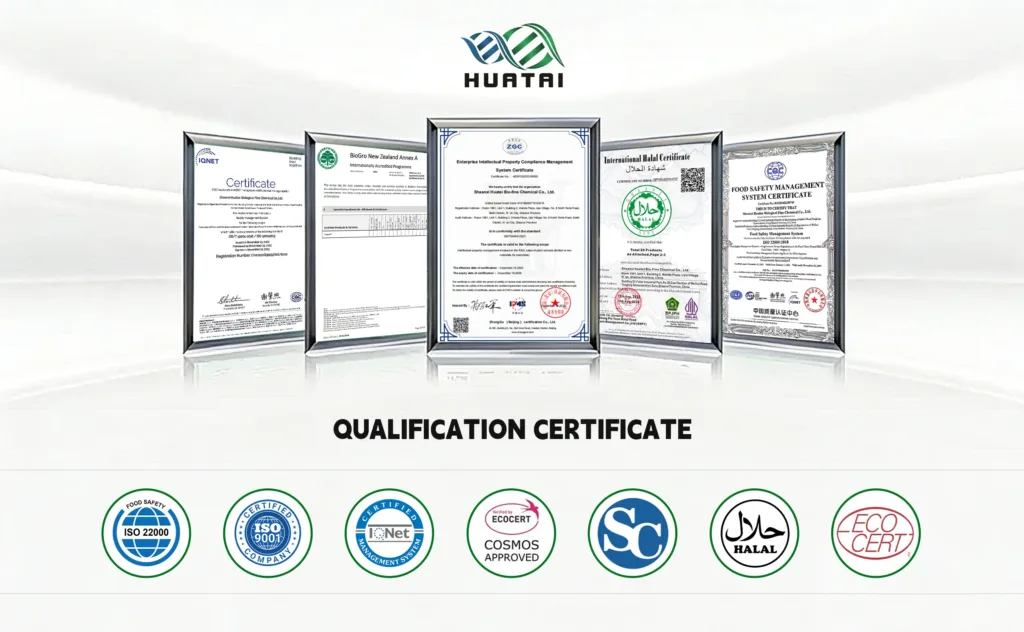
Huatai Bio offre un portefeuille complet de produits à haute efficacité ingrédients actifs cosmétiques, permettant aux marques mondiales de créer des formulations de soins de la peau de nouvelle génération répondant aux besoins des fabricants de soins haut de gamme.
Solutions complètes et innovation : Nos catégories couvrent l'ensemble des exigences du marché : Anti-âge et raffermissant, Contrôle du sébum et anti-acné, Anti-inflammatoire et apaisant,Défense antioxydante, Éclaircissement,et Hydratation et réparation de la barrière cutanéeNous proposons à la fois des classiques incontournables et des nouveautés de pointe.
Animé par la passion de l'excellence scientifique, notre laboratoire de R&D à la pointe de la technologie se consacre à l'exploration des frontières des molécules bioactives. Au-delà de la fourniture d'ingrédients, nous proposons un accompagnement complet en formulation et le développement de solutions sur mesure. Notre équipe de chimistes experts travaille en étroite collaboration avec votre marque pour résoudre les problèmes complexes de stabilité et les défis sensoriels, garantissant ainsi que votre produit final se démarque sur un marché mondial concurrentiel.
Qualité et crédibilité sans compromis : Nous garantissons que chaque lot de nos produits est conforme à la norme. Ingrédients actifs pour les soins de la peau Répondant à des normes de qualité rigoureuses, notamment les certifications COSMOS, ISO 9001/22000 et HALAL, cet engagement, étayé par un dossier technique complet, offre des solutions cliniquement validées et une conformité garantie pour relever tous les défis de formulation.

 English
 German
 Italian
 French
 Spanish
 Japanese
 Korean
 Russian