Formulators often chase the newest synthetic brightening agents. I get it. The pressure to innovate is high. Brands want fast claims. But why ignore a natural compound that outperforms harsh chemicals in lab tests without the side effects?
Licorice root extract, specifically the active molecule Glabridin, is a workhorse. I see brands fail constantly with Vitamin C. It oxidizes, turns brown on the shelf, and frustrates consumers. Glabridin offers a highly stable, potent alternative for serious skin brightening.
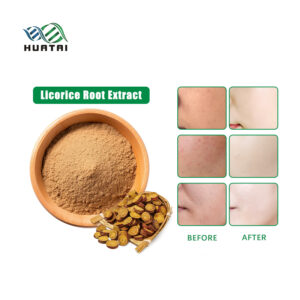
You cannot just buy generic “licorice water” and expect results. You need standardized active content. As a manufacturer, I always tell R&D teams to look at the exact purity grades before formulating.
Product Specification Comparison
| Grade | Contenu actif | Apparence | Solubilité | Application cible |
| 40% Extract | Min 40% Glabridin | Brown powder | Butylène Glycol | Mid-tier brightening creams |
| 90% Extract | Min 90% Glabridin | Poudre jaune pâle | PEG-400 | High-end serums |
| 98% Extract | Min 98% Glabridin | Poudre blanche | Éthanol / Glycols | Clinical-grade spot treatments |
Quality control dictates your shelf life. Heavy metals and microbes ruin emulsions. They cause product recalls. Here is a standard Certificate of Analysis (COA) snapshot for a commercial 90% grade batch.
Standard Quality Control Data (COA)
| Paramètre | Spécification | Actual Test Result |
| Pureté (HPLC) | >= 90.0% | 2% |
| Perte au séchage | <= 5.0% | 2.1% |
| Métaux lourds | ≤ 10 ppm | 1.5 ppm |
| Numération totale sur plaque | <= 100 CFU/g | < 10 CFU/g |
How does it actually work? Glabridin directly blocks tyrosinase. That is the exact enzyme your skin uses to manufacture dark spots. Independent studies show it works much better than kojic acid. No burning. No skin peeling. Just a steady fading of hyperpigmentation.
Look at how it compares to standard industry alternatives.
Performance and Stability Comparison
| Ingrédient actif | Risque d'irritation cutanée | Stabilité de la formule | Main Mechanism |
| Glabridin (Licorice) | Très faible | High (Resists oxidation) | Tyrosinase inhibition |
| Acide L-Ascorbique | Haut | Very Low (Turns brown) | Melanin block / Antioxidant |
| Acide kojique | Moyen | Medium (Color shifts) | Copper chelation |
| Hydroquinone | Très élevé | Faible | Cell toxicity |
You must formulate it correctly. Glabridin is lipophilic. Do not dump the powder into cold water. It will float and clump.
Here is the best method. Pre-dissolve the powder in a solvent like Butylene Glycol or Propylene Glycol. Heat your solvent to about 40 degrees Celsius. Stir until the liquid is fully clear. Add this premix to your oil phase. You can also add it during the final emulsion cool-down. Keep your final batch pH between 5.0 and 7.0 for optimal stability.
Let me share a recent trial. A client wanted a gentle brightening serum for compromised skin. They could not use harsh acids. We recommended a formula using 0.1% of the 90% Glabridin extract.
They tested it on a panel of users with severe sun damage. They measured the melanin index using clinical imaging.
- Week 2: 15% reduction in visible dark spots.
- Week 4: 28% reduction.
- Week 8: 41% reduction in overall spot intensity.
The formula remained snow-white in the glass dropper bottle. They saw zero oxidation. They passed a 3-month accelerated stability test at 45 degrees Celsius with no issues.
The market is shifting fast. Regulators closely watch synthetic lightening agents. Europe restricts many traditional brighteners. Licorice root extract easily bypasses these regulatory hurdles. It is safe and globally compliant. Plant-derived clinical efficacy is exactly what buyers want right now.
Build your formulas on reliable data. Choose pure extracts. Your stability testing will thank you.
References Consulted:
- Simmler, C., et al. (2013). “Licorice Root: A Botanical Dietary Supplement and Cosmetic Ingredient.” Fitoterapia.
- Yokota, T., et al. (1998). “The inhibitory effect of glabridin from licorice extracts on melanogenesis and inflammation.” Pigment Cell Research.
- Draelos, Z. D. (2007). “Skin lightening preparations and the hydroquinone controversy.” Dermatologic Therapy.

 English
 German
 Italian
 French
 Spanish
 Japanese
 Korean
 Russian