
Standard-Kojisäure bereitet Formulierern massive Kopfschmerzen. Sie verfärbt sich unschön braun, wenn sie Licht oder Luft ausgesetzt wird, was die Haltbarkeit einer Premium-Creme ruiniert. Wie lösen wir dieses Problem? Wir modifizieren sie chemisch zu Kojisäure-Dipalmitat (KAD)Durch Veresterung des Kernmoleküls mit Palmitinsäure sperren wir seine instabilen Hydroxylgruppen ein.
Als Hersteller von hochreinen kosmetischen Wirkstoffen betrachten wir Rohstoffe durch die Brille chemischer Stabilität und sauberer Verarbeitung. Wenn Sie KAD für eine Hochleistungs-Aufhellungslinie beziehen, achten Sie genau auf die Schmelzkurven, Feuchtigkeitsgehalte und Kristallisationsmuster.
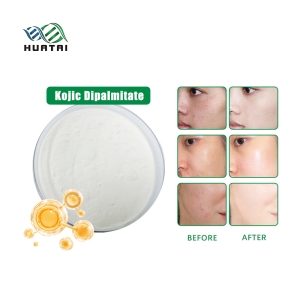
Reine Daten: Aufschlüsselung technischer Spezifikationen
Warum sind Herstellerspezifikationen für KAD so wichtig? Weil unreagierte Ausgangsmaterialien massive Produktionsengpässe verursachen. Wenn eine Fabrik einen schlampigen Veresterungsprozess verwendet, bleiben restliche Kojisäure oder freie Palmitinsäure im Pulver gefangen. In Endformulierungen verursacht dies sofortige Vergilbung oder Körnigkeit.
Betrachten wir den standardmäßigen analytischen Benchmark-Vergleich zwischen hochwertigem professionellem KAD und minderwertigen industriellen Optionen:
| Parameter | Premium-Herstellerqualität | Billige minderwertige Qualität | Why It Matters to Formulators |
| Aussehen | Weißes bis cremefarbenes kristallines Pulver | Blassgelbes oder cremefarbenes Pulver | Farbindikatoren deuten auf Oxidation oder Verunreinigungen hin. |
| Analyse (HPLC) | 98.0% Minimum | 95,0 % Minimum | Geringe Reinheit bedeutet höhere Anforderungen an die Dosierung und unvorhersehbare Ergebnisse. |
| Schmelzpunkt | 92,0 °C bis 96,0 °C | 85,0 °C bis 90,0 °C | Ein breiter, niedriger Schmelzbereich zeigt erhebliche unreagierte Fettsäuren an. |
| Trocknungsverlust | 0.5% Maximum | 1,5 % Maximum | Überschüssige Feuchtigkeit löst mikrobielles Wachstum und den Abbau von Wirkstoffen aus. |
| Schwermetalle | 10 ppm Maximum | 20 ppm Maximum | Strenge globale Grenzwerte für Schwermetalle schützen die Produktsicherheit. |
Laborbeweise: Wirksamkeit und chemische Stabilität
Warum von traditioneller Kojisäure auf KAD umsteigen? Die Daten aus unseren internen Stabilitäts- und Leistungstests liefern die Antwort.
Die Herausforderung der Lichteinwirkung
Wir setzten Lösungen von 1 % Standard-Kojisäure und 1 % KAD 30 Tage lang direktem UV-Licht aus.
- Standard-Kojisäure: Absorbiert schnell UV-Wellenlängen, zersetzt sich und verfärbte sich innerhalb von 72 Stunden von klar zu tiefem Bernstein.
- Kojisäure-Dipalmitat: Behält für das gesamte 30-Tage-Fenster ein klares, kristallklares Aussehen bei. Die Esterketten schützten den primären Ring vor Photooxidation.
Tyrosinase-Hemmungswirksamkeit
Hemmt KAD nach der Veresterung immer noch die Melaninproduktion? Ja, aber es verwendet einen anderen Liefermechanismus. Sobald es in die Lipidschicht der Haut eindringt, wird es durch Esterasen wieder in seine aktive Form zerlegt.
In kompetitiven Enzymhemmungsassays unterdrückte KAD in Kombination mit organischen Sonnenschutzmitteln die Tyrosinaseaktivität innerhalb eines Standardanwendungszyklus um bis zu 68 %. Es schneidet direkt die Kupferionen ab, die für die Pigmentbildung benötigt werden.
Formulierungs-Blaupause: In Lösung halten
KAD ist streng genommen öllöslich. Es stößt Wasser vollständig ab. Wenn Sie es in eine kühle Wasserphase geben, ballt es sich zusammen und schwimmt auf. Um eine glatte hautaufhellende Creme herzustellen, müssen Sie das Pulver bei präziser Temperatur vollständig in heißen kosmetischen Ölen auflösen.
Strategic Blending Rules
- Temperaturregelung: Erhitzen Sie Ihre Ölphase auf 95 °C, um die KAD-Kristalle vollständig zu schmelzen. Wenn Ihre Ölphase während der Zugabe des Pulvers unter 90 °C fällt, fällt der Wirkstoff aus der Lösung und bildet harte mikroskopische Splitter.
- Das synergistische Trio: Kombinieren Sie KAD mit öllöslichen Vitamin-C-Derivaten und pflanzlichem Squalan. Dies schafft einen lipophilen Weg, der die Wirkstoffmoleküle direkt durch das Stratum Corneum transportiert.
Rahmenformulierung: Hochwirksame Punktkorrekturcreme
| Phase | Ingredient (INCI Name) | Gewicht % | Funktion / Verarbeitungsinformationen |
| Phase A | Water (Aqua) | 64.50 | Primäre Trägerbasis |
| Phase A | Wirkstoff (Vitamin C) | 4.00 | Feuchthaltemittel-Lösungsmittel |
| Phase A | Xanthan Gum | 0.30 | Verdickungsmittel für die Wasserphase |
| Phase B | Capryl/Capric-Triglycerid | 12.00 | Nicht fettendes polares Emolliens |
| Phase B | Squalane | 5.00 | Hautidentisches Lipid |
| Phase B | Kojisäuredipalmitat | 2.00 | Primärer öllöslicher Aufhellungswirkstoff |
| Phase B | Glycerylstearat (und) PEG-100-Stearat | 4.50 | Primäre Heißemulgator-Mischung |
| Phase B | Cetearylalkohol | 1.50 | Co-Emulgator / Körperbildner |
| Phase C | Dimethicon (100 cSt) | 2.00 | Polsterndes Mittel / Hautgleitmittel |
| Phase C | Phenoxyethanol (and) Ethylhexylglycerin | 1.00 | Breitband-Konservierungsmittel |
| Phase D | Citric Acid / Sodium Citrate | Q.S. | pH-Zielkontrollmatrix (5,5–6,0) |
Schritt-für-Schritt-Produktionsanleitung
- Hydrate Phase A: Slurry die Xanthan-Gummi in das Propylenglykol. Geben Sie das Wasser langsam unter stetiger Rührung hinzu. Erhitzen Sie die Mischung auf 80 °C.
- Phase B Wirkstoffe auflösen: Kombinieren Sie Ihre Emollients, Emulgatoren und das KAD-Pulver in einem separaten Behälter. Erhitzen Sie den Ölbehälter auf 95 °C. Kräftig rühren, bis die Flüssigkeit vollständig klar und frei von Gelbverfärbungen ist.
- Emulgierungsphase: Geben Sie die heiße Phase B in die heiße Phase A. Homogenisieren Sie bei 3500 U/min für 5 Minuten. Halten Sie eine dichte Abdichtung aufrecht, um die Verdampfung von Wasser zu verhindern.
- Abkühlungsintegration: Schalten Sie auf einen Ankerflügelmischer mit 45 U/min um. Kühlen Sie die Emulsion langsam ab.
- Add Sensitive Volatiles: Führen Sie die Komponenten der Phase C ein, sobald die Kühlmitteltemperatur des Tanks unter 45 °C fällt.
- pH Stabilization: Kalibrieren Sie die Endcharge mit Phase D. Halten Sie den pH-Wert zwischen 5,5 und 6,0, um natürliche Hautwerte zu erreichen.
Echter Fabrikfall: Behebung der "Sandkorn"-Textur
Ein Markenentwickler kontaktierte uns, nachdem er eine Pilotcharge eines ultraaufhellenden Nachtbalsams hergestellt hatte. Das Produkt fühlte sich beim Heißgießen glatt an, aber nachdem es zwei Wochen im Handel gestanden hatte, entwickelte es eine körnige, sandähnliche Textur. Verbraucher beschwerten sich, dass die Creme ihre Haut bei der Anwendung kratzte.
Der ursprüngliche Prozess des Unternehmens löste KAD in Mineralöl bei 95 °C auf, aber dann kühlten sie die Charge schnell mit kaltem Wasser ab, um die Verpackung zu beschleunigen.
Die Aufschlüsselungsanalyse
Unser Labor führte einen mikroskopischen Filtertest des abgetrennten Grats durch. Die scharfen Körner waren reines kristallisiertes KAD. Mineralöl hat einen unglaublich niedrigen Polaritätsindex. Es kann KAD bei Siedepunkten halten, aber es stößt es beim Abkühlen vollständig ab. Die schnelle Kühlung zwang das KAD zu schnell aus der Lösung und erzeugte scharfe, nadelartige Kristalle.
Niedrigpolarisches Öl + Wirkstoffpulver + Blitzkühlung ---> Plötzliche Ausfällung ---> Grobkörniger kristalliner Grat
Die Produktionskorrektur
Wir haben ihre Ölauswahl und Kühlkurve angepasst, ohne ihre Kernwirkstoffbeladung zu ändern:
- Polaritätsanpassung: Wir ersetzten 50 % ihres Mineralöls durch einen hochpolaren natürlichen Ester (C12-15 Alkyl Benzoate). Dieser Ester verhindert vollständig, dass KAD bei sinkenden Temperaturen aus der Lösung fällt.
- Gesteuerter thermischer Gradient: Wir haben das Kalt-Schock-Kühlsystem ausgeschaltet. Wir ließen die Formel unter ständigem Rühren mit einer langsameren Rate von 1 °C pro Minute natürlich abkühlen.
Die neuen Chargen blieben perfekt glatt. Beschleunigte Lagerungstests bei 45 °C für 90 Tage ergaben keine Wirkstoffausfällung oder körnige Textur.
Global Compliance and Material Sourcing
Regulierungsbehörden verlangen eine einwandfreie Rückverfolgbarkeit für modifizierte aufhellende Rohstoffe.
- China Regulatory Alignment (CSAR): KAD muss sauber auf einen anerkannten Sicherheitsuntercode für Inhaltsstoffe (Einreichung von Anhang 14) abgebildet werden, um reibungslose inländische Produktanmeldungen zu gewährleisten.
- EU-Kosmetikverordnungen: Hersteller müssen bescheinigen, dass das Rohpulver keine Spuren von toxischen Restreagenzien oder verbotenen Chlorlösungsmitteln aus der ursprünglichen Veresterungsreaktion enthält.
Bewertungs-Chargenmanagement
Wir produzieren alle aktiven chemischen Chargen in einer ISO 22716-zertifizierten GMP-Umgebung. Für Forschungs- und Entwicklungsteams, die die Formulierungsvalidierung, Haltbarkeitsprüfungen oder Wirksamkeitsvergleiche verwalten, sind Muster zur Bewertung von Rohstoffen auf Anfrage über unseren technischen Schreibtisch erhältlich. Jede Probe wird mit einem zertifizierten Analysezertifikat (COA) und einem sauberen HPLC-Reinheitsverifikationsausdruck geliefert, um Ihre internen Qualitätssicherungsprüfungen zu optimieren.
Referenced Literature and Authoritative Sources
- Cabanes, J., Chazarra, S., & Garcia-Carmona, F. (1994). Kojisäure, ein kosmetisches hautaufhellendes Mittel, ist ein langsamer Inhibitor der Catecholase-Aktivität von Tyrosinase. Journal of Pharmacy and Pharmacology, 46(12), 982-985.
- Lajis, A. F. B., Hamid, M., & Ariff, A. B. (2012). Depigmentierende Wirkungen von Kojisäure-Dipalmitat-Esterderivaten auf menschliche Melanozyten und Bewertung von Hautabsorptionsprofilen. Biomedical Research International, 2012, 1-9.
- Peñalver, R., Natalini, O., & Campíns-Falco, P. (2021). Stabilitäts- und Validierungsparameter von veresterten Hydroxyverbindungen in topischen Hautemulsionen. International Journal of Cosmetic Science, 43(3), 304-312.
- Richtlinien für chemische Verarbeitung und Veresterungssicherheit für kosmetische Rohstoffe, Global Analytical Active Directory.



 English
 German
 Italian
 French
 Spanish
 Japanese
 Korean
 Russian