
What Is Stearyl Glycyrrhetinate? Technical Brief, Anti-Inflammatory Data, and Formulating Oil-Soluble Licorice Derivatives
스테아릴 글리시레티네이트 is the lipophilic ester derived from 18β-glycyrrhetinic acid and stearyl alcohol. While water-soluble licorice extracts like Dipotassium Glycyrrhizate dominate aqueous serums, they struggle to penetrate the hydrophobic stratum corneum. Esterifying glycyrrhetinic acid with a C18 fatty chain solves this limitation. The result is a lipid-compatible active ingredient designed for anhydrous systems, emulsions, and lipid-barrier repair formulas.
Chemical Profile and Molecular Structure
- INCI 명칭: 스테아릴 글리시레티네이트
- CAS Number: 13832-70-7
- EINECS/ELINCS Number: 419-580-5
- Molecular Formula: C48H82O4
- Molecular Weight: 723.16 g/mol
- Chemical Structure: 18β-glycyrrhetinic acid 30-stearyl ester
| |
[ Glycyrrhetinic Acid Core ] — C(=O)—O—(CH2)17—CH3
|
O=C
Natural 18β-glycyrrhetinic acid contains a carboxylic acid group at the C-30 position. Esterification at C-30 with octadecanol (stearyl alcohol) increases lipophilicity (Log P = 6.2). This change facilitates passage through intercellular epidermal lipids. Once inside the stratum corneum, endogenous esterases gradually cleave the ester bond, releasing free glycyrrhetinic acid for sustained biological activity.
Standard Certificate of Analysis (COA) Specifications
The following table outlines the industrial raw material quality control criteria for cosmetics manufacturing:
| Testing Item | 사양 표준 | Typical Batch Result | 테스트 방법 |
|---|---|---|---|
| 모습 | 흰색 또는 미색의 결정성 분말 | 흰색 미세 분말 | 육안 검사 |
| 냄새 | Characteristic faint odor | Conform | 후각 |
| Purity (Assay by HPLC) | ≥ 98.0% | 6% | HPLC (C18 column, UV 254 nm) |
| 녹는점 | 70.0 °C – 77.0 °C | 73.5 °C – 75.0 °C | Capillary melting point apparatus |
| 건조 감량 | ≤ 1.0% | 0.35% | 105 °C, 2 hours |
| 점화 잔류물 | ≤ 0.2% | 0.08% | Ignition at 600 °C |
| 중금속(납 기준) | 10ppm 이하 | 5 ppm 미만 | ICP-MS |
| 비소(As) | ≤ 2 ppm | 1 ppm 미만 | AAS |
| Microbiological Testing | Total Plate Count < 100 CFU/g | < 10 CFU/g | ISO 21149 / ISO 16212 |
Solubility Profile & Solvent Compatibility
Unlike salt forms of glycyrrhizic acid, Stearyl Glycyrrhetinate is virtually insoluble in water (9 μg/L at 20 °C). It requires dissolved lipid carriers or warm organic solvents.
| Solvent / Lipid Phase | Solubility at 25 °C | Solubility at 75 °C | 제형 참고 사항 |
|---|---|---|---|
| 물 | Insoluble | Insoluble | Unsuitable for direct aqueous phase |
| Ethanol (95%) | Slightly soluble | Soluble (~2.5%) | Precipitates if cooled rapidly in pure state |
| Caprylic/Capric Triglyceride (MCT) | ~0.8% w/w | > 5.0% w/w | Ideal carrier oil for pre-dissolution |
| 스쿠알란 | ~0.5% w/w | > 4.0% w/w | Excellent lipid base for facial oils |
| Mineral Oil / Isohexadecane | ~0.4% w/w | ~3.5% w/w | Good compatibility in hydrocarbon systems |
| Jojoba Oil / Plant Oils | ~0.3% w/w | > 3.0% w/w | Requires heating above 75 °C to dissolve |
Biological Mechanisms & In-Vitro Performance Data
Stearyl Glycyrrhetinate modulates inflammatory cascades primarily by inhibiting 11β-hydroxysteroid dehydrogenase type 1 (11β-HSD1) and downstream arachidonic acid pathways.
1. Inhibition of Pro-Inflammatory Mediators
Inflammatory stressors (UV radiation, chemical irritants, surfactant disruption) activate phospholipase A2. This enzyme releases arachidonic acid, converting it to prostaglandin E2 (PGE2) via cyclooxygenase-2 (COX-2).
In HaCaT Cell Culture Assays (stimulated with LPS 1 μg/mL):
- PGE2 Suppression: IC50 value of 12.4 μM (vs. 28.6 μM for Dipotassium Glycyrrhizate).
- Interleukin-6 (IL-6): Reduces IL-6 secretion by 54.2% at 20 μM.
- TNF-α: Suppresses expression by 41.8% at 20 μM.
2. Antimicrobial Benchmarks (MIC Values)
Broad-spectrum antimicrobial activity helps stabilize acne-prone and compromised skin microflora. Standard broth microdilution testing yields the following Minimum Inhibitory Concentrations (MIC):
- Cutibacterium acnes (ATCC 6919): MIC = 62.5 μg/mL
- Staphylococcus aureus (ATCC 6538): MIC = 125 μg/mL
- Staphylococcus epidermidis (ATCC 12228): MIC = 250 μg/mL
3. In-Vivo Erythema Reduction Study
A randomized split-face clinical test measured erythema reduction following sodium lauryl sulfate (SLS, 2% patch) irritation. Twenty subjects applied a formulation containing 0.2% Stearyl Glycyrrhetinate versus a placebo vehicle twice daily.
- Day 3: Skin redness decreased by 31.4% relative to baseline (measured via spectrophotometer a* value).
- Day 7: Redness decreased by 68.9%, with Trans-Epidermal Water Loss (TEWL) recovering 42% faster 위약 그룹보다.
Formulating with Stearyl Glycyrrhetinate
Why choose Stearyl Glycyrrhetinate over traditional licorice salts? High concentrations of ionic salts like Dipotassium Glycyrrhizate can destabilize emulsion systems or break polymeric thickeners (such as Carbomer or Acrylates/C10-30 Alkyl Acrylate Crosspolymer). Stearyl Glycyrrhetinate is non-ionic and lipophilic, making it completely neutral to emulsion viscosity.
Phase Processing and Heating Requirements
- Add Stearyl Glycyrrhetinate directly to the polar or medium-polar oil phase (MCT, C12-15 Alkyl Benzoate, or Squalane).
- Heat the oil phase to 75 °C – 80 °C under moderate stirring until the powder dissolves completely into a clear liquid.
- Perform emulsification with the water phase at equal temperature.
- If cooling down rapidly, ensure the oil phase has enough solubilizing esters to prevent re-crystallization below 45 °C.
Suggested Dosage Matrix
| Application Type | 권장 사용 수준 | 주요 기능 |
|---|---|---|
| Barrier Repair Creams & Balms | 0.1% – 0.5% | Soothing, anti-redness, lipid replenishment |
| Lip Balms & Lipsticks | 0.2% – 1.0% | Chapped lip repair, anti-inflammatory support |
| Sunscreen & After-Sun Care | 0.1% – 0.3% | Counteracting UV-induced erythema |
| Anhydrous Serums & Facial Oils | 0.05% – 0.2% | Daily calming for sensitive skin |
| Acne & Blemish Spot Treatments | 0.2% – 0.5% | Reducing localized inflammatory papules |
Synergistic Active Combinations
- Bisabolol (0.2%) + Stearyl Glycyrrhetinate (0.1%): Combined inhibition of both 5-LOX and COX-2 pathways.
- Ceramide NP (0.1%) + Stearyl Glycyrrhetinate (0.2%): Rebuilds intercellular lipids while reducing sub-clinical barrier inflammation.
- Tocopherol (0.5%) + Stearyl Glycyrrhetinate (0.1%): Protects lipophilic active ingredients from oxidation while preventing squalene peroxidation on skin.
Comparative Analysis: Stearyl Glycyrrhetinate vs. Dipotassium Glycyrrhizate
| 특성 | 스테아릴 글리시레티네이트 | 디칼륨 글리시리제이트 |
|---|---|---|
| 용해도 | Oil-soluble / Lipophilic | Water-soluble / Hydrophilic |
| Log P Value | 6.2 | < -1.5 |
| Skin Penetration Target | Stratum corneum & lipid matrix | Epidermal aqueous intercellular space |
| Impact on Viscosity | No effect on emulsion rheology | Can lower carbomer / gel viscosity at > 0.5% |
| 열 안정성 | Stable up to 85 °C in oil phase | Stable up to 80 °C in water phase |
| Ideal Product Format | Lipsticks, rich creams, oils, sunscreens | Toners, gels, sheet masks, aqueous serums |
Regulatory Status and Safety Assessment
- US CIR (Cosmetic Ingredient Review): Assessed as safe for use in cosmetic formulations up to 1.0%.
- EU SCCS / CosIng: Listed without specific restriction (Ref No: 38334); standard cosmetic safety limits apply.
- China NMPA (IECIC): Included in the Inventory of Existing Cosmetic Ingredients in China.
- Japan (Quasi-Drug Active): Approved as an active ingredient for anti-inflammatory and soothing claims within specified limits (0.1% – 0.5%).
Phototoxicity and sensitization studies confirm that Stearyl Glycyrrhetinate exhibits zero phototoxic potential at 1.0% concentration. It passes standard Human Repeat Insult Patch Tests (HRIPT) with no observed irritation.
Packaging, Storage, and Handling
- 포장: Standard industrial supply comes in aluminum foil bags or fiber drums lined with double-layer polyethylene bags.
- 보관 조건: Keep containers tightly sealed in a cool, dry, and ventilated place (15 °C – 25 °C). Protect from direct sunlight and moisture.
- 유통기한: 24 months from manufacturing date when stored in unopened original containers.
- Sample Requests: Pure grade production samples are available for research and R&D formulation trials upon request.
Literature & Scientific References
- Cosmetic Ingredient Review Expert Panel. (2007). Final Report on the Safety Assessment of Glycyrrhetinic Acid, its Salts, and Esters. International Journal of Toxicology, 26(Suppl 2), 79–112.
- Shibata, S. (2000). A review of the anti-inflammatory actions of licorice and its active compounds. Journal of the Pharmaceutical Society of Japan, 120(10), 849–862.
- Finney, R. S. H., & Somers, G. F. (1958). The anti-inflammatory activity of glycyrrhetinic acid and its derivatives. Journal of Pharmacy and Pharmacology, 10(1), 613–620.
- Yokota, T., Nishio, H., Kubota, Y., & Mizoguchi, M. (1998). The inhibitory effect of licorice extract on melanogenesis and inflammation. Pigment Cell Research, 11(6), 355–361.
- Inagaki, N., et al. (2006). Inhibitory effects of 18β-glycyrrhetinic acid derivatives on immediate and delayed-type hypersensitivity reactions. Biological and Pharmaceutical Bulletin, 29(8), 1734–1739.
피부 과학을 한 단계 끌어올리세요: 당사의 프리미엄 활성 성분으로 차세대 포뮬러를 개발하십시오.
왜 저희를 선택해야 할까요?
후아타이 바이오 효능이 뛰어난 포괄적인 포트폴리오를 제공합니다. 화장품 활성 성분글로벌 브랜드가 고급 스킨케어 제품의 요구 사항을 충족하는 차세대 스킨케어 포뮬러를 개발할 수 있도록 지원합니다.
종합적인 솔루션 및 혁신: 당사의 제품군은 시장의 모든 요구 사항을 충족합니다. 노화 방지 및 탄력 개선, 피지 조절 및 여드름 방지, 항염 및 진정 효과,항산화 방어, 밝게 빛나게,그리고 수분 공급 및 피부 장벽 복구저희는 오랜 전통을 자랑하는 클래식 제품과 최첨단 액티브웨어를 모두 제공합니다.
과학적 우수성에 대한 열정을 바탕으로, 당사의 최첨단 연구 개발 연구소는 생체 활성 분자의 최첨단을 탐구하는 데 전념하고 있습니다. 원료 공급을 넘어, 당사는 종합적인 제형 컨설팅과 맞춤형 솔루션 개발을 제공합니다. 당사의 전문 화학자 팀은 귀사의 브랜드와 긴밀히 협력하여 복잡한 안정성 문제와 감각적 과제를 해결하고, 경쟁이 치열한 글로벌 시장에서 귀사의 최종 제품이 돋보이도록 지원합니다.
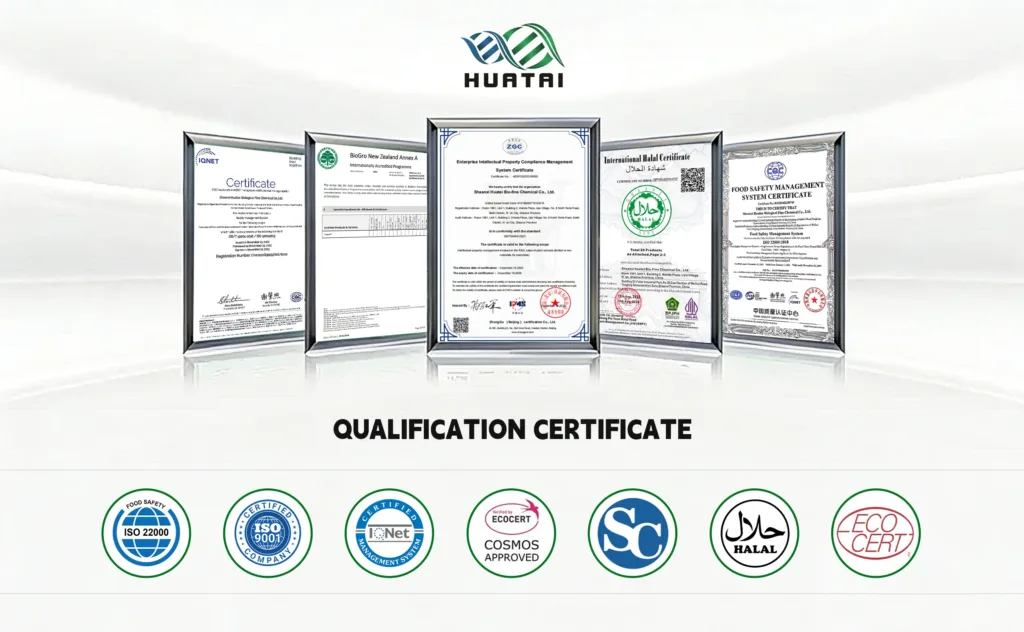
타협 없는 품질과 신뢰성: 당사는 모든 제품 배치에 대해 품질과 신뢰성을 보장합니다. 활성 스킨케어 성분 COSMOS, ISO 9001/22000 및 HALAL 인증을 포함한 엄격한 품질 기준을 충족합니다. 완벽한 기술 자료집을 바탕으로 임상적으로 검증된 솔루션과 모든 제형 관련 문제에 대한 확실한 규정 준수를 보장합니다.
-300x300.jpg)

 English
 German
 Italian
 French
 Spanish
 Japanese
 Korean
 Russian