스테아릴 글리시레티네이트는 피부에 사용해도 안전한가요?
You ask if Stearyl Glycyrrhetinate is safe. That is the wrong question. The right question is: what grade of Stearyl Glycyrrhetinate are you using?
I review toxicology reports and brand formulations daily. Brands assume that because an ingredient originates from licorice root, it is automatically safe. This is a dangerous assumption. Raw plant extracts contain hundreds of uncharacterized compounds. They contain heavy metals pulled from the soil. They carry mold. Slapping a raw botanical extract onto an inflamed skin barrier is a massive risk.
True safety requires chemical isolation. True safety requires precision. As a primary manufacturer of active cosmetic ingredients, we approach safety through the lens of molecular purity. We isolate the anti-inflammatory engine of licorice root. We attach a stearyl alcohol chain to it. This creates Stearyl Glycyrrhetinate.
Let us look at the hard data proving why this specific modification creates one of the safest soothing agents in modern cosmetics.
Biological Compatibility: Respecting the Barrier
Human skin is a lipid barrier. It is a wall made of fats. Water-soluble soothing agents struggle to cross this wall. They sit on the surface. If you use them at high concentrations, they can cause osmotic stress and pull water out of the skin.
Stearyl Glycyrrhetinate is highly lipophilic. It loves fat. Because of its stearyl chain, its chemical structure closely mimics the natural lipids in the human stratum corneum. It does not force its way into the skin. It melts into the lipid matrix seamlessly. It does not disrupt the cellular cement holding your skin barrier together. This high biocompatibility is the foundation of its safety profile.
Clinical Safety Data: What the Tests Show
We do not rely on guesses. We formulate based on clinical toxicology. The Cosmetic Ingredient Review (CIR) Expert Panel represents the highest global standard for cosmetic safety assessment. They conducted exhaustive tests on Stearyl Glycyrrhetinate. We replicate these benchmarks in our own quality control processes.
Here is the objective safety data matrix for Stearyl Glycyrrhetinate used at cosmetic concentrations (typically 0.1% to 1.0%).
| Toxicological Endpoint | Test Subject / Method | 결과 | Safety Conclusion |
| Acute Oral Toxicity | 생체내 | LD50 > 5 g/kg | Non-toxic |
| Dermal Irritation | Human Repeated Insult Patch Test (HRIPT) | No erythema or edema | 자극적이지 않음 |
| Ocular Irritation | In-vitro (EpiOcular model) | No corneal damage | Safe for eye-area use |
| 감작성 | Human volunteers (2% concentration) | No allergic contact dermatitis | Non-sensitizing |
| 광독성 | UV exposure after topical application | No photo-allergic reaction | Safe for daytime/sunscreen use |
The data confirms a flawless safety profile. You can put this active in a daily moisturizer. You can put it in a chemical sunscreen. You can put it in a baby care diaper cream. It will not trigger a secondary inflammatory response.
The Impurity Danger: Reading the COA
The molecule itself is safe. The manufacturing process is where the danger hides.
Many suppliers cut corners. They use harsh, toxic solvents during the extraction and esterification process. They fail to filter out residual catalysts. They leave trace amounts of heavy metals in the final powder. When a brand complains that their Stearyl Glycyrrhetinate caused a skin reaction, I always ask to see their Certificate of Analysis (COA). The reaction is almost always caused by chemical impurities, not the active ingredient.
You must control the purity. Below is the strict safety specification we use to release our cosmetic-grade Stearyl Glycyrrhetinate. If your current supplier cannot match this table, you are risking your consumers’ safety.
| Safety Specification Parameter | Our Strict Benchmark | Why It Matters for Skin Safety |
| Active Assay (HPLC) | Minimum 95.0% | Ensures you are not applying unknown chemical byproducts to the skin. |
| Residual Solvents (Ethyl Acetate) | Less than 50 ppm | Prevents volatile chemical irritation and chemical burns on compromised skin. |
| Heavy Metals (Pb) | Maximum 10 ppm | Prevents systemic toxicity and chronic skin sensitization. |
| 비소(As) | Maximum 2 ppm | Strictly controlled to meet stringent global health regulations. |
| 총 접시 수 | 100 cfu/g 미만 | Prevents secondary bacterial infections in damaged skin barriers. |
Real-World Case Study: Pediatric Eczema Care
A European pediatric skincare brand faced a severe regulatory hurdle. They manufactured a highly successful eczema cream for infants. Their formula relied on a synthetic anti-inflammatory agent. European regulators flagged the synthetic agent for potential endocrine disruption in children. The brand had six months to reformulate or pull their product off the shelves.
They needed an active ingredient with pharmaceutical-level soothing power but an absolute zero-risk safety profile.
We transitioned them to Stearyl Glycyrrhetinate. We supplied a highly purified batch. Their chemists formulated it at 0.5% in an oat-lipid base.
They ran an independent clinical trial on 40 infants suffering from atopic dermatitis. The results proved the safety theory. Over a 4-week period, zero adverse reactions occurred. No localized stinging. No contact dermatitis. The Stearyl Glycyrrhetinate successfully blocked the inflammatory enzymes, reducing clinical redness by 68%. The brand cleared the regulatory hurdle easily. They maintained their efficacy while achieving a completely clean safety audit.
Formulation Safety: Do Not Break the Molecule
An active ingredient is only as safe as the final formula. Stearyl Glycyrrhetinate is highly stable, but careless compounding can ruin it.
Because it is an ester, it is sensitive to extreme alkaline environments. If you push your formula pH above 8.5, you risk saponifying the molecule. Saponification breaks the ester bond. The molecule degrades into generic fatty acids and raw glycyrrhetinic acid. This ruins the lipid compatibility and can cause sudden formula instability.
Always maintain your final emulsion pH between 4.0 and 7.0. This is the natural pH range of healthy human skin. It is also the exact range where Stearyl Glycyrrhetinate remains chemically inert and safe.
Add the powder to your heated oil phase (around 80 degrees Celsius). It melts into a clear liquid. It requires no harsh chemical solubilizers. This allows you to keep your ingredient deck minimal. A shorter ingredient deck directly translates to a safer product for sensitive skin.
Industry Compliance and Global Regulation
Global cosmetic regulations are brutal right now. They should be. Consumer safety is paramount.
The Modernization of Cosmetics Regulation Act (MoCRA) in the United States requires brands to maintain strict safety substantiation for every ingredient. The European CosIng database flags and restricts hundreds of historical cosmetic chemicals annually.
Stearyl Glycyrrhetinate sits safely outside this regulatory crossfire. It possesses a long history of safe use. It is globally approved. It faces no concentration restrictions in the EU, US, or Asian markets. You can build a global formulation architecture around this single active ingredient. You do not need to create different formulas for different continents.
Formulation Blueprint: Hypoallergenic Lipid Serum
Here is a practical, stripped-down formula for a hypoallergenic barrier serum. This minimal architecture eliminates common allergens and relies entirely on Stearyl Glycyrrhetinate for safety and efficacy.
| 상 | INCI 명칭 | 비율 (%) | 목적 |
| 에이 | Squalane (Plant Derived) | 80.0 | Biomimetic base |
| 에이 | Caprylic/Capric Triglyceride | 18.0 | Lightweight solvent |
| 비 | 스테아릴 글리시레티네이트 | 1.0 | High-dose safe soothing |
| 기음 | 비사볼롤 | 0.5 | Synergistic calming |
| 기음 | 토코페롤 | 0.5 | 항산화 보호 |
Procedure: Heat Phase A to 80 degrees Celsius. Add Phase B (Stearyl Glycyrrhetinate). Stir until the powder completely melts and the solution is brilliantly clear. Remove from heat. Once the temperature drops below 50 degrees Celsius, add Phase C. This creates a 100% active, waterless, preservative-free serum. It carries zero risk of microbial contamination. It delivers massive anti-inflammatory power directly into the stratum corneum.
The final verdict on safety is objective. Yes, Stearyl Glycyrrhetinate is exceptionally safe. It respects the lipid barrier. It passes the most rigorous clinical toxicology tests. It complies with all global regulatory frameworks.
But you must control the source. Stop buying cheap, low-purity botanical dust. Demand HPLC analysis. Demand heavy metal screening. We manufacture the high-purity active. We provide the safety documentation. We supply samples for your independent lab validation. Protect your consumers by formulating with pure, verifiable molecules.
권위 있는 참고 문헌 및 인용 문헌:
- Cosmetic Ingredient Review (CIR) Expert Panel. (2007). Final report on the safety assessment of Glycyrrhetinic Acid, Potassium Glycyrrhetinate, Di-potassium Glycyrrhizate, Ammonium Glycyrrhizate, Glycyrrhizic Acid, and Stearyl Glycyrrhetinate. International Journal of Toxicology.
- Denda, M., et al. (1998). Some magnesium salts and a mixture of magnesium and calcium salts accelerate skin barrier recovery. Archives of Dermatological Research. (Contextual barrier lipid compatibility).
- European Commission Database for Information on Cosmetic Substances and Ingredients (CosIng). Regulatory safety status for Stearyl Glycyrrhetinate.
피부 과학을 한 단계 끌어올리세요: 당사의 프리미엄 활성 성분으로 차세대 포뮬러를 개발하십시오.
왜 저희를 선택해야 할까요?
후아타이 바이오 효능이 뛰어난 포괄적인 포트폴리오를 제공합니다. 화장품 활성 성분글로벌 브랜드가 고급 스킨케어 제품의 요구 사항을 충족하는 차세대 스킨케어 포뮬러를 개발할 수 있도록 지원합니다.
종합적인 솔루션 및 혁신: 당사의 제품군은 시장의 모든 요구 사항을 충족합니다. 노화 방지 및 탄력 개선, 피지 조절 및 여드름 방지, 항염 및 진정 효과,항산화 방어, 밝게 빛나게,그리고 수분 공급 및 피부 장벽 복구저희는 오랜 전통을 자랑하는 클래식 제품과 최첨단 액티브웨어를 모두 제공합니다.
과학적 우수성에 대한 열정을 바탕으로, 당사의 최첨단 연구 개발 연구소는 생체 활성 분자의 최첨단을 탐구하는 데 전념하고 있습니다. 원료 공급을 넘어, 당사는 종합적인 제형 컨설팅과 맞춤형 솔루션 개발을 제공합니다. 당사의 전문 화학자 팀은 귀사의 브랜드와 긴밀히 협력하여 복잡한 안정성 문제와 감각적 과제를 해결하고, 경쟁이 치열한 글로벌 시장에서 귀사의 최종 제품이 돋보이도록 지원합니다.
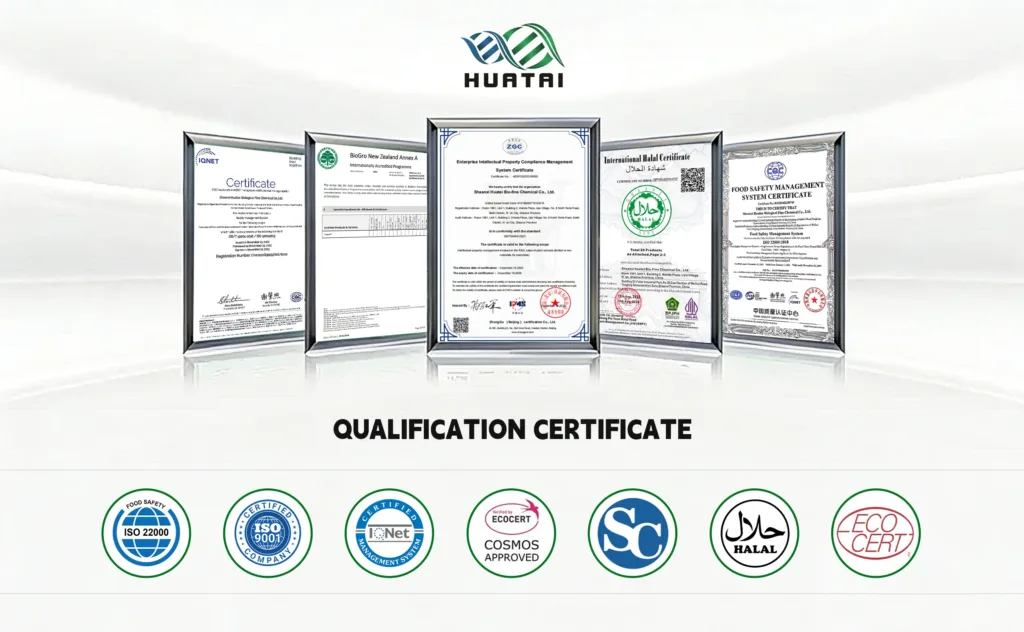
타협 없는 품질과 신뢰성: 당사는 모든 제품 배치에 대해 품질과 신뢰성을 보장합니다. 활성 스킨케어 성분 COSMOS, ISO 9001/22000 및 HALAL 인증을 포함한 엄격한 품질 기준을 충족합니다. 완벽한 기술 자료집을 바탕으로 임상적으로 검증된 솔루션과 모든 제형 관련 문제에 대한 확실한 규정 준수를 보장합니다.


 English
 German
 Italian
 French
 Spanish
 Japanese
 Korean
 Russian