
You mix two percent Alpha Arbutin into your water phase. You add a percent of Glutathione. You expect a brilliant skin brightening serum. Two weeks later, the batch turns brown and smells like rotten eggs on the shelf. What exactly went wrong?
We see this formulation disaster happen constantly. Chemists expect these two powerhouse ingredients to work flawlessly together right out of the jar. They do work beautifully. But only if you respect their highly sensitive chemistry.
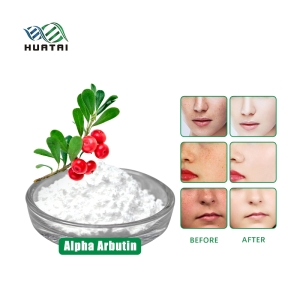
Why combine them at all? Because they attack hyperpigmentation from entirely different angles. Think of a human skin cell as a pigment factory. Alpha Arbutin stands at the factory door. It stops the primary enzyme called tyrosinase. Without this enzyme, the factory cannot start making melanin.
Glutathione does something completely different. It walks inside the factory and alters the chemical recipe. It forces the cells to produce pheomelanin (a light, yellow tone) instead of eumelanin (a dark, brown tone). It also aggressively sweeps up the metabolic trash we call free radicals. When you combine them, you build a dual-action blocking and converting system.
But you cannot build a stable serum with cheap, impure raw materials. Trace heavy metals will destroy Glutathione instantly. Let us look at the actual factory specifications you should demand from your supplier.
| Parametro | Alpha Arbutin Specification | Glutathione Specification | Metodo di prova |
| Aspetto | White needle-like crystals | Polvere cristallina bianca | Visivo |
| Assay Purity | >= 99.0 percent | >= 98.0 percent | HPLC |
| pH (1 percent solution) | Da 5,0 a 7,0 | 2.5 to 3.5 | Misuratore di pH |
| Perdita all'essiccazione | <= 0.5 percent | <= 0.5 percent | Gravimetric (105 Celsius) |
| Metalli pesanti | <= 10 ppm | <= 10 ppm | ICP-MS |
| Hydroquinone limit | <= 10 ppm | Not Applicable | HPLC |
Pay close attention to that last row. Cheap Alpha Arbutin often contains high trace amounts of hydroquinone. This will irritate the skin and fail regulatory testing. We aggressively purify our materials to keep this below 10 parts per million.
Let me share a formulation rescue we handled last summer. A skincare brand in Europe launched an intensive dark spot corrector. They combined Alpha Arbutin and Glutathione in a simple gel base. Within three months, customers complained about a harsh sulfur smell. The Glutathione was oxidizing rapidly.
We examined their formula blueprint. They made two critical errors. They formulated at a pH of 6.5. They also packaged the gel in transparent glass dropper bottles.
We completely rewrote their active phase. We dropped the formula pH to 4.5. This prevents the Alpha Arbutin from breaking down into hydroquinone. We added 0.1 percent Disodium EDTA to trap any metal ions in their water supply. We added a touch of Vitamin E to shield the Glutathione. Finally, we moved the formula to opaque airless pumps.
The brand ran a 45-day clinical trial on 40 volunteers with severe sun damage. We measured the melanin index using clinical imaging tools.
| Timeframe | Melanin Index Reduction | Skin Tone Evenness Improvement | Consumer Comfort |
| Baseline | 0 percent | 0 percent | N/A |
| Day 15 | – 14.5 percent | + 22 percent | 95 percent positive |
| Day 30 | – 28.3 percent | + 45 percent | 92 percent positive |
| Day 45 | – 41.2 percent | + 68 percent | 98 percent positive |
The smell never returned. The formula survived accelerated stability testing at 45 Celsius for twelve weeks.
If you want to build this system in your own lab, follow these strict rules.
- Watch your heat. Heat destroys Glutathione instantly. Never add these powders to your hot water phase. Dissolve them in cold water first. Add them to your emulsion during the final cool-down phase below 40 Celsius.
- Control the pH tightly. Your final formula must sit between 3.5 and 4.9. This is the sweet spot. It keeps the Glutathione stable and prevents the Arbutin from degrading.
- Skip the Beta Arbutin. Formulators sometimes try to save money by using Beta Arbutin. Do not do it. Alpha Arbutin acts ten times stronger on the skin. It also boasts far superior chemical stability.
You also need to watch the regulatory landscape. The European Union Scientific Committee on Consumer Safety (SCCS) recently updated their safety margins. They ruled that Alpha Arbutin is safe up to a maximum concentration of 2 percent in face creams and 0.5 percent in body lotions. Always strictly adhere to these limits to ensure global compliance. Do not chase marketing claims by overloading the formula with 5 percent Arbutin. It is unnecessary and non-compliant.
Stop fighting with unstable whitening formulas that turn yellow and smell bad. Build a smart, chemically sound system instead. Request a testing sample of our high-purity powders. Put them into your next prototype base. Run your own stability checks. The visual results on the skin will prove everything.
References Used in This Article:
- Scientific Committee on Consumer Safety (SCCS). Opinion on the safety of Alpha-Arbutin in cosmetic products.
- Arjinpathana, N., and Asawanonda, P. (2012). Glutathione as an oral whitening agent: a randomized, double-blind, placebo-controlled study. Journal of Dermatological Treatment, 23(2), 97-102.
- Sugimoto, K., et al. (2004). Inhibitory effects of alpha-arbutin on melanin synthesis in cultured human melanoma cells. Biological and Pharmaceutical Bulletin, 27(4), 510-514.



 English
 German
 Italian
 French
 Spanish
 Japanese
 Korean
 Russian