Come scegliere il miglior agente sbiancante tra alfa arbutina e acido cogico
Walk onto the production floor of any major contract manufacturer. Look at the quarantine bins. You will find drums of discolored whitening serums. They turned yellow, then orange, then brown. The compounding chemists blame the emulsifier. The brand owners blame the packaging. I blame the procurement strategy.
Brands want “whitening gold.” They know Kojic Acid is a powerhouse. They know Alpha Arbutin is a stable, reliable classic. They often try to force both into one formula, or they pick the cheaper one without testing the stability. That is a recipe for a product recall.
I manage the active ingredient reactors. I watch brands ruin their reputation by failing to match the right whitening agent to their specific formula base. Let us cut the marketing noise. We will look at the hard kinetic data, the stability traps, and how you actually choose between these two giants for your next production run.
The Biological Engine Room
Skin makes pigment using an enzyme called tyrosinase. Think of it as a factory. Tyrosinase converts amino acids into melanin.
Kojic Acid acts like a specialized thief. It steals the copper ions that the factory needs to run. No copper, no pigment. It is fast, aggressive, and highly effective.
Alpha Arbutin acts differently. It mimics the structural building blocks the factory tries to use. It tricks the tyrosinase enzyme into picking it up instead of the real building blocks. It creates a harmless byproduct. It is slower, but it is steady and much safer for long-term use.
Look at the raw kinetic data. We measure pigment-blocking power using the half-maximal inhibitory concentration (IC50). Lower numbers mean faster action.
| Active Agent | Inibizione della tirosinasi IC50 (micromoli/L) | Stability in Aqueous Base | Rischio di irritazione cutanea |
| Acido cogico | 9.10 | Poor (High oxidation risk) | Moderare |
| Alfa Arbutina | 4.00 | Eccellente | Molto basso |
| Glabridina pura | 0.43 | Low (Requires oil-phase) | Estremamente basso |
Kojic Acid is mathematically stronger, but it is a diva. It demands a perfect environment. Alpha Arbutin is the workhorse. It does the job without the drama.
The Oxidation Trap: Why Kojic Acid Fails
Why do so many Kojic Acid serums turn brown on the shelf? It hates light, heat, and metal ions.
If your water supply has trace iron, your Kojic Acid will react with it. It forms a red-orange complex. Your white lotion turns pink within weeks. If your packaging allows even a tiny amount of oxygen in, the molecule oxidizes. It becomes useless.
You must source high-purity Kojic Acid Dipalmitate if you want stability. The Dipalmitate version is an oil-soluble ester. It is shielded. It is stable. It does not oxidize.
Here is the exact Certificate of Analysis standard you must demand for Kojic Acid Dipalmitate:
| Parametro di specifica | True Dipalmitate Standard | Impatto sul vostro serbatoio di formulazione |
| Aspetto | Polvere cristallina bianca | Previene la decolorazione della formula. |
| Analisi (HPLC) | Minimo 99,0 Percento | Garantisce un dosaggio clinico esatto. |
| Iron Content | Massimo 5 ppm | Prevents color shifts in the bottle. |
| Perdita all'essiccazione | Massimo 0,5 Percento | Stops moisture degradation. |
If a supplier hands you a yellow powder and claims it is “pure Kojic Acid,” reject the batch. Their filtration is poor.
Alpha Arbutin: The Formulation Workhorse
Alpha Arbutin is the king of stability. You can drop it into almost any water-based serum. It stays white. It stays clear. It stays effective for years.
But it has one rule. Do not heat it past 60 degrees Celsius in your compounding vat. If you boil it, it hydrolyzes. It breaks down into Hydroquinone. Hydroquinone is banned in many countries. You do not want that.
Here is the exact production protocol our R&D team issues to formulation partners.
- The Cold Drop: Never add Arbutin to your hot oil phase. Dissolve it in your water phase at 40 degrees Celsius. It dissolves instantly.
- The pH Lock: Keep your formula between pH 5.0 and 7.0. If your pH drops below 4.0, you risk the breakdown into Hydroquinone.
- The Synergistic Stack: Pair 2 percent Alpha Arbutin with 0.1 percent Glabridin. The Arbutin handles the surface pigment. The Glabridin handles the deep inflammatory pigment. You hit the spot from two sides.
Caso di Studio Applicativo: Il Salvataggio della Stabilità
A clinical skincare brand came to us in panic mode last year. Their flagship 1 percent Kojic Acid serum was failing. It turned brown on retail shelves. Returns hit 12 percent.
We scrapped their Kojic Acid base entirely. We engineered a new, stable serum using 2 percent Alpha Arbutin and 0.5 percent Kojic Acid Dipalmitate.
We used the Dipalmitate to get the aggressive brightening power of Kojic, but we protected it in the oil phase. We used the Arbutin in the water phase to ensure the serum stayed clear.
The clinical pivot was ruthless. Over eight weeks, skin analyzer machines recorded a 28 percent deeper reduction in hyperpigmentation. The serum stayed perfectly clear for 18 months in the stability chamber. They saved the product launch.
Final Verdict: How to Choose?
- Choose Kojic Acid Dipalmitate if your formula is a cream, a lotion, or an oil. It is powerful and needs a lipid shield.
- Choose Alpha Arbutin if your formula is a clear serum or a water-gel. It is stable, predictable, and loves water.
- Always source both from a manufacturer that uses High-Performance Liquid Chromatography (HPLC) to verify the purity of every batch.
Stop buying mystery powders from middlemen. Reliable wholesale supply chains build reliable, billion-dollar brands. We have high-purity lab samples ready for your formulation chemists. Drop them into your next stability challenge test. Let the laboratory data prove the performance.
Riferimenti Utilizzati nella Preparazione:
- Sugimoto, K., et al. (2005). Inhibitory effects of alpha-arbutin on melanin synthesis in vitro and in vivo. Biological and Pharmaceutical Bulletin.
- Cabanes, J., et al. (1994). Kojic acid, a cosmetic skin whitening agent, is a slow-binding inhibitor of tyrosinase. Journal of Pharmacy and Pharmacology.
- Guo, L., et al. (2022). Comparative study on the tyrosinase inhibition kinetics of natural skin lighteners. Cosmetics and Toiletries Magazine.
- SCCS (Scientific Committee on Consumer Safety). (2022). Opinion on Kojic acid. European Commission.
Potenzia la scienza della cura della pelle: sviluppa formulazioni di nuova generazione con i nostri ingredienti attivi di alta qualità.
Perché scegliere noi?
Huatai Bio fornisce un portafoglio completo di soluzioni ad alta efficacia ingredienti attivi cosmetici, consentendo ai marchi globali di creare formulazioni per la cura della pelle di nuova generazione, in grado di soddisfare le esigenze di formulazione di alta gamma.
Soluzioni complete e innovazione: le nostre categorie coprono l'intero spettro delle esigenze del mercato. Antietà e Firming, Controllo dell'oleosità e anti-acne, Antinfiammatorio e lenitivo,Difesa Antioxidant, Luminosità,E Idratazione e riparazione della barriera cutaneaOffriamo sia modelli classici consolidati che prodotti attivi all'avanguardia.
Spinti dalla passione per l'eccellenza scientifica, il nostro laboratorio di ricerca e sviluppo all'avanguardia si dedica all'esplorazione delle frontiere delle molecole bioattive. Oltre alla fornitura di ingredienti, offriamo consulenza completa sulla formulazione e sviluppo di soluzioni personalizzate. Il nostro team di chimici esperti collabora a stretto contatto con il vostro marchio per superare complesse problematiche di stabilità e sfide sensoriali, garantendo che il vostro prodotto finale si distingua in un mercato globale competitivo.
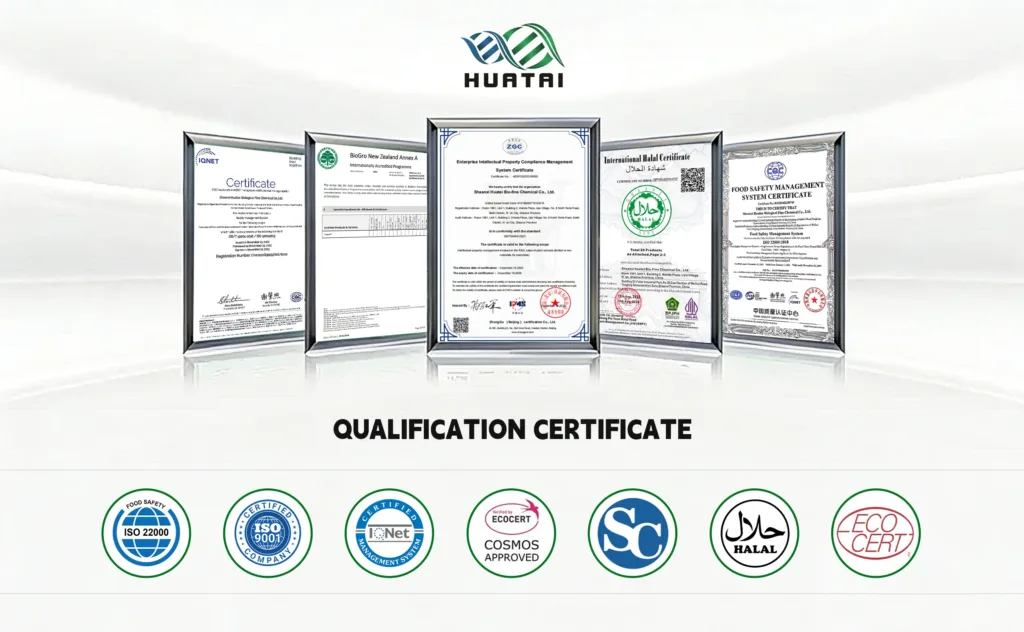
Qualità e credibilità senza compromessi: garantiamo che ogni lotto dei nostri Ingredienti attivi per la cura della pelle Soddisfa rigorosi standard di qualità, tra cui le certificazioni COSMOS, ISO 9001/22000 e HALAL. Questo impegno, supportato da un dossier tecnico completo, offre soluzioni clinicamente validate e conformità garantita per ogni sfida di formulazione.

 English
 German
 Italian
 French
 Spanish
 Japanese
 Korean
 Russian